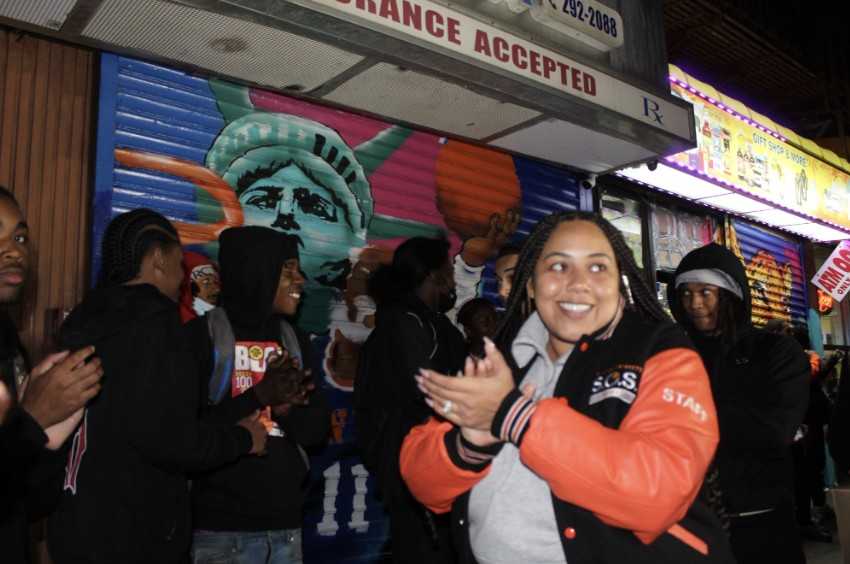
During the middle of the night, credible messengers canvass their Bronx neighborhoods or what they call catchment zones, searching to mediate potential conflicts before they escalate into violence.
When violence does knock on their doorstep, they are sometimes among the first responders called when someone ends up in the hospital.
Violence interrupters don’t carry a gun or a badge. They don’t wear the tactical gear that police officers use to protect themselves from harm. They brandish no weapons of any kind. Yet for many, their work in responding to violence and preventing it from happening makes them the city’s most underrated unsung heroes.
At the same time, however, as credible messenger groups continue to grow and have demonstrated success in reducing gun violence among youth across the Bronx, violence interrupter groups, part of the NYC Crisis Management System, say they must overcome challenges of increasingly younger youth entering their catchment areas.
While The Bronx represents nearly 17% of New York City’s population, 25% of violent crime in all seven major crime categories (murder, rape, felony assault, robbery, grand larceny, burglary, auto theft) across the city occurs in the Bronx.
Executive Program Director Carjah Dawkins-Hamilton for NYC Health + Hospitals/Jacobi Stand Up to Violence (S.U.V.) says they see up to 20% of all pediatric gunshot wounds in the city.
“Even though we are seeing a decrease in a decline in gun violence, we’re seeing a bit of an uptick in youth violence,” says Dawkins-Hamilton.
As a result, S.U.V. started an under-21 initiative to see what services are and aren’t working and to tackle gun violence among youth.
S.U.V. partners with Fordham Leadership Academy and Harry S. Truman High School, and offers employment training and youth programming, wrap-around support, prevention workshops, and many more mental health and social services.
Their group is not the only community-based violence prevention group that shares the same concern.
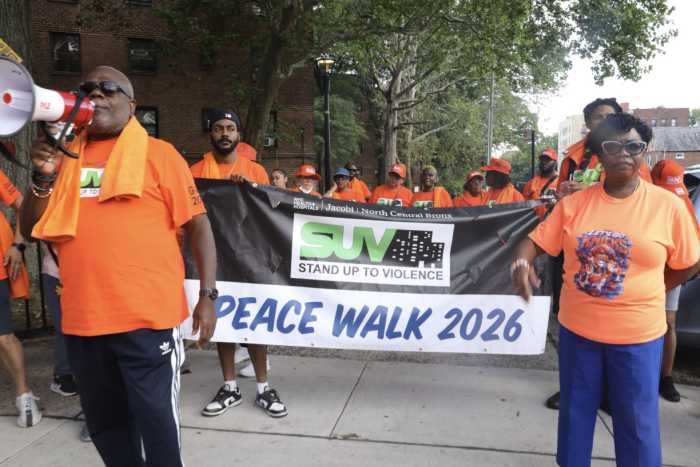
Outreach Worker Supervisor/Hospital Responder Coordinator Marisol Rivera for Center for Justice Innovation, Save Our Streets (S.O.S.) shares that they’re seeing more younger youth in middle and elementary school involved in gun and gang-related violence due to the COVID-19 pandemic.
“COVID just kind of set us back a lot because of social media and them not coming outside. When people did come outside, it was just like ongoing beef, ongoing arguments because they didn’t see each other for a long time,” Rivera said. “That was the worst thing that happened. All of the after-school programs, the basketball programs, got closed down because of COVID. So it was like, now you’re gonna say, you don’t want kids to be in the street, but there’s nowhere for them to go.”
Community-based violence interrupter groups are struggling to keep up with the needs of increasingly younger youth, and Dawkins-Hamilton is calling for more research to examine how the COVID-19 pandemic set back New York City’s youth.
Another challenge Dawkins-Hamilton says she saw in S.U.V. is having more skill-specific workforce development training for their high-risk youth.
Dawkins-Hamilton is implementing creative ways for high-risk youth to compete in the workforce, such as teaching their youth photography and starting a barber program.
Program Director for the Bronx Community Justice Center, Deymis Baquero at S.O.S. shares that their programming is focused on “entrepreneurship.” S.O.S. teaches their youth how to build murals, sneaker restoration, woodworking, culinary, photography, e-sports, cosmetology, music production, and much more.
“We have all of the things that they wanted to see or wanted to learn, and we teach them how they can build out their own little micro businesses to really advance and get the barrier of economic mobility, or gain economic stability to remove some of the other barriers that they may be facing,” Baquero said.
Another barrier for crisis management groups is the iron pipeline, which connects I-95 to New York City, causing illegal trafficking of firearms from Southern states with less restrictive gun laws to enter the city. The pipeline disproportionately affects the Bronx because it is one of the first points of entry into New York City along the I-95 corridor.
“At the end of the day, sometimes our neighbors don’t have the kind of gun laws that we have, and partnerships and task forces to combat this problem don’t always take flight,” said David Caba, Senior Vice President of Good Shepherd Services’ Bronx Rises Against Gun Violence (B.R.A.G.). “That is the big challenge that we have because while we’re fighting this issue, imagine what we could do if we stopped the flow of guns coming into our borough.”
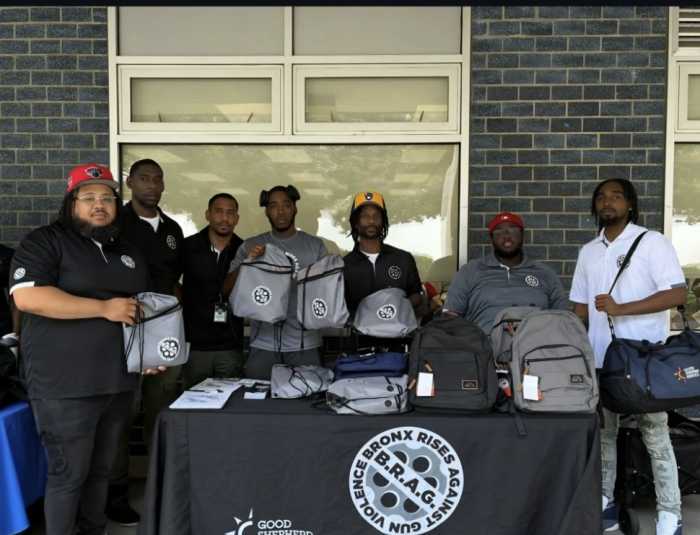
Despite the current challenges these groups are facing, they’re optimistic that the credible messenger workforce will expand to reach more high-risk youth across the city.
In 2016, S.O.S. recorded 349 consecutive days without a shooting in its South Bronx catchment area, which covers the 40th Precinct, while B.R.A.G. recorded 1,750 days without a shooting in its Fordham Manor catchment area, which covers the 52nd Precinct.
“This is a new industry that is unheard of. The credible messenger can do things and go places that your average law enforcement, social worker, lawyer can’t go to, but they open us with open arms,” Caba said.
Dawkins-Hamilton echoes Caba’s sentiment, saying that more research needs to be done for the impact of the credible messenger workforce.
B.R.A.G. program has mediated more than 25,000 street conflicts and provides support services for high-risk youth, including music and boxing programs, DOE programming, youth enrichment services, vocational training, therapy and hospital-based response services at St. Barnabas Hospital.
Caba emphasized that credible messengers are essential to building trust in communities affected by gang-related violence because, having once been part of that world themselves, they are uniquely positioned to mediate conflicts.
On Oct. 20, Mayor Zohran Mamdani expanded community-based violence prevention in neighborhoods in Harlem, Bushwick, and Washington Heights/Inwood, as the evidence-based Cure Violence model has proven to be effective in neighborhoods in the Bronx and Brooklyn.
According to Bronx Borough President Vanessa Gibson, an announcement by Deputy Mayor for Community Safety Renita Francois and the Office of Community Safety for expansion of New York City’s Crisis Management System (CMS) within the Bronx is forthcoming.
“What I want them to do is help us expand because organizations like B.R.A.G. that span multiple precincts in our borough want to grow. They’ve been able to successfully contain the violence within their catchment,” Gibson said.