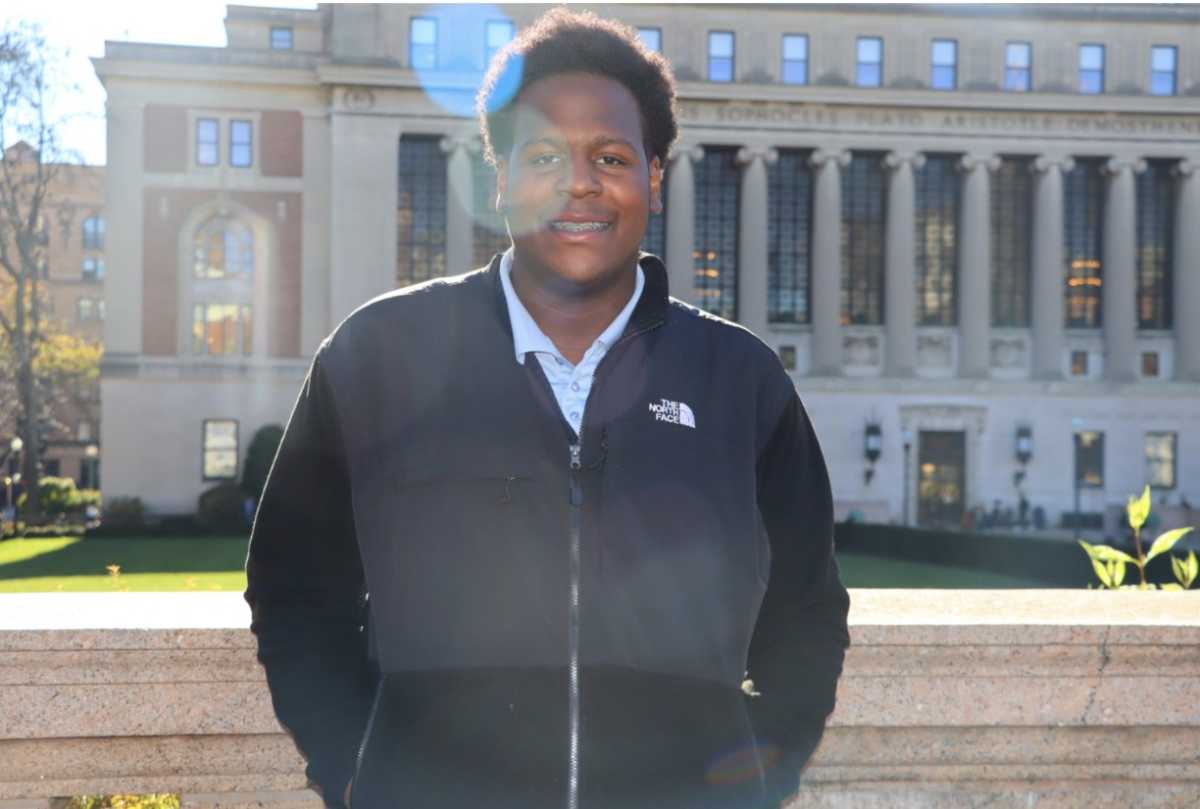
Javier Piña’s first day at high school was daunting — and not just for the usual reasons.
Piña had recently moved from the Dominican Republic to New York, and was confronted for the first time with the intensive surveillance and safety measures of his new high school, the International Leadership Charter High School in the Bronx.
The first-day routine involved handing his backpack to school safety officers to search, passing through a large metal detector, and potentially getting wanded down by a third officer, if the detector happened to light up red.
By the time he had entered school, Piña, like every student at his high school, had had his belongings rummaged through, and his body scanned.
“ Having that process daily felt new, and it made me a little bit anxious. It made me feel like my privacy might have been intruded a little bit,” Piña told the Bronx Times in an interview.
That sense of surveillance only continued during the school day. While Piña and his fellow students moved between classes and recreation, School Safety Officers patrolled the halls with walkie-talkies, keeping an eye out for any sign of misbehavior. It’s one thing for the school to have surveillance cameras, Piña said, but it’s another to feel that you’re never more than fifteen feet from someone who is watching out for a reason to suspend you.
For many of Piña’s classmates, the security measures at the high school were par for the course. The school is in the Bronx, where metal detectors in schools are more frequent than in any other borough, according to data collected by WNYC.
Up-to-date figures on the use of metal detectors in high schools are not widely available, although the NYPD is by law required to collect this information and share it with the public, according to the New York Civil Liberties Union (NYCLU).
However, a WNYC 2016 survey found that over 91,000 New York City high school students passed through metal detectors each morning. The use of these measures is not evenly distributed. Black high school students were more than three times as likely than White high schoolers to have to pass through metal detectors, according to the research.
“There is no evidence that metal detectors make schools any safer,” Johanna Miller, Director of the Education Policy Center at the NYCLU said in a statement to the Bronx Times.
“In reality, metal detectors put students into unnecessary confrontations with police, exacerbate absenteeism, subject young people to invasive searches, and overwhelmingly impact students of color.”
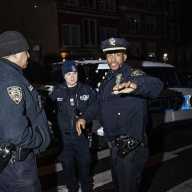
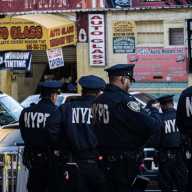
The surveillance, Piña told The Bronx Times, didn’t end at the school gates. Around the end of the school day, Piña says he would notice a dramatic increase in the number of school safety vehicles patrolling the neighborhood. The School Safety Officers operating the vehicles, while not fully sworn-in members of the NYPD, are hired and trained by the NYPD.
Their omnipresence in the community made it hard for Piña and his friends to just enjoy being teenagers, he said.
”When you’re just, you know, pushing around with your friends or you’re just playing around with your friends… If there’s a school safety car across the street and they look through the window, they’ll see this behavior as suspicious or ghetto,” he said. “So I wish that me and other teens in the city, we could at least have that freedom to be expressive in the streets while also obviously allowing other people to be peaceful.”
Sometimes, Piña said, he would realize he hadn’t seen a fellow student for a while, only to find out they had been “caught up.”
“They’ll kind of disappear,” he said, explaining that fellow students stopped and searched by school safety might be handed either a suspension or a custodial sentence for something found on their person.
“This is kind of where I started finding that pattern recognition and realizing, ‘Hey, there’s a bigger problem here,” he said.
Piña didn’t have the words for it at the time, but he later learned to understand his school experiences as part of what is often referred to as the school-to-prison pipeline. The phrase, according to the American Civil Liberties Union (ACLU), refers to “the policies and practices that push our nation’s schoolchildren, especially our most at-risk children, out of classrooms and into the juvenile and criminal justice systems.”
Interning with the Bronx Defenders
Conceptualizing his and his fellow students’ experiences as part of this larger framework came when Piña was selected to participate in the Bronx Civic Scholars Institute, a six-week summer program hosted by Hostos Community College that pairs rising seniors with local organizations.
This summer, Piña was part of a cohort of interns paired with The Bronx Defenders, a non-profit that takes a holistic approach to public defense in the Bronx. Rather than just focusing on legal representation in the courtroom, The Bronx Defenders also offers community support and outreach, including through the Bronx Leadership and Organizing Center (BLOC). The summer program Piña took part in was organized through the BLOC.
Part of Piña’s internship involved not just learning about the school-to-prison pipeline, but getting involved in advocacy around it, including teaching others in the community about what he and his fellow interns had learned.
Getting young people engaged in the issues that affect them is a crucial part of the work that Aleciah Anthony, Director of Community Engagement at The Bronx Defenders, does.
“ We believe that the people most impacted by the issues have to be part of the solutions. They have to be centered, and they have to be the focus point of it,” Anthony told the Bronx Times.
“ They’re just not participants. They are decision-makers and strategists. And so if we’re meeting with elected officials, they’re going to be doing the talking. If we’re going to Albany, they’re gonna be up front,” she added.
For Piña, the summer program was transformative, and he has already been thinking about solutions he would like to see implemented. One of those changes, he told the Bronx Times, would be to have far fewer Safety Officers in schools, and to replace them with more counselors.
“ The issues with violence in schools start with the emotions of teenagers,” Piña said. “I’m not saying we need to get completely rid of safety [officers], but it needs to be in a way where the number of counselors, the number of mental health professionals, the number of rape crisis counselors, the number of homelessness crisis counselors in schools is significantly larger than the number of school safety officers.”
Anthony echoed this desire, adding that The Bronx Defenders is also working as part of a statewide coalition trying to pass the Solutions Not Suspensions Bill, which they hope will reduce the number of children being excluded from school.
“ We don’t see suspensions as the solution to dealing with behavior problems in the schools. In fact, it does the opposite,” she told the Bronx Times. “Because when you suspend the kids, and there’s no plan for them, then there’s opportunity for them to get into all kinds of things in the neighborhood which may eventually have them in this pipeline.”
Since returning to his High School, Piña has continued his advocacy, and hopes that he can get other young people involved in shaping the future of the Bronx. One thing he’s been doing is calling up his representatives.
“If you call them and you have an issue, they need to at least give you a response,” he said, adding that his fellow students can find out who their local elected officials are using websites like “Who Represents Me.”
“ I live by the quote that closed mouths don’t get fed,” Piña said. “We shouldn’t have to make hundreds of calls just for basic counseling. But in this case, that’s what needs to happen.”