
This year, the Bronx saw major headlines. From the building collapse at the Mitchell Houses to Bally’s winning a 15-year license to build a casino-hotel complex in Ferry Point Park, our borough saw it all.
Aside from our biggest stories, here are our most read stories of 2025:
1: Investigation finds paraprofessionals falsified timesheets while helping to transport three Bronx special needs students
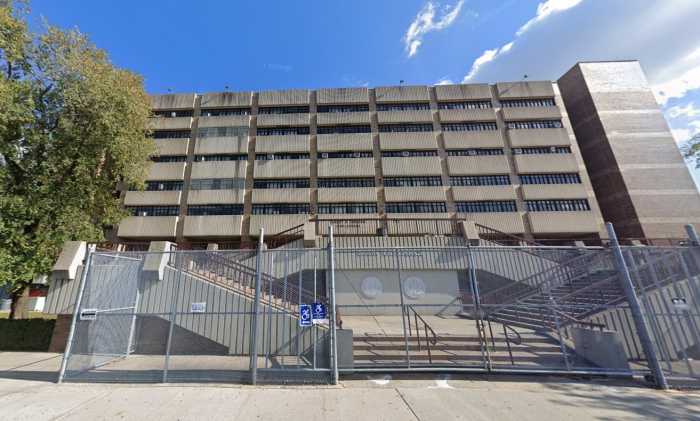
A report released by the New York City Special Commissioner of Investigation (SCI) found that four paraprofessionals with the Department of Education (DOE) falsified their timesheets while transporting three special needs students to and from their school.
Robert Brown, Michel Desgrottes, Alex Gonzalez, and Carla Alvarez were all found by the SCI, back in 2022, to have forged their timesheets while performing their duties for three teenage students at P176x, located in Co-op City.
Randi Levine, the policy director for Advocates for Children, which gives free advocacy and legal services for low-income families and children with disabilities. Levine told the Bronx Times that cases like these are part of a wider issue.
“In fact, last year, more than 300 students with disabilities were waiting for the DOE to assign the required paraprofessional they needed to ride the bus, in violation of their legal rights,” she said.
“The City must take steps to ensure it can recruit and retain the paraprofessionals needed for students with disabilities to ride the bus safely and ensure that students can get to school on time every day,” Levine added.
2: Three Bronx restaurants named to New York Times’ 100 Best list
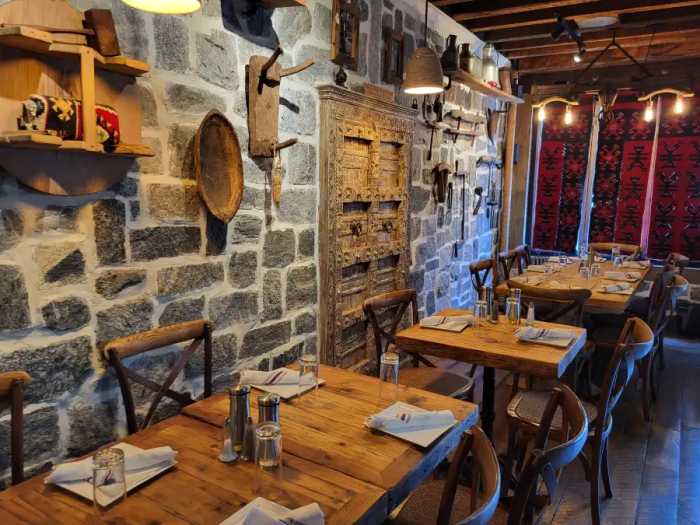
The Bronx’s dynamic food scene caught attention from New York Times journalists Priya Krishna and Melissa Clark and got a seat in the 2025 list of the 100 best dining experiences in New York City.
Among the local honorees were:
- 188 Bakery Cuchifritos: a Fordham Heights institution that has been serving Puerto Rican and Dominican classics for decades. The Times praised the restaurant’s unapologetic approach and signature dishes that capture the soul of Bronx street cuisine.
- Çka Ka Qëllu: a cozy Albanian restaurant tucked into Belmont’s Little Italy. The Times noted its authenticity and welcoming atmosphere as key ingredients in its success.
- Birria-Landia: the viral Mexican food truck chain that helped spark a citywide obsession with Tijuana-style birria tacos. The Times commended its consistency and the electric flavor that continues to draw lines from borough to borough.
3: New 2,200-bed migrant shelter opening in South Bronx amid citywide shelter closures
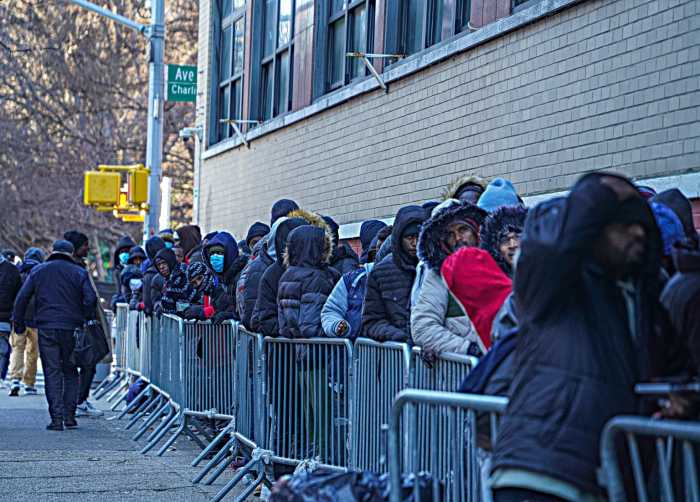
In January, officials announced a new migrant shelter would open up –as the city moved forward with closing 13 additional shelters– in the South Bronx by February.
The new facility was planned to temporarily house up to 2,200 single adults, many of whom were transferred from the tent shelter at Randall’s Island, a spokesperson from the mayor’s office told the Bronx Times. Migrants at the new site would be subject to the city’s 60-day policy, which requires individuals to exit the shelter or reapply for placement after that period.
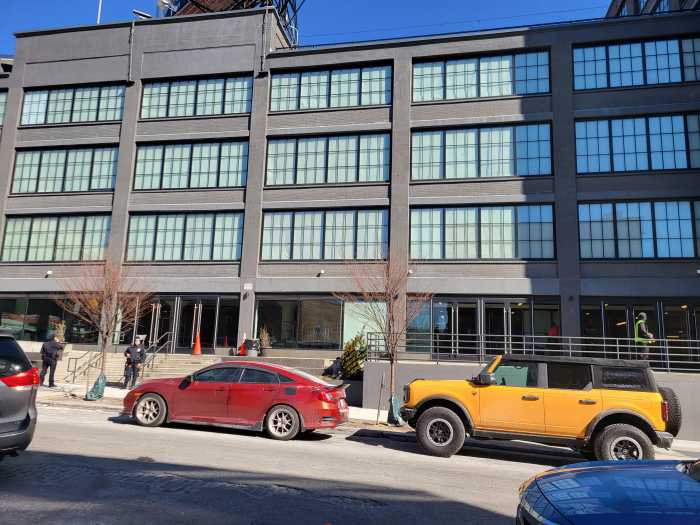
At the time, city officials did not disclose the shelter’s address, citing security concerns, but council members confirmed it is located in a large, vacant building on Bruckner Boulevard.
While the city emphasizes the need for each district to contribute equally, Council Member Rafael Salamanca Jr. argued, “The South Bronx is carrying the burden of the city on its back. Where is the investment in our communities other than affordable housing units?”
When asked about the immediate impact the new shelter could bring to the neighborhood, Salamanca Jr. was skeptical. “Two thousand men moving into a community with no jobs, you know, looking for a way to make a living? They’re gonna get some services, but they don’t want to be there,” he said, adding that city resources could go to existing shelters or food pantries instead.
4: Protesters rally outside Bronx courthouse against Hochul’s proposed changes to discovery reform law
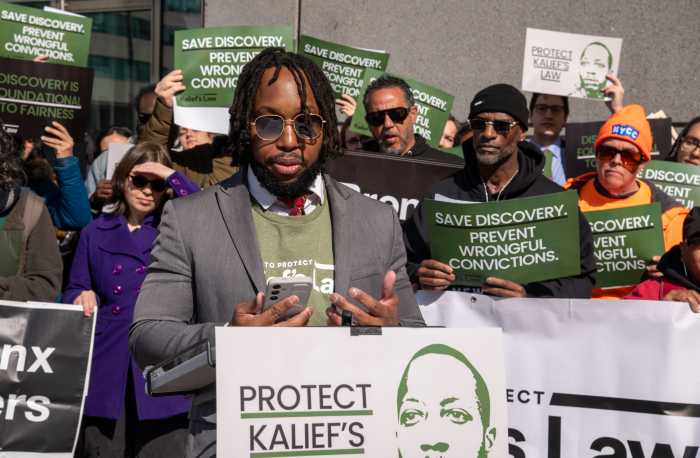
In March, dozens rallied outside the Bronx County Criminal Court, urging Gov. Kathy Hochul to stop her efforts to amend a law requiring the state to promptly and automatically disclose evidence against criminal defendants in New York.
In her 2026 Executive Budget, Hochul proposed easing certain provisions of the 2019 discovery reform law, known as “Kalief’s Law.” The law is named after Kalief Browder, a Black teenager from the Bronx who spent years on Rikers Island awaiting trial without access to the evidence against him for a low-level theft charge.
“ Gov. Hochul’s proposals besmirched Kalief’s memory,” said Conrad Blackburn, policy counsel and staff attorney for the Bronx Public Defenders. “They would take us back to when we were forced to defend cases without seeing any discovery.”
“ Those are not ‘tweaks,’” Blackburn said, referencing the governor’s description of the rollbacks. “It’s a full repeal of the law. These changes would take us back to a time where prosecutors can hide crucial discovery.”
5: Bronx Borough President condemns Trump administration’s decision to revoke temporary legal status for migrants
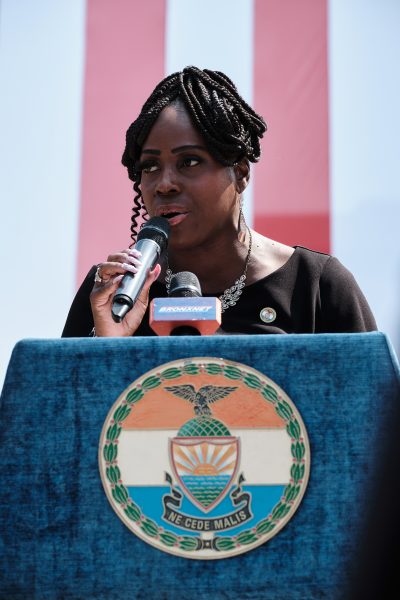
Also in March, Bronx Borough President Vanessa L. Gibson issued a sharp rebuke of the Trump administration’s recent decision to revoke Temporary Protected Status (TPS) and said it would disproportionately impact communities of color and immigrant neighborhoods throughout the Bronx.
“The Trump Administration’s decision to revoke the temporary legal status of over half a million migrants is a nefarious attempt to distract from policy failures and further undermine communities of color,” Gibson said.
“Targeting our most vulnerable groups is shameful and un-American. This destabilizing move will make our communities less safe, not more. Our neighbors who hail from Cuba, Haiti, Nicaragua, and Venezuela deserve far better than this, and The Bronx stands united with them and all other immigrant groups that have been targeted by this administration.”
6: Three Bronx Catholic schools to close amid financial struggles and declining enrollment
2024-2025 marked the last-ever school year for three longstanding Bronx Catholic institutions: All Hallows High School, established in 1909, Sacred Heart School in Highbridge, since 1926, and Immaculate Conception School in Melrose, since 1854.
The closures were in keeping with a trend of religious schools and churches declining, closing and consolidating throughout the country.
Today, two schools within the Brilla Public Charter Schools network occupy the former sites of Sacred Heart (1248 Nelson Ave.) and Immaculate Conception (378 East 151st St.).
Despite these closures, you may have heard about one Bronx Catholic school that actually survived a brush with death this year.
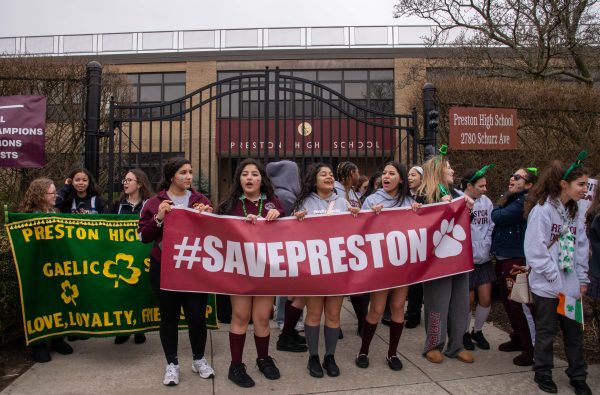
Preston High School in Throggs Neck was slated to close in June 2025 after the property owners, the Sisters of the Divine Compassion, wanted to sell but were unable to reach a deal that would allow the school to become self-sustaining.
Preston was ultimately saved by an unexpected entity: Bally’s Foundation, the nonprofit arm of the gaming company Bally’s Corporation, which was just awarded a state license to build a hotel-casino-entertainment complex in Ferry Point Park.
The Sisters initially rejected Bally’s purchase offer, the Bronx Times exclusively reported. But after intervention from Attorney General Letitia James, whose office oversees nonprofit real estate deals, Bally’s Foundation successfully purchased Preston High School in April for $8.5 million.
The Foundation leased it back to the school for $1 per year in perpetuity, saving it from permanent closure.
7: Longtime Army veteran fired from Bronx VA under Trump federal workforce cuts
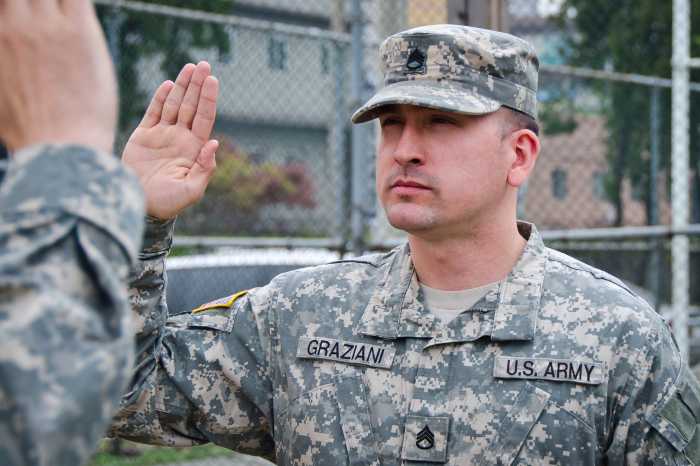
This story of a Bronx VA employee fired by the Trump administration made nationwide headlines and sparked outrage about the federal government’s overreaching efforts to root out waste, fraud and abuse.
In February, Luke Graziani of Queens, an Army vet who served four tours in Iraq and Afghanistan, was abruptly fired from his communications job at the Bronx VA under the Trump administration’s drastic cuts to the federal workforce.
The Department of Government Efficiency (DOGE), led at the time by Elon Musk, slashed thousands of workers from federal offices across the country. Graziani was among many who received the dreaded email saying that he had “not demonstrated that [his] employment at the Agency would be in the public interest.” Overall, more than 1,000 VA employees with less than two years of service were dismissed.
Graziani, who is permanently disabled from his Army service, was reinstated to his position in early April, and he returned to work. However, he said he felt a lingering uncertainty.
“A lot of things are kind of coming together and making me feel like maybe my situation is not as stable as I thought,” he told the Bronx Times on April 9.
8: South Bronx student going from Highbridge to Harvard

The story of Christina Adja, a graduate of Central Park East High School in East Harlem, was inspiring to many Bronx Times readers.
Adja was headed to Harvard that fall — after turning down Yale, UPenn, Georgetown University and Smith College. She was the first student in her school ever to be accepted to multiple Ivy League universities.
The honor was quite unexpected for Adja, the daughter of Togolese immigrants with just an associate’s degree between them. But Adja’s own accomplishments — including a strong academic record, a podcast that aired on WNYC and a trip to Botswana with a Black maternal health organization — helped secure her admission to some of the country’s most prestigious universities.
Now, with one semester under her belt, Adja shared an update in text messages to the Bronx Times.
She said her first few months at Harvard were “interesting and intense.” It took some time to adjust to a completely different environment and expectations, she said.
However, “As time went on, I started to feel more comfortable asking for help and less ashamed when taking advantage of campus resources like the writing center,” Adja said.
According to Harvard’s admissions data, 20% of the 2,000-student freshman class from all over the United States and the world are first-generation college students like Adja.
“It is extremely different from what I grew up around, but it has been fun and eye-opening interacting with people from a variety of backgrounds,” she said. “I feel like the hardest part of my journey is done, and the only thing to do is persevere from this point forward.”
9: South Bronx residents protest new 2,200-bed migrant shelter
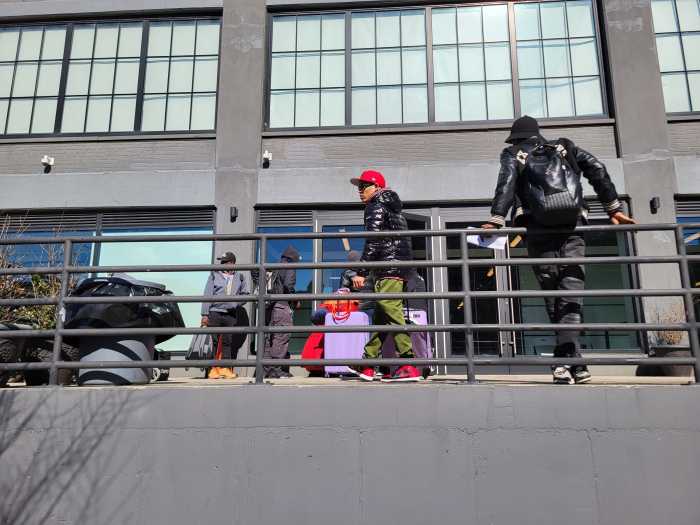
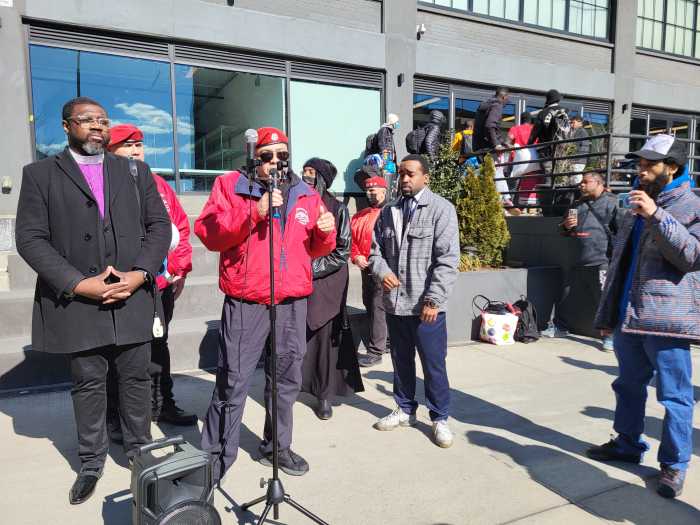
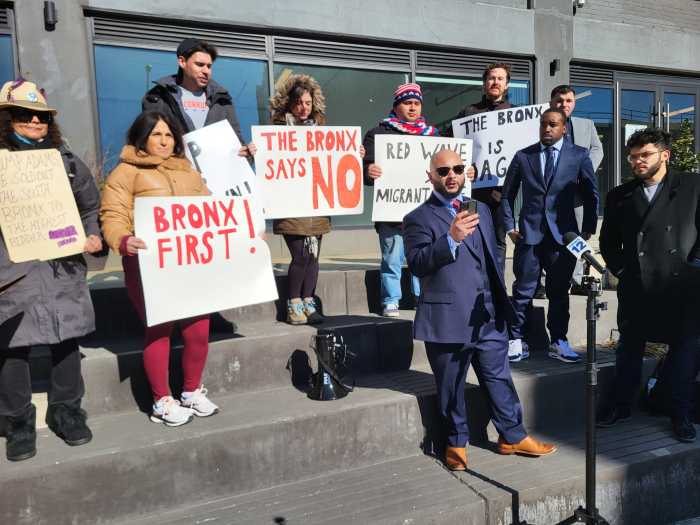
Residents of the South Bronx came out in full force, sometimes multiple times per week, against the migrant shelter that opened in February at East 141st Street and Bruckner Blvd.
As Mayor Eric Adams touted the closure of many of the city’s largest and most controversial migrant shelters, citing a decrease in new arrivals, the South Bronx site came as a surprise even to local elected officials, who said they were unaware of the plan until after contracts were signed.
Residents were furious about what they viewed as adding to an over saturation of shelters in the neighborhood. They also protested the lack of community input about the plan, which was already a done deal when city officials confirmed it at a heated Community Board 1 subcommittee meeting on Jan. 27.
Despite residents’ objections, the shelter opened on Feb. 22, to no announcement or media attention — except from the Bronx Times, which received a tip from a neighbor and went there to witness staff at work and residents bringing belongings into the building.
Today, the shelter is home for 1,912 adult men as of Dec. 19, according to Zachary Nosanchuk, deputy press secretary for the mayor’s office.
But for the press and neighbors living in the community, the site has become something of an informational black hole.
Community Board 1 has received no updates since the shelter opened, despite promises of open communication, said CB1 District Manager Anthony Jordan on Dec. 19.
The city has called the shelter a temporary site, but, nearly a year after opening, has provided no timeline for how long it will be needed.
“Ongoing reductions in the number of asylum seekers under our care enable the city to effectively manage population sizes and consolidate groups within newly established locations,” Nosanchuk said in a statement.
“As we have moved past the emergency phase, activating Bruckner is just one of the tools in our toolbox to manage sites broadly throughout all the boroughs.”
While visiting the location, shelter employees have consistently stated they are not allowed to speak with reporters, and despite multiple attempts, the Bronx Times has never been granted access inside.
10: Roberto Clemente Plaza emerges clean following the first weekend after the city shuts down The Hub open air drug market
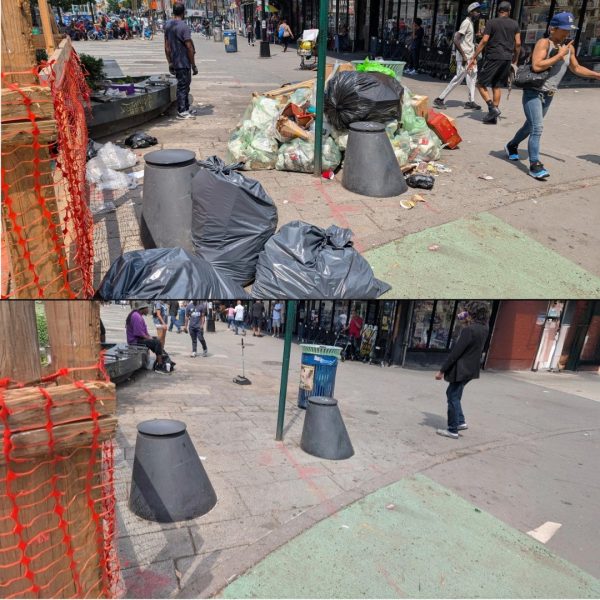
This year, the mayor’s office took decisive action in the busy commercial corridor near Third Avenue and East 149th Street, which has long been plagued by open drug activity and overdoses.
After an escalating pressure campaign by Rep. Ritchie Torres, Borough President Vanessa Gibson, the Third Avenue Business Improvement District and others, Adams’ office temporarily shut down Roberto Clemente Plaza in July.
The Department of Sanitation and NYPD put up barriers around the seating area at Third and Willis Avenues, escorted people using drugs out of the public area, cleared out trash and drug paraphernalia and set up a mobile command center to address residents’ needs.
However, not all Bronxites approved of the efforts — especially the compulsory treatment component that Adams maintained was sometimes necessary in The Hub and elsewhere in the city. “We must help those struggling finally get treatment, whether they recognize the need for it or not,” he said at the time.
However, Renee Jones, who identified herself to the Bronx Times as a drug user, said in August that forcing people into treatment was likely to backfire.
“I think a lot of people will resist it, and that it will do more harm than good,” Jones said. “Because once again, people are out here telling us what to do.”
Today, the area has seen “considerable improvement,” and crime tallies are down in that area compared to last year, according to Pedro Suarez, executive director of the Third Avenue BID.