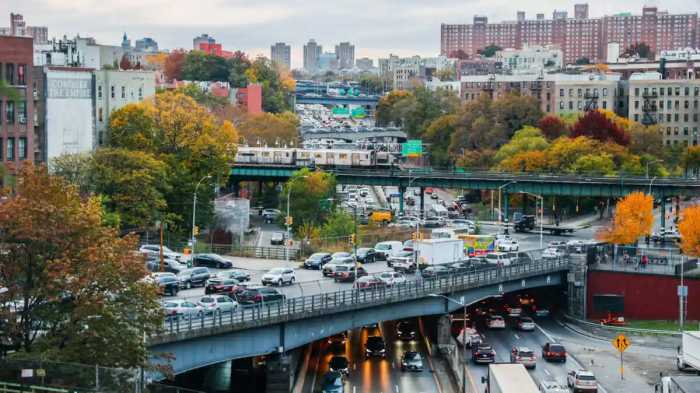
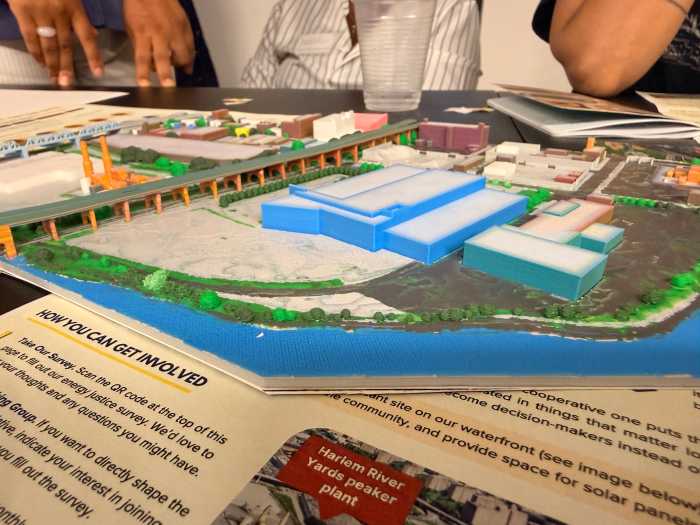
The massive former New York Post printing plant on the South Bronx waterfront could one day generate clean energy, train local workers, or provide public open space and return millions of dollars to the community under a new vision unveiled by South Bronx Unite.
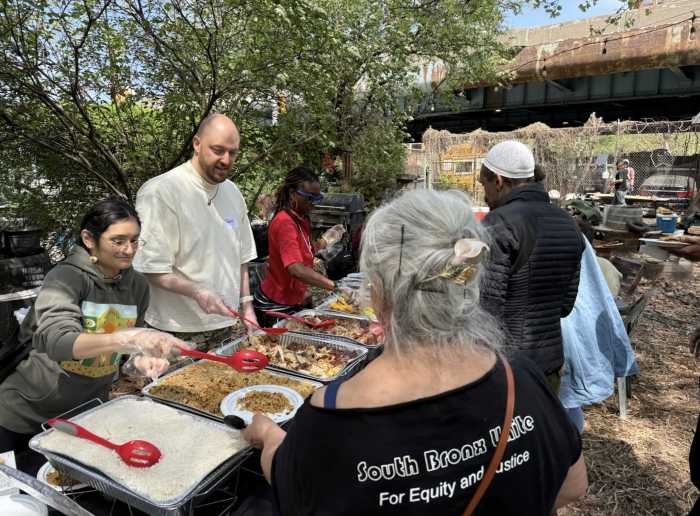
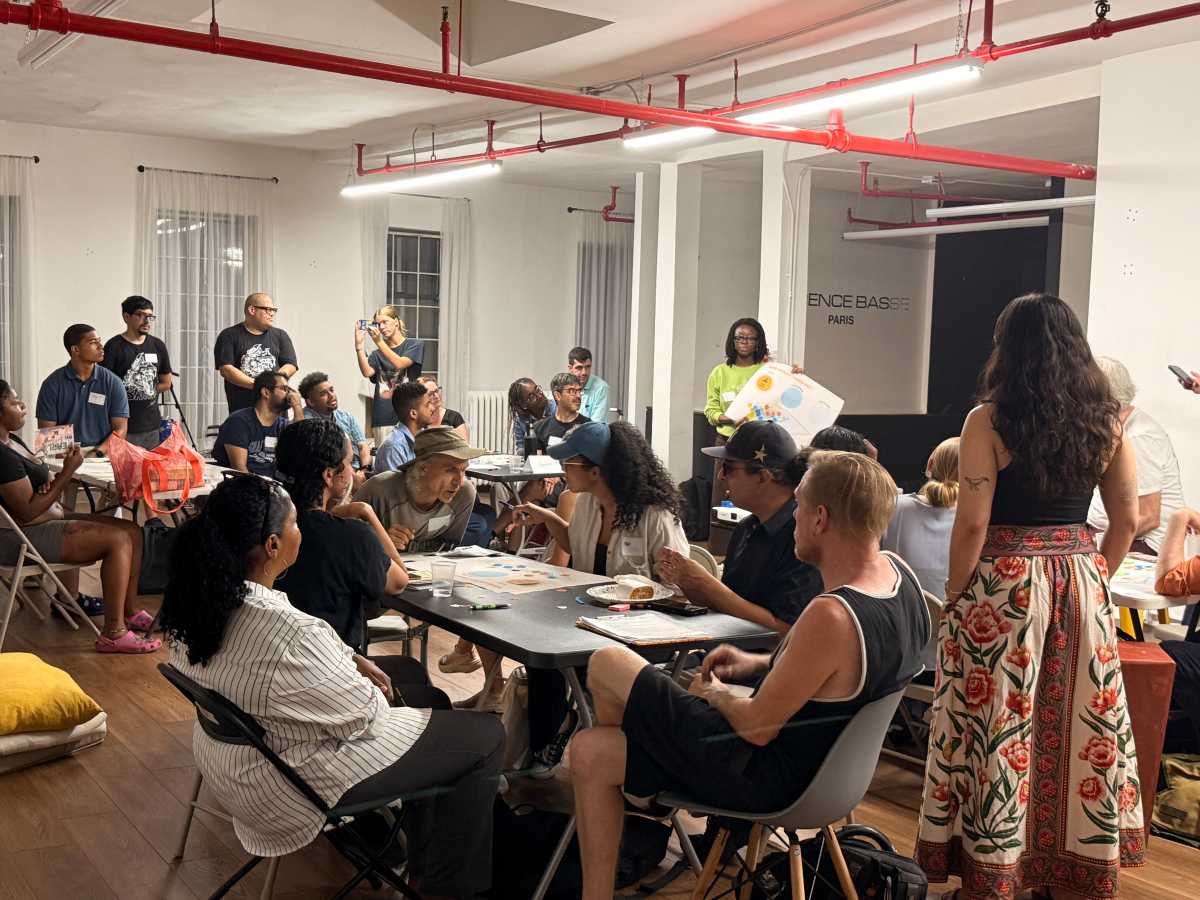
South Bronx Unite held its monthly meeting this week, bringing community members together with research fellows from the Massachusetts Institute of Technology to examine the site’s history and imagine how it could be transformed into a community-oriented hub.
The workshop also doubled as the launch of the organization’s Energy Justice campaign, which builds upon their previous campaigns against unaffordable development, clean air, and waterfront access.
“Whose Con Edison bills are too high?” Matthew Shore, director of planning and development at South Bronx Unite, asked the group.
Almost all of the hands of the roughly 40 people in attendance shot up.
“Who likes the fact that we have four peaker power plants in the neighborhood?”
Everyone’s arms stayed at their sides.
For South Bronx Unite, the questions underscored the connection between the cost of energy, the neighborhood’s history of pollution and the larger question of who benefits from the South Bronx’s land and infrastructure.
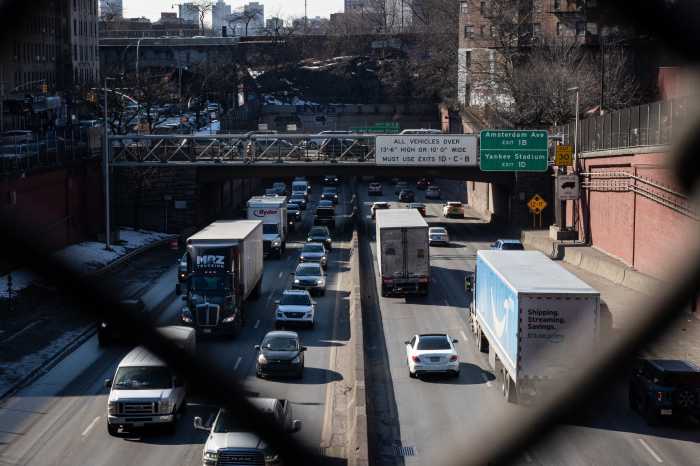
The organization grew out of community opposition to FreshDirect’s expansion into the South Bronx, a fight centered in part on concerns about truck traffic and air pollution. Its latest campaign turns toward energy— and a massive property that organizers say could become a model for community-led clean energy development and not another last-mile warehouse.
The former Post printing plant spans more than 350,000 square feet and sits directly on the waterfront. News Corp began operating at the site in 2001 before moving its printing operations to College Point in 2021. The property is now largely vacant, creating what South Bronx Unite sees as an opportunity to rethink its future amid the Mamdani administration’s willingness to challenge big corporations.
The land is currently operated by the Galesi Group, which holds a 99-year lease with Empire State Development Corporation. Galesi also leased part of the property to FreshDirect in 2011. According to South Bronx Unite, FreshDirect received $127.8 million in tax breaks from the state to keep the business from moving out of state.
With developers continuing to show interest in waterfront industrial properties, South Bronx Unite organizers said they want to begin planning now, before the site is leased to another truck-heavy business that could add to pollution in the neighborhood.
A community-owned solar project
The workshop centered on participants’ hopes for what the future of the site could look like.
Solar panels on the building’s massive rooftop would be a central component of the vision.
South Bronx Unite is currently conducting a pre-feasibility solar assessment with Working Power, which helped secure Sunset Park Solar, the city’s first community-owned solar project. Organizers are also seeking pro bono legal assistance as they work through the property’s complicated ownership and lease arrangements.
Preliminary projections presented at the meeting estimate that solar panels on the roof could generate about $3.1 million in operating income over 25 years. The project could provide a 20% discount on electricity bills for about 100 households, with participating households saving an average of $142 a year.
The project would also be community co-owned. That means residents who participate could benefit from lower energy bills, while excess revenue could be reinvested into the neighborhood through a community-governed process.
Organizers said the potential project could generate roughly twice as much energy as the Sunset Park Solar Project, making the former Post rooftop a potentially significant source of community-owned renewable energy.
The rest of the property’s future remains up for discussion.
Limited by the lot’s zoning restrictions, participants said they would like to see the building used for green manufacturing, office space, workforce training and art studios.
Outside, residents envisioned public green space, urban farming, EV charging stations, battery storage, walking trails, rainwater collection and infrastructure designed to help address flooding. Some also proposed transportation connections, including bus and ferry access.
The ideas are still preliminary. Organizers emphasized that no decisions have been made about the site’s future.
“Places like the Bronx are very much impacted by issues like energy insecurity. And yet, there are solutions,” said Dr. Diana Hernandez, associate professor of Sociomedical Sciences at Columbia University’s Mailman School of Public Health, who lectured at the meeting.
“So many people don’t know enough about energy, and energy literacy is something that we need to be able to develop efficiency, electrification, and also the moral questions around disconnections,” Hernandez said.
“Is it okay in a society that is otherwise wealthy to be disconnecting people on the basis of affordability?”
A long road ahead
The project does not yet have a firm timeline, but organizers estimate that fully realizing the vision could take as long as seven years.
Much of that time would involve figuring out how the site could be acquired or otherwise placed under community control. The property spans two lots with different ownership and lease arrangements, adding another layer of legal complexity to the proposal.
Organizers said the political moment makes it important to begin that work now, particularly as the city and state consider the future of industrial and publicly connected waterfront properties.
South Bronx Unite plans to establish a working group that will meet regularly beginning later this month and continue through at least mid-2027. The group is intended to serve not only as a place for residents to learn about energy justice, but also as a space to make decisions about the organization’s work around the site.
“There is a nationwide struggle for the liberation of these lands,” said community organizer Kaila Paulino.
“We don’t have an answer, but that’s why we want to have this conversation.”
Reach Marina Samuel at msamuel@schnepsmedia.com. For more coverage, subscribe to our newsletter and follow us on Twitter, Facebook and Instagram!