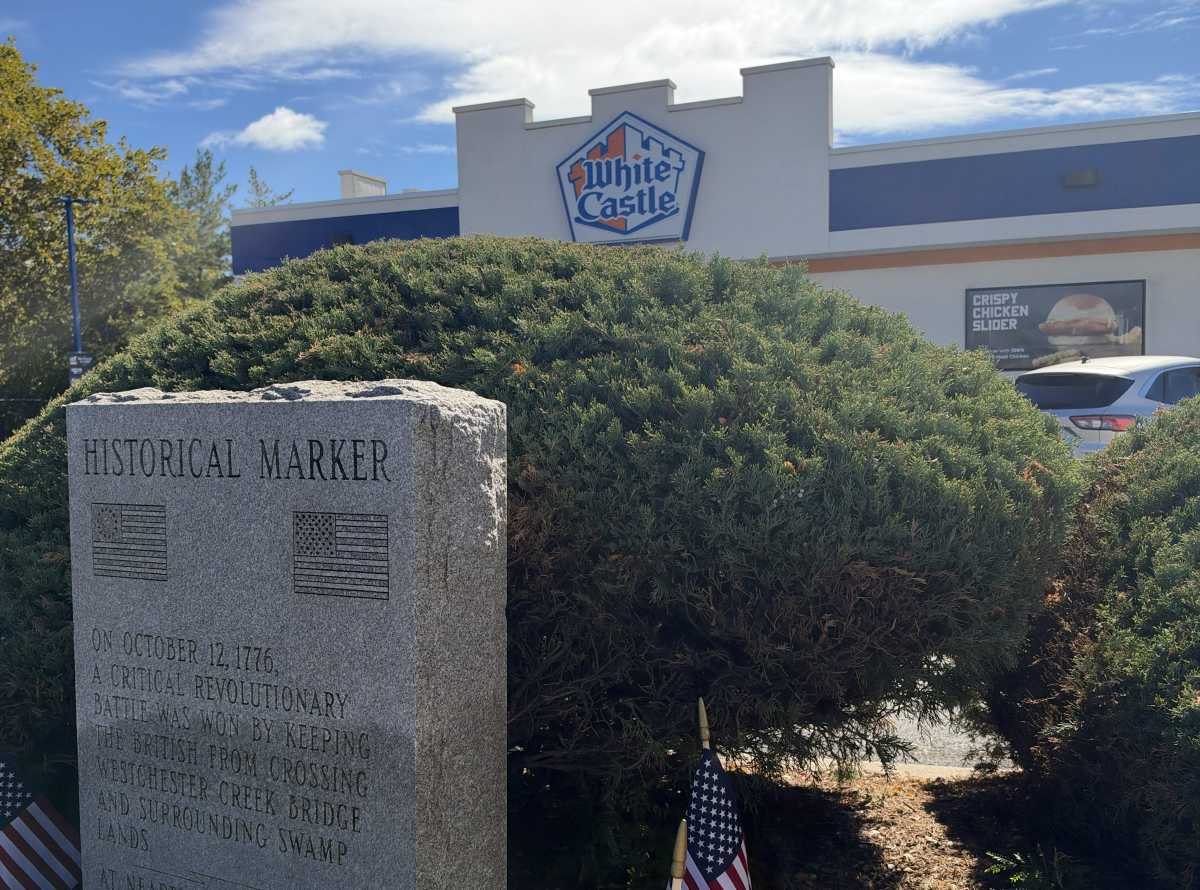
Most people stopping by the White Castle at 2900 East Tremont Avenue in Westchester Square are looking to grab a few sliders or perhaps a Crave Case. What many may not realize is that just outside the restaurant sits a reminder of a Revolutionary War confrontation that took place 250 years ago.
On October 12, 1776, approximately 25 American riflemen stood their ground against a British force of nearly 4,000 soldiers near Westchester Creek. Their resistance helped delay British General William Howe’s advance and gave General George Washington additional time to move his Continental Army to safety.
This October marks the 250th anniversary of the confrontation, which played a small but important role in the American Revolution.
At the time, Westchester Square was known as Westchester Village and was still part of Westchester County. Much of the surrounding area consisted of marshland, with narrow crossings connecting Throggs Neck to the mainland.
Howe had landed thousands of British soldiers at Throggs Neck with the intention of advancing west and cutting off Washington’s troops, who were positioned in northern Manhattan.
However, a small group of American riflemen under the command of Colonel Edward Hand had other plans.
The soldiers removed planks from a bridge crossing Westchester Creek and opened fire as the British approached. With the surrounding marshes making it difficult to maneuver, the much larger British force was unable to advance as planned.
Although the encounter was relatively small compared to other Revolutionary War battles, the Americans succeeded in delaying the British and disrupting Howe’s plans.
Just six days later, on Oct. 18, another confrontation took place at Pell’s Point, in what is now Pelham Bay Park. There, American forces under Colonel John Glover again slowed the British advance, helping Washington’s army continue its withdrawal toward White Plains.
Today, the landscape looks nothing like it did in 1776. Portions of Westchester Creek have been filled in, and the marshland has given way to streets, businesses and residential neighborhoods.
However, a stone marker near the White Castle commemorates the October 12 confrontation and the former Dock Street, which once served as a landing point for ships traveling along Westchester Creek.
Bronx Borough Historian Angel Hernandez said the White Castle location is just one example of the many historic sites throughout the Bronx that residents may not know about.
“The Bronx has so much history, and I think a lot of people would be surprised by just how much of it happened right here in our own neighborhoods. You can walk past a place like White Castle a hundred times and never realize that something so important happened there nearly 250 years ago,” Hernandez said.
“That’s why I always encourage people to learn about the history around them. There’s so much to discover right here in the Bronx, and it’s something we should all take pride in.”
Today, Westchester Square is a heavily trafficked commercial district that serves as an economic hub for the surrounding communities, with thousands of residents passing through the neighborhood every day.
Many are likely unaware of the important role the area played in the American Revolution. The historical marker outside White Castle is just one of the many reminders of the Bronx’s rich history, much of which can be found in places residents pass by every day without realizing their significance.