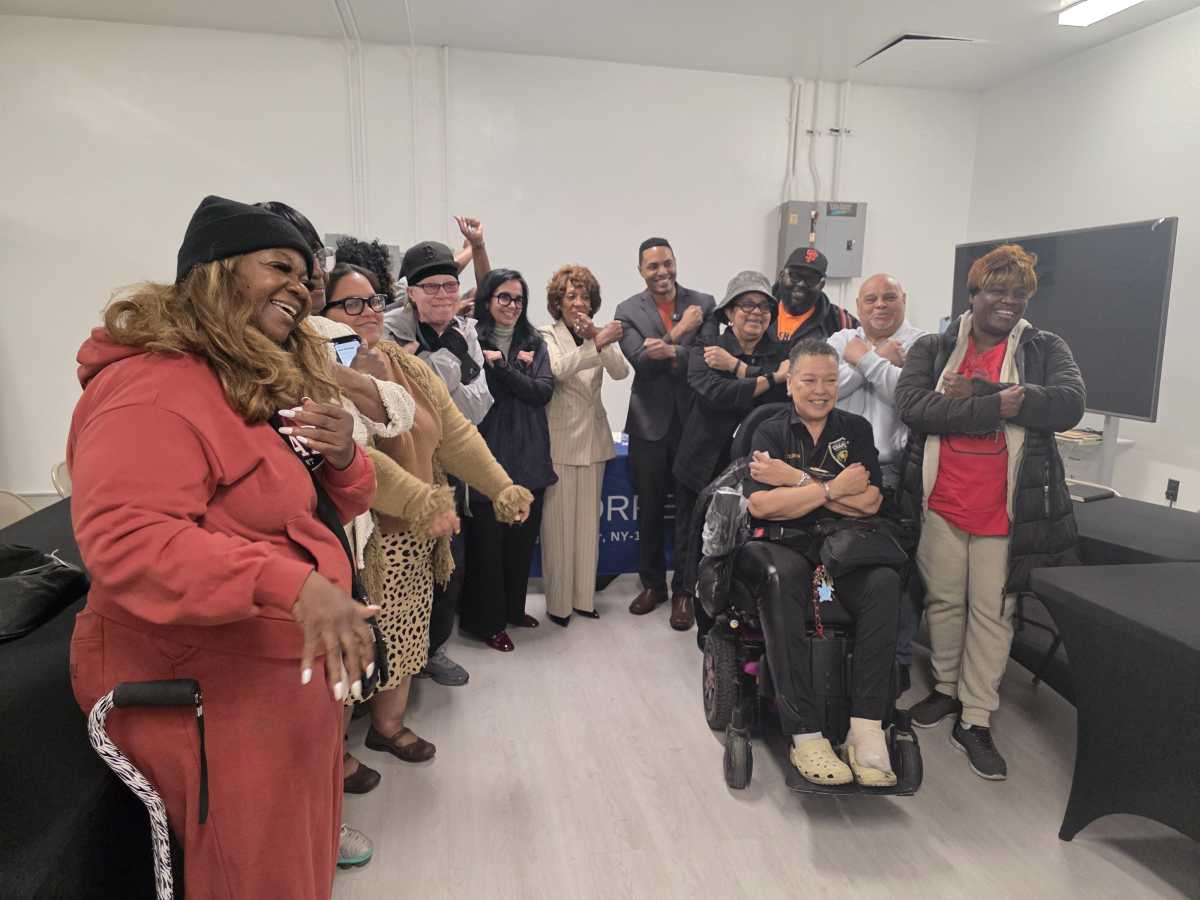
Rep. Maxine Waters of California, who is serving her seventeenth term in Congress, made an appearance in the Bronx on April 19, joining a breakfast roundtable with Bronx Rep. Ritchie Torres and NYCHA leaders.
Waters, often affectionately called “Auntie Maxine,” heard directly from NYCHA resident leaders in Torres’ district, along with NYCHA CEO and COO Lisa Bova-Haitt and Eva Trimble.
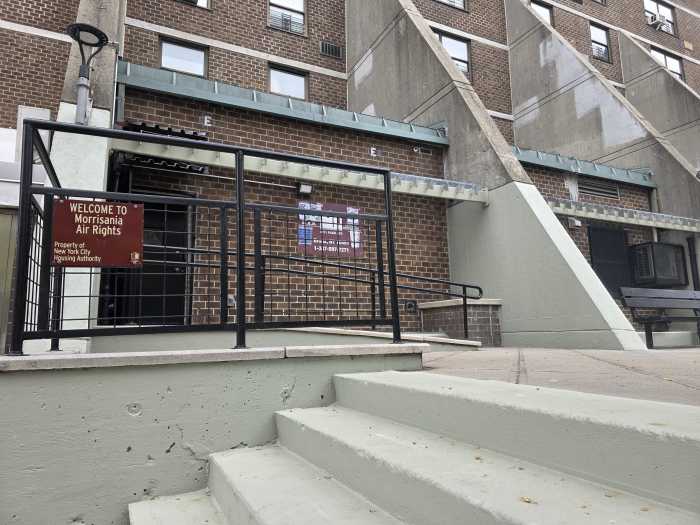
During the breakfast gathering at Morrisania Air Rights at East 159th Street and Park Ave., the Congress Members and NYCHA officials mainly listened as Bronx tenant representatives from several developments took the floor.
The developments represented were Clay Avenue, Melrose Houses, St. Mary’s Park Houses, Patterson Houses, Morris Houses, Sedgwick Houses, Eastchester Gardens, McKinley Houses, Gun Hill Houses and Webster Houses.
Tenant leaders discussed the many challenges faced by NYCHA residents, ranging from scaffolding in place too long and outdated surveillance cameras to broader concerns about privatization and tenant empowerment.
The event was cordial despite some disagreements, but some city leaders and roundtable attendees have been vocal in calling out NYCHA for poor conditions, including broken elevators, water leaks, vacant units, rodent infestations and even major structural collapses like the explosion at Mitchel Houses last October.
Public Advocate Jumaane Williams has called NYCHA the city’s worst landlord due to underfunding and fiscal mismanagement, and NYCHA tenants rallied to make their voices heard at Mayor Zohran Mamdani’s recent “Rental Ripoff” hearings, which focused mainly on privately-owned buildings.
Meanwhile, Bova-Haitt and Trimble’s combined salaries total nearly $677,000, according to the government transparency website SeeThroughNY.
Torres said NYCHA is “often a punching bag for criticism” but that its leaders are working hard to improve conditions.
The Congressman, who was raised in public housing, where his mother still lives, said the battle for public housing was personal. “I’m not only fighting for my community, I’m fighting for my family.”
NY-15 has the highest concentration of public housing residents in the country and is “ground zero for the humanitarian crisis that every one of you are experiencing in public housing every single day,” Torres said.
He said the United States’ public housing system has more than $200 billion in capital needs but is “savagely starved of funding.”
No one understood the challenges more than the Bronx roundtable attendees, which Torres called “the most important room in America” when it comes to public housing.
NYCHA: bigger than Atlanta
NYCHA’s operating budget heavily depends on the federal government, and past shortfalls, combined with the cost of maintaining aging infrastructure, make the system highly sensitive to any federal cuts, according to the Independent Budget Office.
In recent years, Waters introduced bills that included $150 billion in affordable housing investments, but they did not advance through the legislature under Donald Trump.
Waters is the ranking member of the House Financial Services Committee, which she formerly chaired, becoming the first woman and African American to do so. The powerful committee oversees how federal dollars are spent on public housing, along with other crucial economic stability factors such as banking, international finance, insurance, currency, credit and more. Torres also serves on the committee.
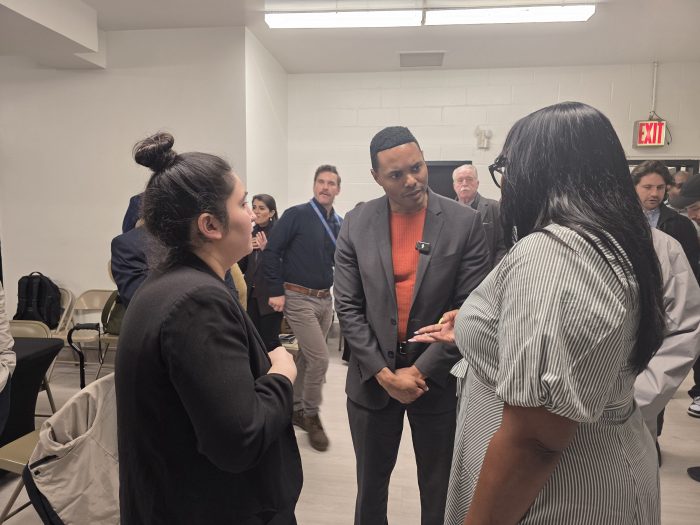
Waters said she was “delighted” by the invitation to the Bronx and said of Torres, “No matter whatever else he’s into, he’s into public housing.”
Bova-Haitt said she has worked closely with Torres on funding concerns. NYCHA’s population of well over half a million makes it larger or as large as some major cities like Orlando and Atlanta, “but we don’t have the tax base,” Bova-Haitt said.
She said NYCHA is facing a 14% cut in operating dollars — a concern made even more acute by the city’s low vacancy rate, which means residents have few options for where to live, especially at lower rents
One resident, Father Frank Skelly of Immaculate Conception Church, spoke of ways to work around the limitations of the current NYCHA system.
He spoke in favor of the Ombudsman Call Center (OCC), which is independent of NYCHA and addresses residents’ complaints about water leaks and mold when NYCHA is not responsive.
Skelly said the OCC has served 32,000 units, which is only a fraction of the need. He said expanding the OCC and promoting it to residents — many of whom are currently unaware of the option — could greatly improve housing conditions.
At the same time, Skelly said he would never seek to dissolve NYHCA.
“NYCHA is the best solution for public housing in New York City. We’re looking to make it better,” he said.
Torres said the OCC is effective and should be in every development. He added, “NYCHA may not agree,” but Bova-Haitt did agree that the ombudsman is effective.
Danny Barber, who leads the citywide council of NYCHA presidents, called on residents to report housing problems to the OCC and other entities and live responsibly on the properties.
At the same time, he called himself NYCHA’s “biggest adversary” and said he’s not afraid to bombard the agency with emails addressing concerns.
“We ask NYCHA to treat us, at all times, as we count. Not just when special guests come,” Barber said.
To privatize or not to privatize?
One point of contention during the roundtable was privatization, with some leaders expressing grave concerns about private managers taking over NYCHA properties and others saying it has worked wonders.
Keith Ramsey of Eastchester Gardens said Wavecrest Management took over last year under the Permanent Affordability Commitment Together (PACT) program and “transformed” the property “from a lowly caterpillar to a beautiful butterfly.”
Ramsey said he was initially skeptical of having a private manager take over the second-oldest NYCHA property in the Bronx — but has been thrilled with the results.
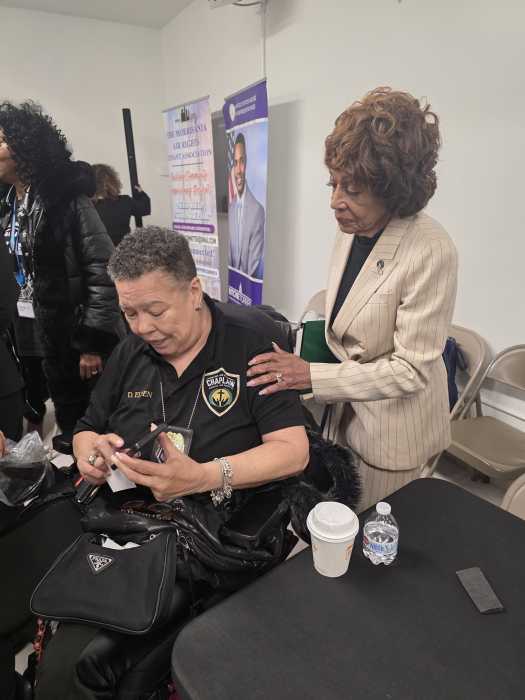
On the other hand, Dana Elden of St. Mary’s Park Houses said she was worried that residents dilute their power under private companies.
She called for more traditional Section 9 housing support instead of Section 8 conversions. After seeing examples of privatization, Elden said she was convinced that residents in other public housing programs “don’t have the power or the rights that they used to have in Section 9.”
Elden expressed concern that there are “no set standards” that private managers must follow. “We want to keep our rights. We want to keep the ability to govern within our walls,” she said.
Elden pressed Waters to find more NYCHA funding, which has generally been “neglected for many years.”
Another point of debate was surveillance cameras on NYCHA properties.
Several leaders expressed a need for new cameras, reigniting the debate over how the footage is used — and by whom.
Regina Carter at Morris Houses, which has more than 4,000 residents, said her property’s cameras are horribly outdated.
“We have been told by the police that a person could be raped, robbed and murdered in full view of the camera, and they would have difficulty seeing it,” she said.
Torres said he will work on funding for cameras — but other leaders were more wary of their purpose.
“Cameras are not for the criminals, they’re for you. So they can watch you,” said Elden at St. Mary’s Park Houses.
‘Democracy at work’
As the event wrapped up, Waters applauded the variety of perspectives and said it was “democracy at work.”
She vowed to continue working closely with Torres on the House Committee and to remain a fierce advocate for public housing.
Waters recalled the 33-tower Pruitt-Igoe development, demolished in her hometown of St. Louis in 1972, and said government should work to prevent similar situations.
“They lost all of those units, and they’ve never been replaced,” she said.
Waters said she’s working on a massive $1 trillion bill that includes a “substantial amount” for public housing — but added she still hasn’t landed on a great solution for tenants who cannot afford to pay.
After the discussion, Barber said he was thrilled to have Waters’ ear. He said he had “thought it was all lost, that no one in Congress wanted to hear us out.”
“To have such a strong, positive woman to come is a monumental moment,” Barber said.
Cassandra Bowlin, who has lived in Melrose Houses for more than 50 years, said she was also pleased to hear from Waters in the Bronx.
Residents must use their voice to speak up, and improving NYCHA requires “people on the ground floor to make it happen,” she said. “We’ll keep on fighting.”
Reach Emily Swanson at eswanson@schnepsmedia.com or (646) 717-0015. For more coverage, subscribe to our newsletter and follow us on Twitter, Facebook and Instagram!