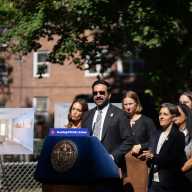
High school students at the Laboratory School of Finance and Technology presented their ideas for enhancing Bronx roads, community spaces, and transit infrastructure to city government representatives during the closing ceremony of the Department of City Planning (DCP)’s annual Young Voices in Planning curriculum.
Now in its fifth year, the eight-week program, taught jointly by teachers Hope Grossman-Devore, Bria Lynah, Alfonsina Jimenez and 10 DCP volunteers, introduces seniors at the Mott Haven high school to planning and public engagement concepts.
After participating in site visits across the Bronx to learn how community advocates and city planners work together to shape developments in the borough, 73 students applied their knowledge through independent planning projects.
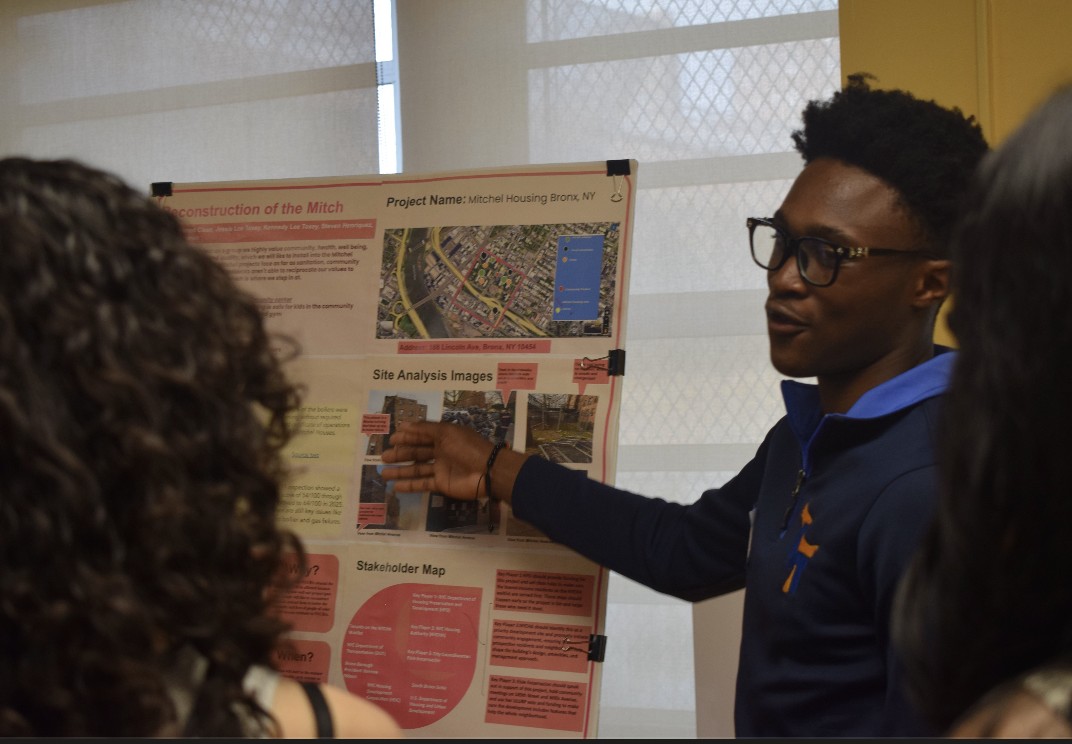
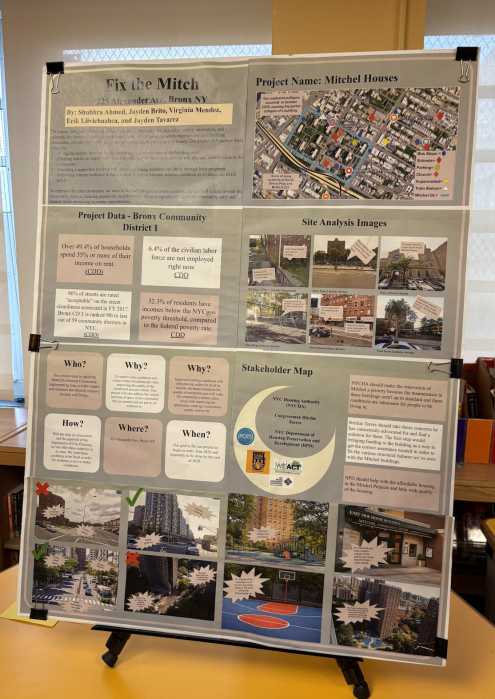
For Mohamed Cisse, a senior who wants to study mechanical engineering after graduating, his “Reconstruction of the Mitch” project was personal. One of his friends has two younger siblings with asthma, he said, and their conditions get worse when they’re outside the Mitchel Houses complex in Mott Haven.
“He’s gotta go all the way to St. Mary’s to get to the parks, and we feel like that’s a long trip,” Cisse said.
“You can be anything you want if you just put your mind to it,” he said, adding that the hands-on nature of the work helped him decide to pursue his chosen career path. “I feel like you can always try something new.”
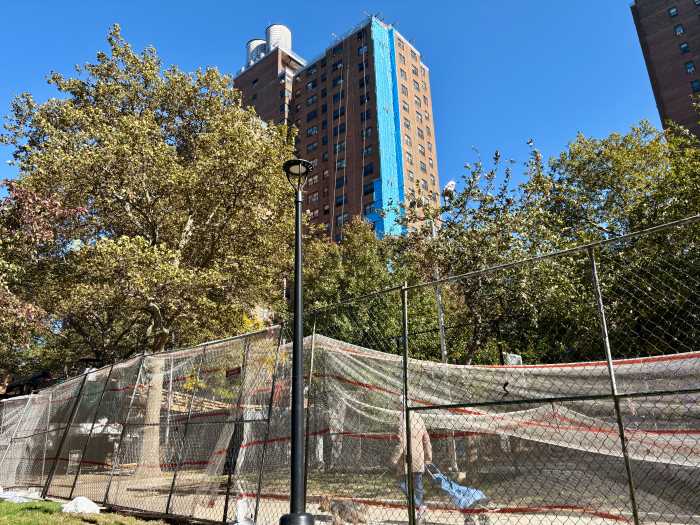
In October, a boiler explosion collapsed a 20-story chimney in the public housing complex, triggering a blast that sent thousands of bricks crashing down.
Multiple groups of students looked into the area and imagined doing more than just repairing the site of the explosion. They proposed different ways to revitalize the housing complex by fixing cleanliness issues, improving the community’s resilience to floods and extreme weather conditions, introducing new green space and building a new playground.
Being able to visit the site in person was particularly valuable, said Jayden Brito, whose “Fix the Mitch” proposal reimagined the area as a green, welcoming environment for community members of all ages.
Many of his basketball teammates live in the housing complex and he said that implementing repairs and long-term solutions to improve residents’ quality of life is critical.
“The students are the greatest experts on our neighborhood because they experience these sites more than any of us, and I want people to know how committed all of them are to creating real change,” said Hope Grossman-Devore, a government teacher at the Laboratory School of Finance and Technology.
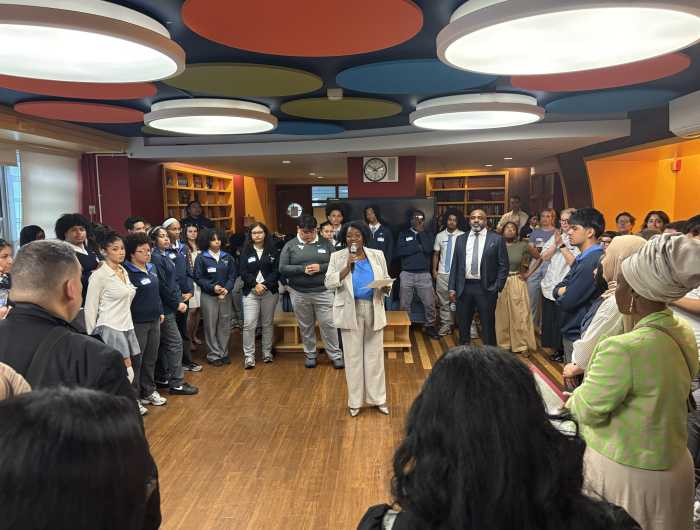
At the event, DCP director Sideya Sherman announced a new partnership with NYC Her Future at the NYC Mayor’s Office of Equity and Racial Justice to bring together up to 30 students from 15 public and charter high schools across the city to learn the fundamentals of city planning, which will culminate in a citywide Youth Planning Summit in June.
“I grew up in a neighborhood where accessing opportunity often meant leaving my community,” said Sherman, who grew up in Staten Island.
“I understood from a very early age that place matters. It impacts how you access education, resources, jobs, transportation, economic mobility and the decisions that we make as planners impact those opportunities for other New Yorkers.”
Sherman called up the example of Yolanda García, a Bronx city-planning activist.
In the early 1990s, García and other concerned South Bronxites founded Nos Quedamos/We Stay, a nonprofit community development corporation in Melrose.
The organization worked with small businesses, architects, borough leaders and city bureaucrats to fight against the massive displacement of residents which their communities were undergoing and provide an alternative voice to that of politicians and wealthy developers.
“This was a community hero who, at a time when the Bronx was burning, when people were leaving communities, when the city had an urban renewal plan that really focused on moving people out of the Bronx, she and her fellow neighbors and partners across the city and nonprofits and a number of stakeholders cast a vision for the Bronx that was focused on growth, ” Sherman said.
In June 2019, NYC Parks dedicated a new park in Melrose to the activist, naming it the Yolanda García Park.
“That is an example of how a singular voice, a community voice, can actually change the trajectory of a neighborhood and how we as the city can also learn from the steps that communities take, which are often innovative at a time when we’re sometimes playing catch up,” Sherman said.
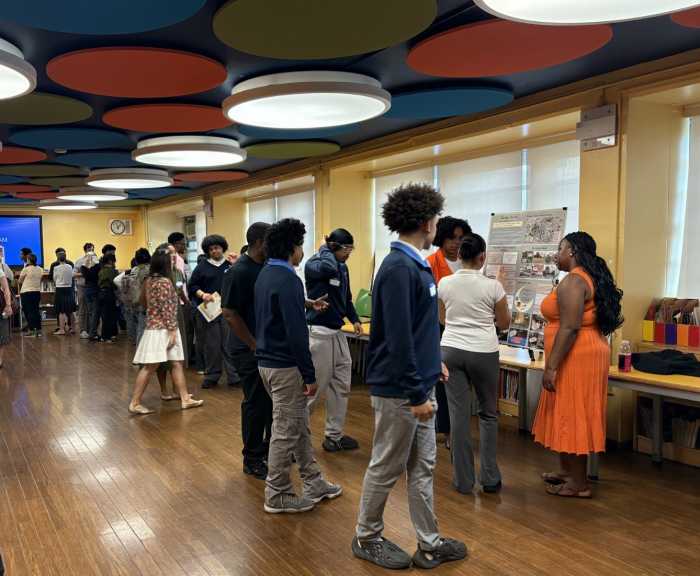
A common theme in the presentations was that the process of looking into the living conditions of the neighborhoods of their friends and community members revealed issues to the students which they were not aware of before they embarked on their projects.
Walking through the sites in person and talking with construction workers showed that the realities on the ground can look very different from what one might expect by studying the areas from afar, said Emma Hawkins, a senior who worked on a project to make the Port Morris waterfront more pedestrian-friendly.
“This project is so beneficial for our own sake and for the people around the community, because it gives more access to things that we’re not able to access right now,” she said.
Hamilton Espinoza, who worked with Emma to envision the area as a space that prioritizes people over cars and industry, said that he plans to work in construction as an operations engineer and hopes to work on projects like the one they designed.
Young Voices in Planning is one of the DCP’s efforts to increase participation in city planning processes, especially among populations that have historically not been invited into it or haven’t felt comfortable participating in the planning process, said Jack Darcey, a transportation planner and designer at DCP who co-leads the program.
“Over the past five years, it’s grown from sort of an ad hoc thing that depends on volunteers having the goodwill to come to the classroom into a more organized program with a well-organized curriculum,” Darcey said.
He said that one of the students from the third year of the program is now studying urban design at Pratt Institute, and another moderated a youth engagement panel at an American Planning Association conference at New York University.
“By investing in our youth through programs such as Young Voices in Planning, we are investing in our scholars’ leadership skills and creating more connected communities across our borough and throughout our city,”Bronx borough President Vanessa L. Gibson told the Bronx Times.
At the event, NYC Her Future founding executive director Nathifa Forde encouraged students to join their community boards, which Darcey said many students expressed interest in after learning that anyone 16 and older can participate.
“We certainly hope that some of these students will choose to pursue planning as a career path, but we’re also hoping to empower the students, even if they don’t go into planning professionally, to use their voices to inform changes in their community,” said Veronica Brown, a planner with the housing division at the DCP who also co-leads the project.
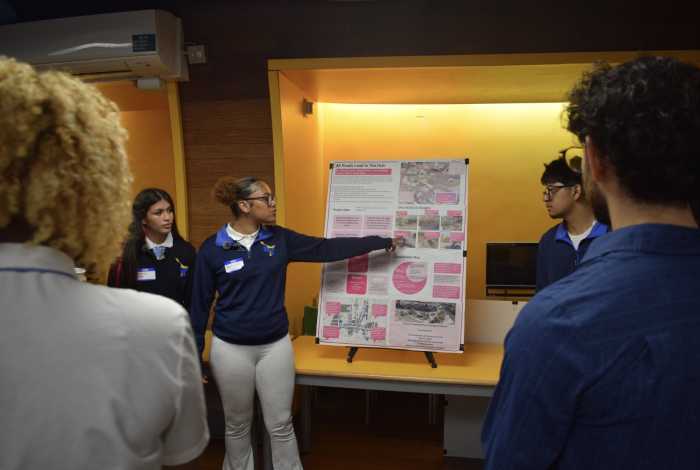
“We live in this community,” said Isabella Rivera, whose “All Roads Lead to the Hub” project proposed revitalizing Roberto Clemente Plaza by increasing sidewalk space, working with elected officials to support local businesses, adding more green space, and introducing signs and memorials to recognize the area’s history.
“To be able to actually work on our community, where we live, means a lot to me.”
Siddhartha Harmalkar is a student at the Craig Newmark Graduate School of Journalism. You can reach him at s.harmalkar08@journalism.cuny.edu. For more coverage, subscribe to our newsletter and follow us on Twitter, Facebook and Instagram!