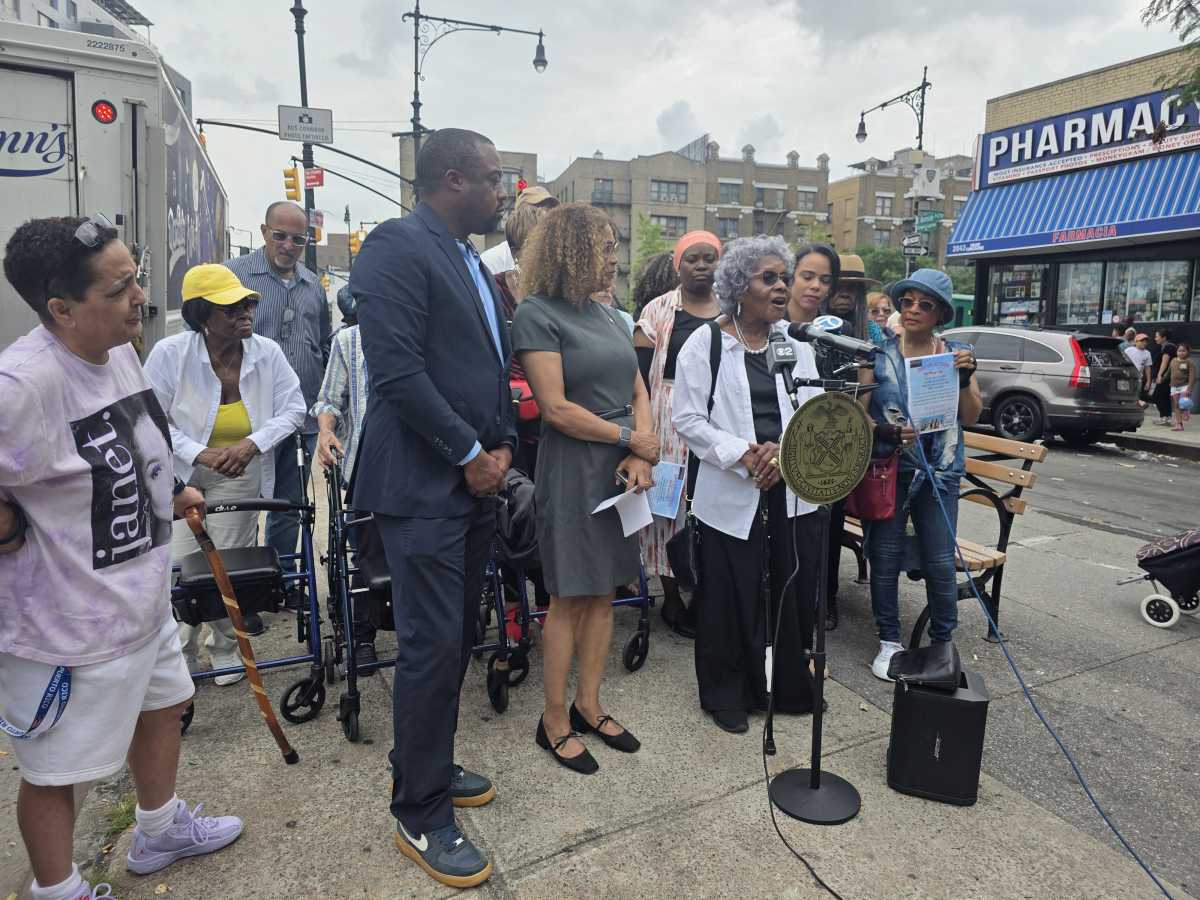
Local elected officials and residents gathered July 9 to call on the MTA to reinstate bus stops that were removed in 2022 from East Burnside Ave. and Grand Concourse.
The stops used to be on all four corners of the intersection but were removed under the Bronx Local Bus Network Final Plan, which eliminated 29 of 111 stops along the BX40 route and 24 of 114 stops on the BX42 to improve speed and efficiency.
The MTA’s six-month review showed that BX40 and BX42 riders saved an average of three minutes of travel time in each direction following the changes. But residents at the rally said the savings haven’t been worth it.
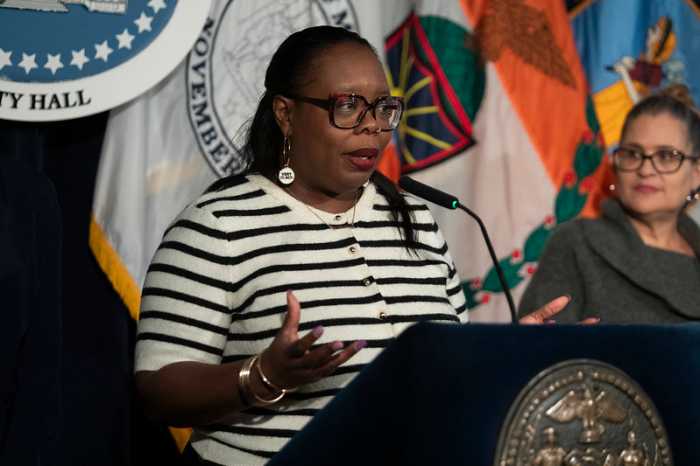
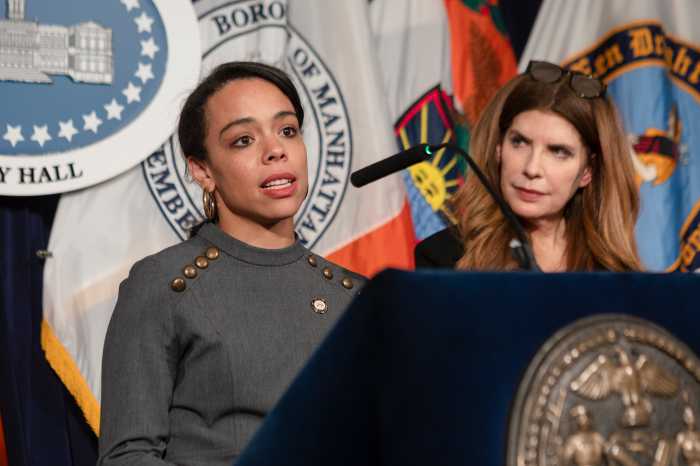
The press conference at Devanney Triangle took place on the site of one of the missing bus stops. Council Member Pierina Sanchez and Assembly Members Yudelka Tapia and Landon Dais joined Community Board 5 members and residents in demanding that the bus stops be reinstated.
They also accused the MTA of failing to meaningfully engage and listen to residents’ needs.
Sallie A. Wilkins, 88, a longtime resident leading the charge to bring back the stops, said at the rally that forcing residents to cross ten lanes of traffic at the Grand Concourse was “unacceptable.”
“We’re asking you to give us what you took away from us,” she said.
Wilkins told the Bronx Times that she has asthma and arthritis, and she walks with a cane. Getting to the BX40 and BX42 in either direction requires her to not only cross traffic but also to navigate a steep uphill or downhill.
“It’s a challenge,” she said.
Instead of taking away the bus stops, Wilkins said there should be stricter enforcement of double-parking rules, which would allow buses to run faster. At one point during the brief press conference, large trucks were double-parked on both sides of Devanney Triangle, including one where the BX40 and BX42 used to stop.
In a statement to the Bronx Times, the MTA said that restoring the bus stops would compromise speed improvements on the route and would require removing a different stop. It would also require removing trees planted at the site of the former stops.
“Since the Bronx Bus Network Redesign was implemented, eastbound bus speeds at this location have improved by 19% and westbound by 17%, with faster buses saving time for thousands of riders every day on those routes,” said MTA Spokesperson Aaron Donovan in a statement to the Bronx Times.
But Sanchez said the changes in 2022 “immediately resulted in a community outcry” that has persisted for years, and the MTA has been “unresponsive.”
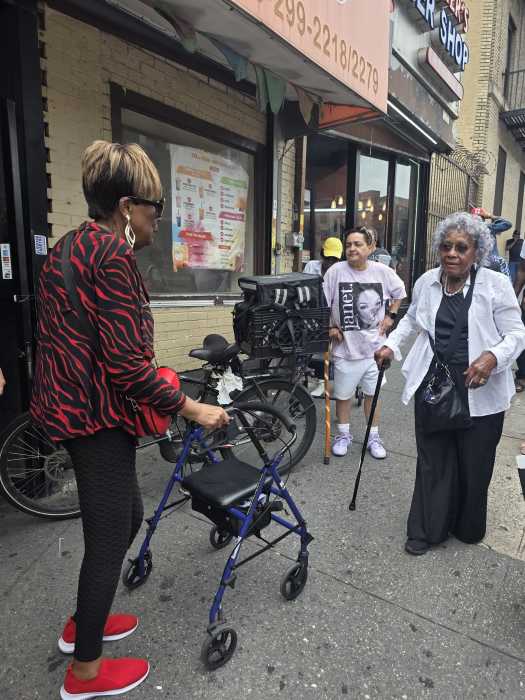
The Bronx has the city’s highest population of disabled residents, and within a few blocks of the former bus stops are several assisted living facilities, senior centers and schools, Sanchez said. “Replacing these stops could bring accessibility back to our community.”
Sanchez said she was pleased to see Mayor Zohran Mamdani’s newly announced plan to improve bus speed and efficiency across the city. However, she said the MTA and city leaders must listen to community needs before making changes.
She encouraged residents to speak up now, “Otherwise, changes are made that impact our safety.”
Tapia said she’s heard dozens of complaints about the missing bus stops and that the Grand Concourse is “already a dangerous area for pedestrians.”
The entire Grand Concourse has been identified as a Vision Zero roadway and is in “the top 10% of pedestrian deaths and serious injuries in the Borough,” according to the Department of Transportation.
“We need real engagement from the MTA to sit down with our community to chart a path forward,” she said. “When we start a fight, we never step back until we win.”
Community Board 5 chairperson Osiris Guzman also spoke at the press conference, saying Wilkins and other residents have appeared at every general board meeting for three years to advocate for the return of the bus stops.
His board issued a resolution in May calling on the MTA to heed residents’ concerns before someone gets injured or killed.
“Bringing these bus stops back is essential to protecting bus riders — especially our senior citizens, children, and people with disabilities — before and after riding the bus by allowing them to get on and off on their desired side of the Concourse. We call on all agencies to use their authority now to protect our residents rather than waiting for someone to be killed or grievously injured,” the resolution said.
After the press conference, residents and elected officials walked across Grand Concourse and down the hill to the Throggs Neck-bound bus stop to demonstrate the challenges they face.
The group included multiple seniors with canes and walkers, one of whom said she had two artificial knees. Midway across the Grand Concourse, the walk sign turned red, and Dais briefly held up traffic to allow them to cross to the next island.
Going down the hill to the bus stop, though a short distance, is especially hard in the winter when the ground is slippery, residents said.
The bus stop placement issue is not unique to the BX40 and BX42 riders. Dais said residents in his nearby district experienced the same frustration with stops removed from the BX18.
“Why does the Bronx always have to fight more than anyone else? Why do we always have to raise hell more than anybody else?” he said.
Dais called on MTA officials to ride the affected bus routes in his and Tapia’s districts to get a firsthand look at the challenges residents face in getting around. He told the Bronx Times that he’s been contacting the MTA since early June.
“Come here and do a ride along with us, and bring your grandmother or your aunt, or a young mother or father with three kids in a stroller, so you can experience what our district experiences every day,” Dais said.
Reach Emily Swanson at eswanson@schnepsmedia.com or (646) 717-0015. For more coverage, subscribe to our newsletter and follow us on Twitter, Facebook and Instagram!