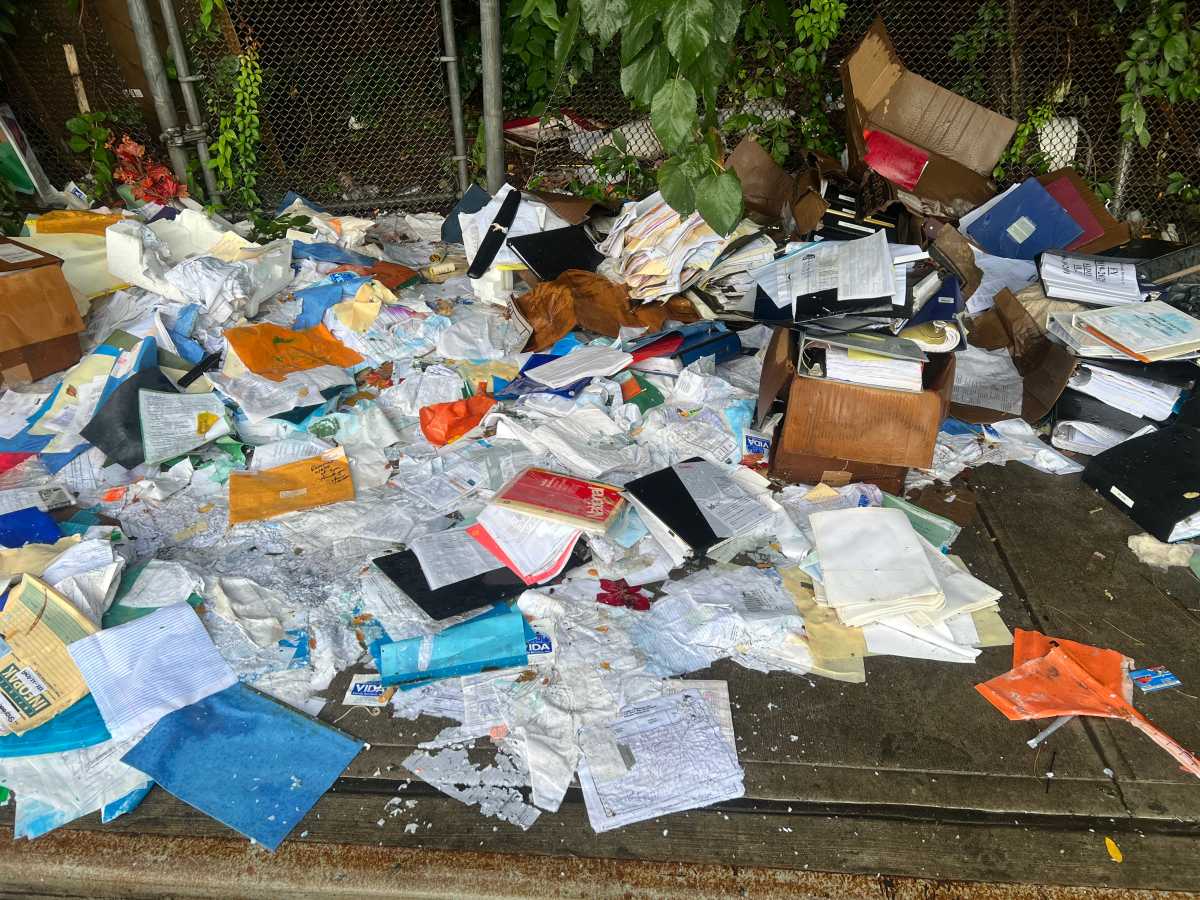
Illegal dumping continues to ravage a half-mile portion of Sedgwick Avenue into a trash-strewn corridor.
As recently as late last month, the Bronx Times witnessed the severe condition of the sidewalks and tree lawns along Sedgwick Avenue between University Avenue and West 167th Street, located in Highbridge and in close proximity to the Harlem River.
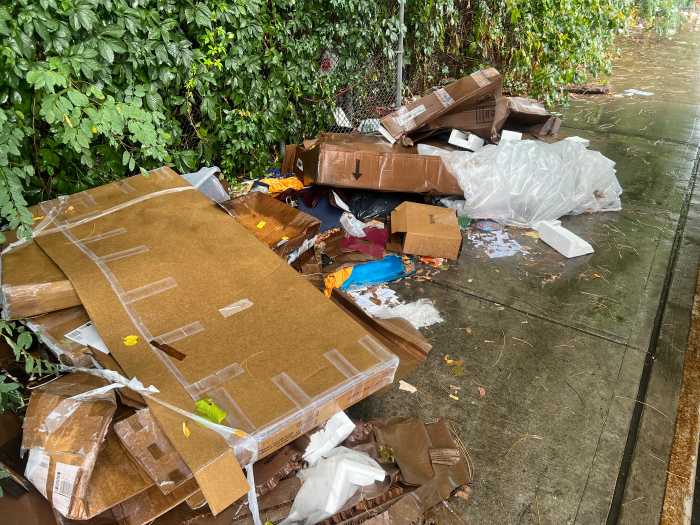
The half-mile-long stretch of Sedgwick Avenue was riddled with discarded objects which range from used mattresses and old cardboard boxes to empty milk cartons and binders of financial records, among other illegally disposed items.
The thoroughfare begins as the Major Deegan Expressway Service Road at its southernmost point, but still acts as the service road for a portion of the interstate highway when it turns into Sedgwick Avenue, before the road veers right north of the George Washington Bridge near West Tremont Avenue.
The aforementioned segment of Sedgwick Avenue, which runs parallel to the northbound side of the highway, has become an eyesore for motorists as well as pedestrians and cyclists who pass through.
Overgrown vegetation and overhanging branches have also caused sidewalk obstruction for active walkers and runners along the one-way Sedgwick Avenue section.
Non-emergency service portal 311, which handles inquiries regarding overgrown grass or weeds on highways, street signs and sidewalks, did not return a request for comment regarding the condition of Sedgwick Avenue, as of press time.
The Bronx Times also observed several stationed semi-trucks, as well as a handful of idle mobile living quarters, such as travel trailers, motorhomes and fifth wheels, parked along the Sedgwick Avenue strip.
Parts of the sidewalk path, which are also susceptible to flooding during downpours, present an accessibility issue as well as a safety concern for vulnerable road users.
Due to these conditions, pedestrians and cyclists traveling southbound on Sedgwick Avenue are forced to shift off the sidewalk into a one-way lane of oncoming vehicular traffic, which frequently includes mobile semi-trucks which use the street as a service road.
The semi-trucks already stationed on the side of the street generate a blind spot for passersby, who are forced to wait until the coast is clear and all visible traffic has passed before they can proceed.
According to street signage along the half-mile stretch of Sedgwick Avenue, all parked vehicles must be removed from the area on Tuesdays and Fridays from 11:30 a.m. to 1 p.m.
Last March, NYC Parks announced a fine increase for illegal dumping in parks — as the penalty for a first offense was officially increased from $1,000 to $5,000.
According to the new regulations announced by NYC Parks last year, repeat offenders will face an additional $10,000 if caught again within one year.
In collaboration with global volunteer group ASEZ WAO, an acronym which stands for “Save the Earth from A to Z – We Are One Family,” Bronx Borough President Vanessa Gibson launched the “Don’t Dump on the Bronx” initiative last May to clear litter and beautify Bronx neighborhoods.
The clean up campaign targeted illegal dumping and litter spots across the borough which include Webster Avenue, Bailey Avenue and the Hub located at 149th Street and Third Avenue.
By the end of the month-long cleanup, nearly 250 volunteers had removed more than 4,000 pounds of illegally dumped garbage from Bronx streets.
The Sanitation Foundation, which is the official nonprofit partner of NYC Department of Sanitation (DSNY), launched the annual Bronx Summer Cleanup series in partnership with the New York Yankees in 2021.
In last summer’s cleanup series, over 400 on-site volunteers cleared more than 2,000 pounds of garbage, as previously reported by the Bronx Times, while this past summer’s cleanup series saw 375 volunteers collect more than 1,800 pounds of trash, according to the Borough President’s office.
“The Borough President’s office is excited to continue building on the success of this (past) summer’s cleanup series and already exploring opportunities for additional volunteer-driven cleanups in the months ahead,” a spokesperson told the Bronx Times.
Towards the conclusion of last summer, Gibson announced the allocation of $1.5 million in total, including $1 million to the NYPD and $500,000 to DSNY, to combat illegal dumping in the borough with the installation of the security cameras and further enforcement efforts against illicit waste disposal throughout the borough.
Gibson’s office is currently in the process of reaching out to DSNY and city agency partners about the issues at the Sedgwick Avenue location, in addition to other locations currently on the office’s radar.
Cameras to catch and deter illegal dumpers have not yet been installed from Gibson’s $500,000 allocation, but DSNY is currently coordinating with NYC Parks to identify potential placement locations, according to the Borough President’s office.
A significant amount of resources have been allocated toward cleanup and maintenance of the area, according to DSNY.
A spokesperson for DSNY told the Bronx Times the portion of Sedgwick Avenue has been cleaned 24 times in the past six months alone, with enforcement and derelict teams having conducted operations in the area.
In the nine and a half months since the start of the new year, there have been approximately 120 vehicle impounds and 149 summonses in the Bronx issued by DSNY in response to illegal dumping — both stats well above the amounts recorded from the same time period in 2025.
To further enforce illegal dumping in the borough, DSNY said they have reallocated personnel and implemented stricter standards for what constitutes illegal dumping, which carries a $4,000 fine by the DSNY for first time offenders.
DSNY chose not to disclose the locations of the camera or in-person surveillance, so as not to tip off would-be illegal dumpers, but said a network of roughly 300 cameras have been deployed in the past four years to catch perpetrators.
The DSNY spokesperson also said they have worked with local elected officials, community boards and 311 service requests to mitigate the problem.
“We know the locations that are prone to illegal dumping, and we deploy resources accordingly,” the DSNY spokesperson said.
The spokesperson added DSNY, currently in the process of installing more illegal cameras around known dumping locations with the help of Borough President Gibson’s funding, has impounded a significant number of vehicles from Drake Street in Hunts Point and East 176th Street in West Farms.
Other illegal dumping hotspots in the borough over the past few years include stretches of Webster Avenue between East Gun Hill Road to 233rd Street and the Nelson Avenue overpass above I-95 between West 172nd Street and Featherbed Lane, along with parts of the Castle Hill and Soundview neighborhoods.
Vacant and private lots located in the Melrose neighborhood of the borough, including a Gerald Avenue property once proposed as a charter school site, continue to function primarily as high-frequency dumping grounds.
According to NYC.gov, it is illegal to dispose of any type of material or debris and dump it on any street, lot or park — whether or not the property is a public or private space.
“The message is clear — if you dump on our neighborhoods, we (DSNY) will catch you, we will impound your vehicle, and we will issue summonses,” the DSNY spokesperson said in a statement on behalf of the government agency.
To report illegal dumping, fill out an affidavit and include the time, date and location of the incident, the type and amount of the dumped material along with a description of the vehicle (not the people) and a license plate number.
Towards the conclusion of last summer, Gibson announced the allocation of $1.5 million in total, including $1 million to the NYPD and $500,000 to DSNY, to combat illegal dumping in the borough with the installation of the security cameras and further enforcement efforts against illicit waste disposal throughout the borough.
Gibson’s office is currently in the process of reaching out to DSNY and city agency partners about the issues at the Sedgwick Avenue location, in addition to other locations currently on the office’s radar.
Cameras to catch and deter illegal dumpers have not yet been installed from Gibson’s $500,000 allocation, but DSNY is currently coordinating with NYC Parks to identify potential placement locations, according to the Borough President’s office.
A significant amount of resources have been allocated toward cleanup and maintenance of the area, according to DSNY.
A spokesperson for DSNY told the Bronx Times the portion of Sedgwick Avenue has been cleaned 24 times in the past six months alone, with enforcement and derelict teams having conducted operations in the area.
In the nine and a half months since the start of the new year, there have been approximately 120 vehicle impounds and 149 summonses in the Bronx issued by DSNY in response to illegal dumping — both stats well above the amounts recorded from the same time period in 2025.
To further enforce illegal dumping in the borough, DSNY said they have reallocated personnel and implemented stricter standards for what constitutes illegal dumping, which carries a $4,000 fine by the DSNY for first time offenders.
DSNY chose not to disclose the locations of the camera or in-person surveillance, so as not to tip off would-be illegal dumpers, but said a network of roughly 300 cameras have been deployed in the past four years to catch perpetrators.
The DSNY spokesperson also said they have worked with local elected officials, community boards and 311 service requests to mitigate the problem.
“We know the locations that are prone to illegal dumping, and we deploy resources accordingly,” the DSNY spokesperson said.
The spokesperson added DSNY, currently in the process of installing more illegal cameras around known dumping locations with the help of Borough President Gibson’s funding, has impounded a significant number of vehicles from Drake Street in Hunts Point and East 176th Street in West Farms.
Other illegal dumping hotspots in the borough over the past few years include stretches of Webster Avenue between East Gun Hill Road to 233rd Street and the Nelson Avenue overpass above I-95 between West 172nd Street and Featherbed Lane, along with parts of the Castle Hill and Soundview neighborhoods.
Vacant and private lots located in the Melrose neighborhood of the borough, including a Gerald Avenue property once proposed as a charter school site, continue to function primarily as high-frequency dumping grounds.
According to NYC.gov, it is illegal to dispose of any type of material or debris and dump it on any street, lot or park — whether or not the property is a public or private space.
“The message is clear — if you dump on our neighborhoods, we (DSNY) will catch you, we will impound your vehicle, and we will issue summonses,” the DSNY spokesperson said in a statement on behalf of the government agency.
To report illegal dumping, fill out an affidavit and include the time, date and location of the incident, the type and amount of the dumped material along with a description of the vehicle (not the people) and a license plate number.