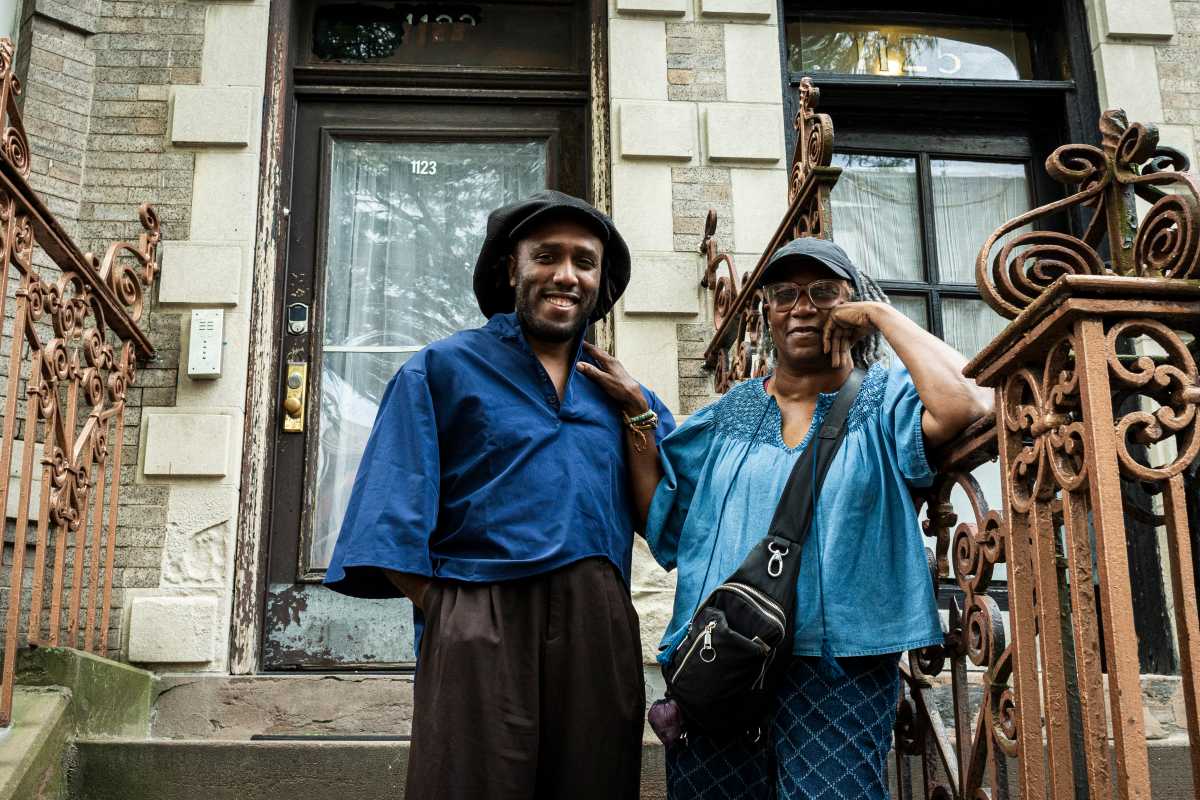
For Sheila Edwards, 73, and her 30-year-old son Kimani, their brick row house at 1123 Forest Ave. in Morrisania/Longwood is not just a property. It’s a hard-won legacy they’re fighting to protect.
Their four-family home, built in 1920, is in a South Bronx neighborhood some view as on the front lines of gentrification. But they have no plans to leave and are renovating to preserve, not modernize, their house’s unique character.
The area was once rural, with an actual forest at the end of the block. The Edwards’ European-inspired row house was designed by Warren C. Dickerson, who designed similar homes in Mott Haven and Harlem, according to the Landmarks Preservation Commission (LPC), which designated the neighborhood as a historic district in 1982.
The neighborhood was dubbed the Morris High School Historic District, anchored by the castle-like educational complex at 1110 Boston Road, built on the highest point in the borough, according to the LPC.
But demand for the rowhouses was immediate, spurring speculation even in the early 1900s. For example, between 1906 and 1907, 1114 Jackson Ave. changed owners five times, the LPC report said.
Now, more than 100 years later, the appeal remains. Right outside Sheila’s house, the city recently installed new brown historic marker signs that describe the neighborhood as having “one of the Bronx’s finest collections of turn-of-the-20th-century housing.”
Sheila and Kimani said they feel the constant threat of displacement but insist they’ll never sell out.
“This area is the last remaining stock of old rowhouses for this kind of pricing,” Kimani said. Real estate corporations, more than family buyers, have “kind of descended on this area.”
But many who seek to invest have little understanding of what it took for the family to obtain it, Sheila said.
Her family moved from Harlem to Forest Avenue when she was four years old. She was an only child, but the house was full of tenants, including six other kids, and a live-in babysitter watched over them all.
As a Black family, securing the house was an ordeal. Sheila’s mother spent three generations as a domestic worker for a German Jewish family, but “In spite of that longevity of one position and commitment to that job, she could not walk into a bank at that time and get a loan.”
Instead, the house was placed in Sheila’s father’s name, but only because he worked for a major property firm at the time. The employer’s name got them a loan from the Black-owned Carver Bank, the only one that would lend to them, according to Sheila.
Even though her mother contributed a significant amount of the funds towards the house, a $13,000 gift from a relative, her name wasn’t on the deed, Sheila said.
Still, her mother was determined to invest in property to pass down. And she wasn’t the only one. During her youth, many of the block’s six-story walk-ups were actually owned by Black families, Sheila said. “There were ways, but people had to really fight to get what they wanted to uplift their family.”
Speaking with the Bronx Times in the first-floor living room with rounded bay windows, she shared memories of a neighborhood engulfed in music and alive with activity. Men sat outside playing conga drums, and Sheila grew up on salsa, jazz, soul and blues. Kids played in the street, and people took care of each other. Across the street was a Jewish women’s center established in 1928.
Sheila recalled that neighborhood kids bought their ice cream “from a rickety, old, mean lady called Miss Brooks. When you walked in, you’d better say, ‘Ma’am, thank you, please,’ and the rest. Or else she’d get word to your mother you were rude.”
Once, when Sheila was young, she mistakenly took several hundred dollars in cash to that ice cream shop — and the owner promptly alerted the babysitter, who took the money safely back home.
In addition to the Black-owned houses, many of the local shops were also Black-owned, Sheila said. “I don’t know how they did it.”
But her block also had an Italian vegetable market and a Jewish meat market, creating an “interestingly mixed neighborhood,” Sheila said. “In the 50s, it was not a lost borough. It was a borough of very proud people of all immigrants.”
“I have all these images of myself and my friends. The six-story walkups. The corner store with the phone booths in the window and the candy counter. Here on this corner, three stores … you had to walk across an iron grate [in the sidewalk]. It was like a cellar down there. We never feared it, because that’s what we were used to.”
But over time, “The Bronx began to burn,” she said. “And once it burned, certain people left, collected insurance money. Little by little, people began to miss these shops. They disappeared.”
Can’t be bought out
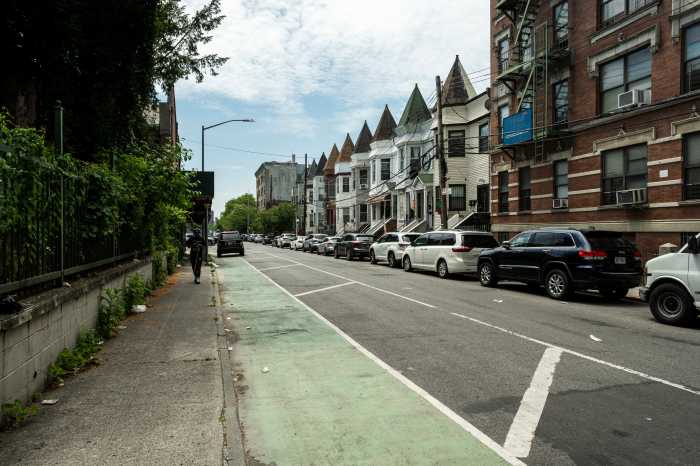
century still remain. Few more can be found along Charles Prince Place and Forest Avenue. Photo by Jonathan Portee
Today, Sheila said she worries that many in Kimani’s generation won’t be able to hold on to the wealth their families worked hard to secure.
She said she’s talked with him about investing money and preserving the family home, but she fears things won’t fall into place easily.
In New York, “It’s tough. You have to be smart, you have to be sharp, you have to know a person or two,” she said.
Like many longtime residents of changing neighborhoods, Sheila said she’s heard plenty of offers from investors looking to buy the house.
At one point, she was getting one or two calls per week from the same person for a year and a half. The man offered her $500,000 cash, to which she said, “Go and jump in the lake.” The house next door had sold for $900,000, and it’s only a two-family, Sheila said.
An agent once encouraged her to consider her age and that he could give her money on the spot. But Sheila said she responded, ‘Well, I feel that I have more value with what I have.’”
Sheila said she’s been offered as much as $1.2 million, but “That’s not my price.” When asked if she did have any price in mind, she said, “I tell them $1.5 [million]— but I wouldn’t give it up.”
She said her mother worked every day in a white family’s home, toiling through stress and pain in the era when taking off work to preserve one’s mental and physical health “wasn’t a thing.”
“You would never know what they’re going through. And out of that respect, I’m trying to teach my son, dammit, respect what someone had to go through to get what they have,” Sheila said.
“When I think about that, I say hell no.”
But she said it worries her that young people today, even those who are fortunate enough to have something passed down to them, “This generation will hardly be able to invest anywhere.”
“This [house] isn’t a lot, but it’s a jumping-off point. It’s a roof over your head. If you take care of it, it will take care of you. I don’t see where the 20- and 30-year-olds will get that chance.”
Kimani said he feels pressure to preserve his family legacy. He’s heavily involved with renovating the house and preserving its finely crafted details, from the crown molding, wood floors, built-in cabinets, fragile glass and high ceilings.
“In buildings like these, everything in them is a bespoke fixture,” he said.
But that craftsmanship is expensive to maintain, and some in the neighborhood have done away with their home’s original features for the sake of cost and convenience.
For instance, Kimani said one of the neighbors removed the giant sliding doors that pull out from each side to meet in the middle. To Sheila, these doors separated the grown-ups from the kids at her parents’ parties. But the neighbors took the doors out and put up a solid wall with a regular door in the middle, a choice Kimani found horrifying.
Their house, where his mom grew up on the second floor, and he on the third, is far more than an investment to Kimani.
“I don’t want it as a speculative asset, I want to live here,” he said. Yet he thinks it may still be impossible for him to hold on to the property. “That weighs on my mind quite a lot.”
Finding a balance
Kimani had a unique upbringing in the Bronx. He showed early signs of academic giftedness and could read everything in the house by age three, Sheila said.
Kimani never went to a Bronx school. Instead, he attended the toddler center at Barnard College and attended elementary and high school in Brooklyn. He spent hours on the train each day until the family got a car and drove him to Brooklyn for school, Manhattan for music classes, and to zoos, museums and other institutions in all parts of the city, where they often stayed from open till close, Sheila said.
All around them, Sheila and Kimani believe their neighborhood institutions, especially schools, are suffering. Kimani pointed to the nearby Morris campus, a beautiful building he compared to a “huge castle on a hill,” but educationally is “not up to par at all.”
“The Bronx has always been overlooked,” Sheila added. She said supporting her son’s advanced learning was, in some ways, as challenging as finding the right school for a child with disabilities. “The Bronx does not provide for all children.”
In their area, Sheila felt there were no options for Kimani and refused to put him in a school she felt was underperforming.
The Bronx could and should have more kids attending Ivy League schools and Historically Black Colleges and Universities, then entering high-level professions, she said.
“I’m judging [the neighborhood] by your kids. I’m judging it by the schools they go to,” Sheila said. “We should have choices. Why is it that kids in the Bronx don’t have more choices?”
Kimani attended Northwestern University in Chicago, where he double majored in art and film, and now works in animation production and art direction for an independent game developer.
Kimani said he never met other kids from the Bronx at his Brooklyn private schools. Though he views New York as just “one big city,” leaving one’s own borough every day still involves sacrifices: long commutes, less time for homework, fewer friendships.
At home in the South Bronx, Kimani said he was bullied because kids viewed him as “too educated to fit in with them culturally.”
The experience was “ostracizing — but why is that even a thing?” he said. “The idea that I didn’t belong here because I was schooled too well is a really troubling cultural touchstone for a borough.”
Kimani said he was “lucky” to have the opportunities he did. But his mother said, “I didn’t have a choice. It annoyed us that we had to travel so far to get the type of education we knew he needed and deserved.”
She said the family considered buying a home in Brooklyn but decided to stay in the Bronx “in order for him to be a balanced human being. Despite the unfairness, Sheila said her son’s experiences were a unique advantage.
While he went to school with rich kids, living in the Bronx kept him grounded. “You need to be able to come home to the Bronx, go outside and play, hang out with your folks,” Sheila said. “That meant a lot to us.”
Over the years, she’s learned more about the bullying he experienced, which she said has been hard to reckon with. But she pointed to an example that proved he was raised with the right perspective.
Kimani, as a preschooler, was invited to lunch at a classmate’s home — a Manhattan penthouse with gold walls, mahogany furniture and windows providing 360-degree skyline views, according to Sheila.
When they came home, her husband asked Kimani how it went, to which he replied,
“Well, it was nice. They had steps, and we have steps. They had windows, and we have windows.”
Kimani said he doesn’t remember this incident, but for his mother, it was a proud moment.
“That’s exactly what we were aiming for. For him not to judge or be judged, or allow others to judge him. So that balance was very important to us,” Sheila said. “And we didn’t change a thing.”
The Bronx as ‘just a place to dwell’
When asked where they see their neighborhood in 15 years, Sheila and Kimani struggled to answer.
Sheila said she has “many concerns” stemming from her Harlem roots. “I saw gentrification start there. That’s how I got to know what it was.”
Growing up, Harlem was “a beautiful cultural place,” she said. Over time, the neighborhood got what some would call nicer amenities and homes, which brought higher rents and ultimately the displacement of many longtime residents.
Today, Sheila said the Bronx is “the last borough standing that hasn’t been totally taken over.”
But too much change has been driven by big corporations adding housing without building up the rest of the neighborhood, she said.
The other boroughs have more appeal from entertainment, events and institutions, and Sheila said the Bronx lags behind in that respect. Given all the new development, the borough should have better schools, hospitals, buses, cultural spaces and more by now, she said.
“The way the Bronx is going, it’s going to be just a place to dwell,” Sheila said. “The buildings are going up, the people are filling them in — what else are you giving?”
Kimani agreed, adding that when out-of-town visitors come, he feels there’s little to show off in his own neighborhood.
He said the Bronx tends to have many chains and franchises but few niche, independent storefronts. He blamed it on real estate speculation by those who don’t actually live in the Bronx, who don’t have skin in the game.
The stigma of the Bronx being run-down and scary has lasted longer than in Brooklyn, making it harder to attract people away from other areas, Kimani said. But he believes negative perceptions could be changed with “an amenities-first kind of approach.”
“If you don’t have that, there’s not really a reason to pick the Bronx” over other parts of the city, he said.
The Bronx could be more like Flushing, Queens, he said, imbued with culture and tradition, but the Bronx’s uniqueness doesn’t always show in its storefronts, restaurants and public face.
“In order to jumpstart that, people need some kind of assistance,” Kimani said. “All of the necessary culture is here, but none of the finance.”
‘Once it’s gone, it’s gone’
Looking to the future, Sheila said she hopes her block remains much the same. “I’m hoping we can all hold on and not sell out.”
She and Kimani are doing extensive renovations at a slow pace to prepare for up to four new tenants. Rather than modernizing the home’s interior, they’re in the painstaking process of preserving its imperfections. They believe in the work, and hope future renters will too.
They already had to fight a contractor to keep the high ceilings. “A lot of people just come in and do drop ceilings and recessed lighting,” Kimani said.
He compared these old houses to classic cars: “There will never be more of them than there are right now, but there can always be less,” he said. “Once it’s gone, it’s gone.”
Being a landlord, especially during the pandemic, has been tough on Sheila. Like many small landlords, she said she got burned by tenants who simply stopped paying rent, eventually accumulating $90,000 in arrears.
There was no quick fix, and many city programs seemed available only to homeowners with no debt — which means they probably didn’t need the help, Sheila said.
The ramifications of that era are still playing out today, but people like her who own houses “should be not just holding on, but well-established and secure,” she said. “The Bronx should’ve been in a better position. The people in the Bronx should be living a lot better.”
Even so, Sheila said she feels fortunate to have something to pass down to Kimani and proud to provide a quality home for other residents once the renovation is complete.
With many Bronx homes in deplorable condition, overrun by pests or with ceilings collapsed from water leaks, she knows what she has is special. “Those of us who have one little thing, we know we have to hold onto it.”
Despite the hard work, Sheila and Kimani are determined to create a warm home for future tenants. They want original artwork by the door and for the house to be filled with people once again, as it was in Sheila’s youth.
“That’s what 1123 has always been about: home,” she said. “It was always about family. That, I had the privilege of experiencing, and that’s what my son is trying to bring in as well.”