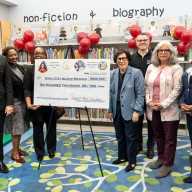
New York City Council Member Amanda Farías led the Council on Thursday, April 30, in advancing Resolution 183, which calls for the passage from the State Legislature and signature from Governor Kathy Hochul of legislation meant to enable public institutions to have more preference for New York State farmers and utilize public dollars to advance public health, racial equity, good jobs and climate resilience.
The bill, S.7638-B/A.8091-B, also known as the Good Food NY Bill, would amend General Municipal Law 103 to allow agencies to award certain food contracts to bidders based in New York State with proposals within 10% of the lowest bid.
“When agencies are required to accept the lowest bid, quality can suffer. We now have an opportunity to move toward a more responsible, farm-to-table approach—prioritizing local producers, strengthening our regional agricultural economy and ensuring the food served in our public institutions meets a higher standard from source to service,” Farías said.
“We must continue raising the standard for how we feed people, and I am proud to be working alongside advocates, labor and partners to demand better when it comes to food quality, nutrition, transparency and accountability—especially for those who depend on these meals every single day.”
Bidders must also be able to meet defined, values-based procurement standards, including support for local and regional economies, a valued workforce with fair labor practices, environmental resilience, animal welfare, racial equity, improved food quality, improved nutrition and supply chain transparency.
“Municipalities are recognizing that it is time to update New York’s outdated food procurement laws by passing the Good Food NY Bill,” Assembly Majority Leader Crystal Peoples-Stokes said.
“This important legislation will provide New York farms and food producers more opportunities to provide our public institutions with healthy, sustainable and ethically produced local food. I am glad to see the growing municipal support for this important legislation and look forward to getting this bill across the finish line.”
The current version of the Good Food NY Bill is based off years of sustained work to address concerns that were raised in earlier iterations. After a previous version was vetoed in 2024, multiple revisions were made to align it more closely with the Governor’s office and agricultural stakeholders.
Among the revisions made were establishing New York State-based sourcing as a central requirement for eligibility, integrating farmer-supported programs, incorporating a “best value” procurement framework already in use by New York City and explicitly including dairy as an example of a nutritious food group.
Thanks to these updates, vendors who source food locally, employ fair labor practices, and provide food that meets higher quality standards are more likely to gain preference.
“Our purchasing power is one of the strongest powers we have as a society, and our Good Food NY bill will help communities across the state, like New York City, to harness that influence in their food purchasing decisions, increasing equitable access to good food for all,” New York Senate Agriculture Committee Chair and Good Food NY Bill Prime Sponsor Michelle Hinchey said.
“From school cafeterias to public hospitals and nursing homes, our bill will set New York on a path to lead the country in values-based food procurement that models what we want our food system to be: sustainable, nutritious, equitable and local. I thank Council Member Amanda Farías for leading this resolution and the New York City Council for supporting our bill. I look forward to passing it again this session and the Governor signing it into law.”
Farías introduced Intro 533, which establishes a Good Food Purchasing Program in New York City, in response to the Good Food NY Bill. This program would set standards across key categories like local economies, environmental sustainability, valued workforce, nutrition and animal welfare. Additionally, it would require ongoing evaluation of agency food contracts. Full implementation of the Good Food Purchasing Program is dependent upon the Good Food NY bill being passed.
“This is about fixing a system that prioritizes the lowest price, even when it sacrifices better outcomes for New Yorkers,” Farías said. “The state bill has been carefully revised to reflect concerns raised at every level, and what remains is a practical, flexible approach that allows us to make better choices when they are available.”
Several labor unions, food system workers and community organizations have called for procurement policies regarding food distribution as a matter of public health, economic investment and basic dignity over the last decade.
“We applaud New York City’s leadership in advancing Resolution 183, calling on the New York State Legislature and Governor Hochul to pass the Good Food New York Bill. This would open essential pathways to ensure the city’s values-based food purchasing goals can be implemented with integrity,” Center for Good Food Purchasing Chief Ecosystem Strategy Officer Colleen McKinney said.
“The rights and well-being of food workers, local small and mid-scale businesses, animals raised for food and the environment should be priorities when public agencies select food vendors, and this bill supports everyone who has a hand in purchasing food on behalf of the City to act on those values.”
“Like so many people across the country, New Yorkers are hungry for a more humane and transparent food system that doesn’t perpetuate the cruelest factory farming practices,” ASPCA Senior Director of Municipal Affairs Michelle Villagomez said.
“We thank Councilwoman Farías for leading efforts to affirm the Council’s support for the Good Food NY Bill, and we encourage state lawmakers to advance this commonsense measure, which will ensure greater access to better food options for students and communities and establish New York as a leader in the country’s shift to a more resilient food system.”
“City Harvest prides itself on rescuing high-quality and nutritious foods to deliver to New York City’s food pantries and soup kitchens, because we know the value of nourishing food for our neighbors’ health and well-being,” City Harvest Senior Policy and Government Relations Manager Keith Carr said.
“That’s one of the reasons we strongly support the Good Food NY Bill, because it would improve the quality of food provided by critical institutions like schools, hospitals and senior centers—the places that community members rely on for most and sometimes all of their meals. And by creating a path for public institutions to direct the hundreds of millions of dollars they spend across New York City on food that supports our local food economies, as well as prioritizes the health of our communities and environment, supports food workers, prioritizes racial equity and ensures animals are treated humanely, GFPP also has the power to create a more equitable and just food system from top to bottom.”