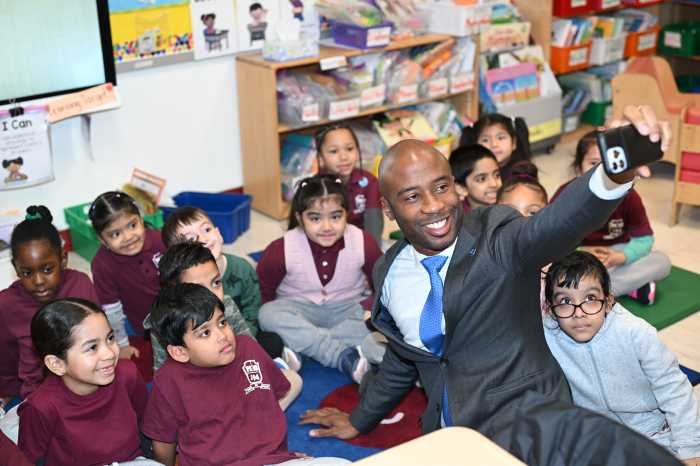
It was hardly a typical day at the Creo College Preparatory Charter School in the South Bronx.
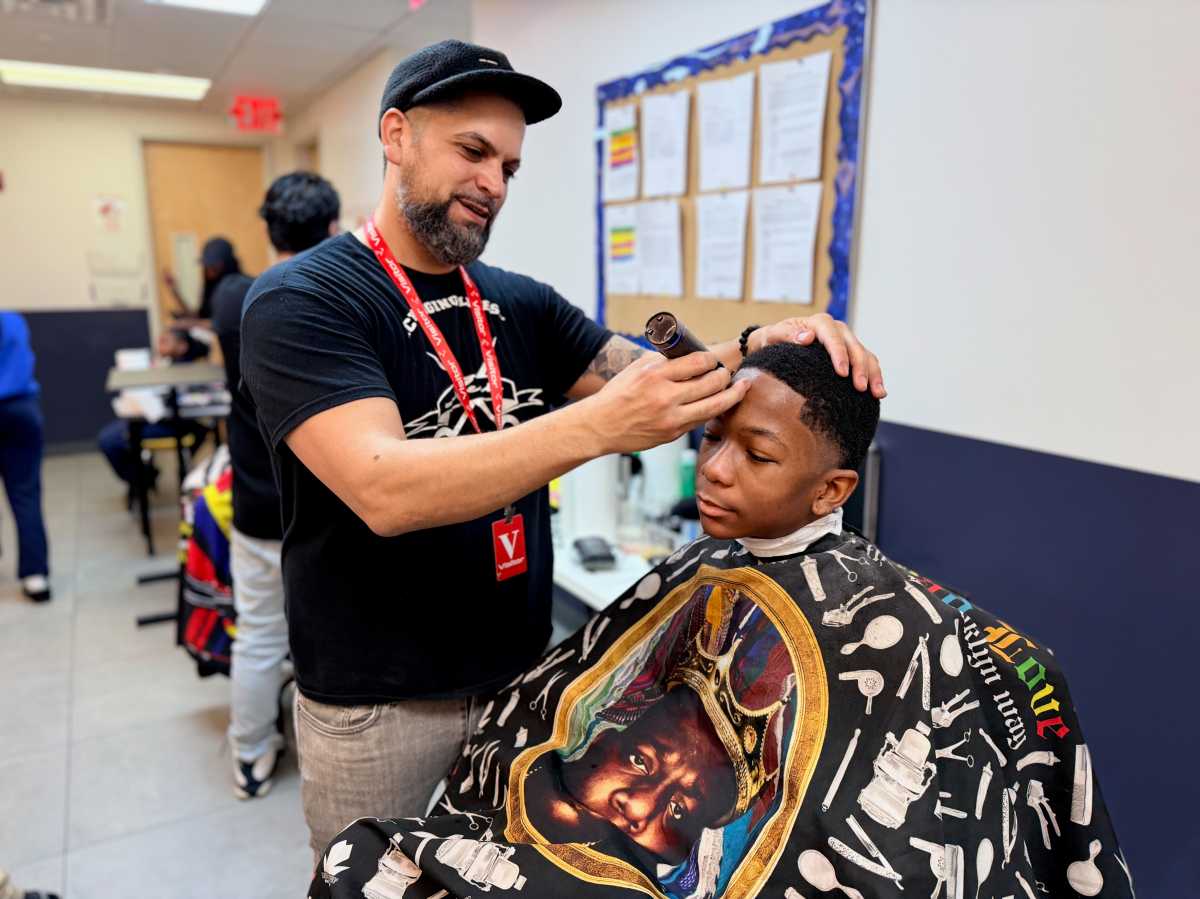
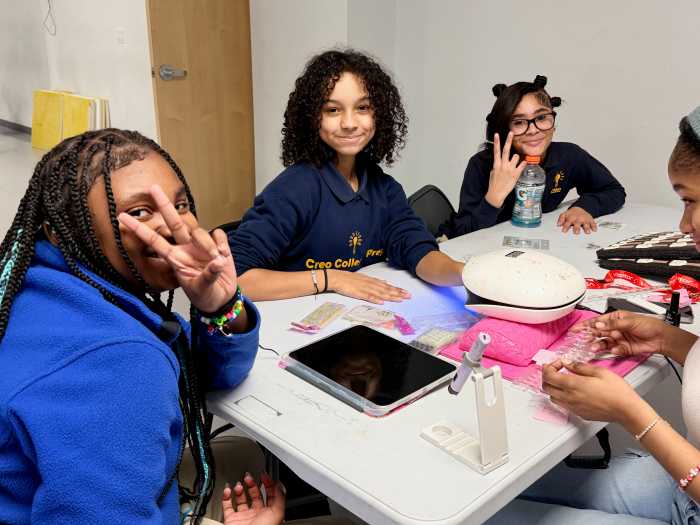
Following a day where students sat for hours, taking mock state exams, they were pampered by barbers and nail technicians, petted therapy dogs, sang karaoke, played video games and ate ice-cream.
“As adults, after we do a big, hard thing we reward ourselves,” said Benjamin Samuels-Kalow, the founder of Creo College Prep. “If we get a promotion, we might go on a vacation or treat ourselves to a haircut or go shopping.”
All of their students –not including those who had excessive absences– spent one day before break indulging in self care at a school that seeks to encourage responsibility as well as provide rewards.
“There are a lot of options,” said sixth-grader Madison, who enjoyed having her nails done and spending time with a dog. “After we do this, we go on break. It’s to send you out with a little care.”
Seventh-grader Logan enjoyed the video games and pets, while sixth-grader London enjoyed spending time with the dogs.
“They’re very loving,” he said. “And they cheer you up.”
Sixth grader Jovany found the self care day to be relaxing, a break from typical school activities and a way to refresh before the break.
“It’s calming,” he said. “It’s a way to show that your skin matters and how you should take care of your body.”
Creo College Prep has been beating the odds with students’ scores soaring as well as maintaining teacher retention.
While self-care day is one example of Creo College Prep’s winning strategy, it also gives interim assessments, where students take mock state exams.
“I think it’s helpful,” Logan said of mock state exams. “It shows you what to expect from the real test and things you learn earlier in the year.”
Jovany added, “You need practice so you know what to do in the real tests.”
Yet another student, Adams, took a practical approach. “Practice makes perfect,” he said. “It helps you understand what happens on the state tests later.”
Samuels-Kalow said the school acclimates students to tests by giving mock exams where scores aren’t calculated into semester grades. The idea is to take some of the fear out of testing.
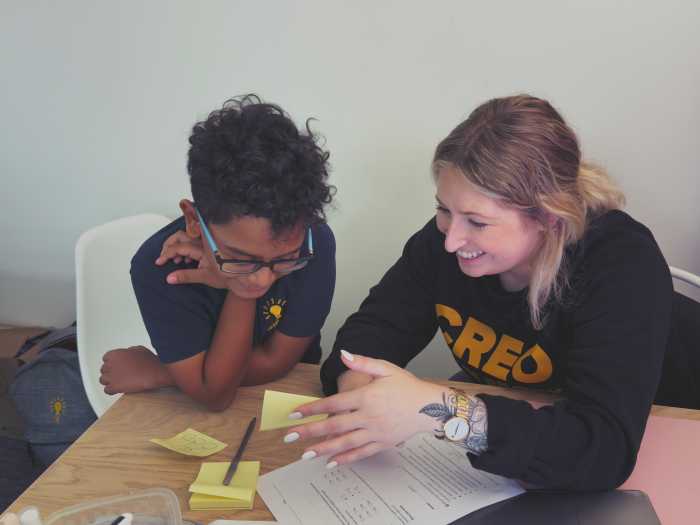
“If you do something a lot, it becomes less scary, but a way to show off,” Samuels-Kalow said. “When sports teams have scrimmages, they don’t complain to their coach that they’re having a mock game. It’s how they get better.”
Creo College Prep doesn’t cherry pick students based on high performance, but performance tends to rise.
“We get kids from 50 to 70 elementary schools,” Samuels-Kalow said. “The majority come in not reading on what the state considers fifth grade level or math. We have kids who can’t add in fifth grade or don’t know letters who are English speakers.”
The students typically leave their school at a very different place, seeing double-digit improvement rapidly.
According to the most recent data, 70% of Creo College Prep’s students have ELA test scores at or above grade level compared to 44% of the rest of their district.
“You know what’s cool about children’s brains?” Samuels-Kalow said, citing the power of belief backed by process. “If you tell kids you’re going to learn to read by the end of this year, they learn how to read.”
Samuels-Kalow said he created Creo College Prep based on a few basic principles on best practices of how to make education enjoyable.
“Learning how to read is not some magical thing,” Samuels-Kalow said. “It’s a teachable sequence of steps.”
Samuels-Kalow has spent his entire teaching career in the Bronx, but grew up on the Upper East Side and then the East Village before going to the University of Chicago.
Creating Creo College Prep
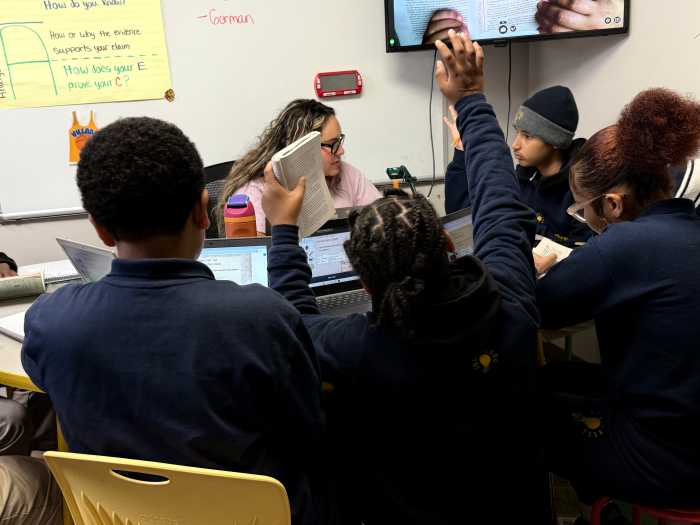
In 2012 he began working as a computer science and economics teacher at the Laboratory School of Finance and Technology, for 6-12 grades in the Bronx –just blocks from where he would open Creo College Prep.
Samuels-Kalow began a fellowship designed to create leaders in starting high achieving charter schools.
“For a year, I visited 50 high performing schools across the country,” he said. “They opened their doors and said take whatever works. There are aspects of this school we developed. A lot of the things that make this school work are learnable.”
In 2019, Samuels-Kalow started Creo College Prep, “Creo” was named after the Spanish word, “I believe.”
The school was a critical addition to the neighborhood where 60 to 70% of the population speaks Spanish as their first language.
“It was important for us to have the name of the school be in the language that the majority of our students speak,” Samuels-Kalow said. “If they can leave every day, saying, ‘Yo creo,’ I believe in myself, my neighborhood, we’re doing something right.”
Creo College Prep is a New York State Department of Education authorized charter school that Samuels-Kalow said was founded “to educate students to thrive in college and assume responsibility for identifying and solving problems in our community and world.”
They are a 501C(3) nonprofit audited annually with a board of directors who meets monthly, open to the public, with an $11 million budget for 360 students –a little less than traditional public schools.
Class sizes can get up to 24 and their curriculum includes college prep, coding courses, yoga and holistic classes, along with traditional subjects.
“Thriving in college is not just passing exams,” he said. “It’s having the resilience and passion to try new things and persevere.”
Burning interest not burning out

The tuition-free school has a longer school day and year than typical New York City schools, from 7:30 a.m. to 4 p.m.
Teachers teach English and math in the morning and other subjects in the afternoon, such as science, history, computer science, health and wellness. They can use the other half of the day to grade, look at data, talk to parents and give students feedback.
“50% of urban teachers leave the profession within five years,”Samuels-Kalow said about teacher burn out. “We’re at 90% retention. We need to make conditions where teachers and kids do the work we’re asking and we need to be thoughtful about designing.”
Students described the school as designed to be enjoyable but also that they are given a lot of responsibility.
“This is my first year here,” Riggins said. “They’re helping you understand, getting to the goals you need to get to. Goals can help you achieve what you want to be, what you want to do in life.”
Creo College Prep is showing that it can help students, helping lift scores and motivate their students without cherry picking.
“We get kids in fifth grade not performing at a high level,” Samuels-Kalow said. “We get 50 points of growth in English and math, outscoring the neighborhood schools in our district by large margins.”
The charter school’s first graduating class attended school in the basement of a Catholic school, growing 50% in ELA and 40% in math scores.
Their second graduating class, which did fifth grade on Zoom, grew by 52% in ELA and 54% in math with a 100% pass rate on the algebra Regents for the eighth grade.
Their third graduating class –the first to spend four years in the school– grew ELA scores by 56% and math by 53%, also with 100% passing algebra.
The word “Thrive” is written on classroom walls in capital letters with letters which stand for: Team, Hard work, Repeat, Ingenuity, Voice and Excellence.
“The school is cheerful,” said Adams, who has been at the school since April. “Before the tests, they say, ‘Are you ready?’”
What works at Creo College Prep
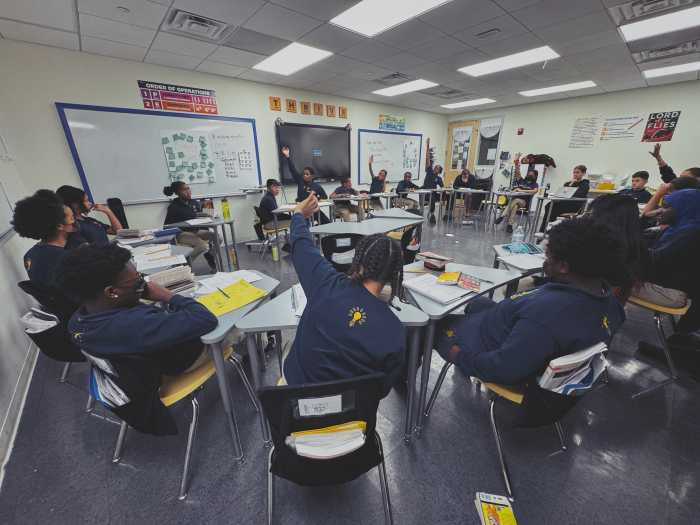
According to Samuels-Kalow, what makes the school successful is people working together towards one mission.
“I’ve worked in schools with an accumulation of talent, teachers doing their own thing,” he said. “This school is a bunch of people constantly in communication and coordination toward one goal, a school where kids are always safe and never bored.”
“What we do is reproducible. What we do takes consistency and effort,” Samuels-Kalow added.
Students are selected to enter the school through a random lottery in April with 96 seats.
“We practice, get ready, prepare our lessons, get up in front of each other and teach and get feedback,” Samuels-Kalow said. “School shouldn’t be an unpleasant activity. You put in hard work. You get to use your intellect, have joy. Those things are connected.”
As students greeted him while we walked through the hall, Samuels-Kalow began talking about how he greets students every morning. “I had a kid yesterday,” he said. “I greet him every day in the morning with a fist bump.”
That student, Samuels-Kalow added, has test anxiety. Yet, he had great news he couldn’t wait to tell the student.
“You got the highest score you ever got, crush it today,” Samuels-Kalow said, believing confidence is contagious. “He kept his head up and did his test.”