
Bronxite Joshua Cartagena, 29, identifies as neurodivergent. The non-medical umbrella term encompasses a wide spectrum of behavioral and psychological conditions which include, but are not limited to, Attention Deficit Disorder, dyslexia and autism.
For Cartagena, Tourette’s has been a lifelong struggle, a disorder characterized by vocal and bodily tics. In 2022, he had a pacemaker implanted in his brain to help with the tics, but when he’s on stage, they all seem to melt away.
“I would explain my Tourette’s as really difficult, but when I perform, it’s like a different me. I don’t do my Tourette’s when I’m singing or acting or dancing,” he told the Bronx Times.
Cartagena’s love for performing started in fifth grade while taking keyboard lessons in school. The lessons then evolved into duets which sparked an interest for Cartagena. The following year, he performed in a school production of the rock-musical, GREASE and caught the acting bug.
He continued in school plays and then went on to join the Mama Foundation for the Arts in Harlem where he met several celebrities, including one of his personal heroes, Billy Porter. However, Cartagena quickly realized gospel was not for him, a large focus of the foundation and joined EPIC Players in 2022, a non-profit theatre company highlighting neurodivergent and autistic artists in NYC and Los Angeles since 2016.
In his latest project, running through June 20, Cartagena takes on a dream role, playing Angel in the EPIC Players production of “RENT.”

“RENT is ultimately about finding your people and building community and that’s exactly what our artists do every day at EPIC,” Aubrie Therrien said, the company’s founder and artistic director.
Written by the late Jonathan Larson, RENT, received a Pulitzer prize for drama in 1996. The musical follows a group of friends living in Manhattan’s Lower East Side who meet through chance encounters. Themes focus on sexual identity, drug addiction, death and the burgeoning AIDS crisis of the time, all while dealing with the timeless and pervasive issue plaguing nearly all New Yorkers – rent.
Among the central cast of eight characters is Angel Dumont Schunard, known simply as Angel, a transgender busker living with AIDS in NYC.
“This body provides a comfortable home, for the acquired immune deficiency syndrome,” Angel tells Tom Collins (played by Cameron Walker) after offering him a bandage for the busted knee he acquired after a recent violent mugging.
Softened by Angel’s candor and sympathy, Collins admits he too carries the virus.
The audience meets Angel as a kind and caring individual, but also as a no-nonsense diva, shunned by society and jaded by the streets of the concrete jungle.
“I love Angel so much that I’ve been been training for it. Like, I will never forget me going to the gym, because you know, Angel’s fit, and I would say to myself, ‘You have to work hard for this role,’ Cartagena said. “I even came in full drag [for the audition.]”
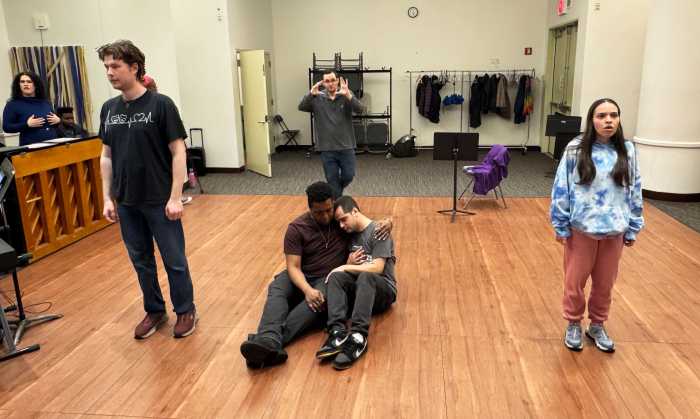
Cartagena tends to over sympathize with the characters he plays, often finding himself in tears while rehearsing for the role of Angel, identifying with her traumas and feelings of “not being enough.”
“I used to cry a lot every time when it comes to Angel, like, as an actor, and I learned that no matter what, it’s okay to cry and let it out, but Angel is just the character,” he said. “I don’t have to put my shoes in her shoes.”
The moment harkened a memory of Cartagena’s own feelings of rejection when he auditioned for a special performing arts college and was accepted with a scholarship. He was over the moon, until it was ripped way.
“I got into the school, I got into orientation, they knew I had a learning disability, they knew I graduated with an IEP [individualized education program,]” he said, not wanting to publicly disclose the name of the school. “After orientation finished, and I did my whole placement job, they said, ‘Joshua, we cannot have you here anymore,’ and that destroyed me because I didn’t get the chance to share my personality.”
Neurodivergent individuals often face social and professional rejection. According to a 2023 study, youth with physical tic disorders experienced discriminatory environments in school and work, and limited availability of community services and healthcare access, as do those with autism.
Due to either real or perceived stigmatization, neurodivergent people may feel pressured to mask, where they – either consciously or subconsciously – work to suppress their unique quirks and behave in line with social norms.

While the experience deterred Cartagena from pursuing a college education, it motivated him to work harder towards a career in musical theater, while looking up to pop singer Billie Eilish as a role model. The GRAMMY-award-winner disclosed her Tourette’s Syndrome via Instagram in 2018 when she was in her early 20s, despite being diagnosed at age 11.
“She taught me that if she can do it, I can do it, and that’s what I want to relay, the message to other people that that doesn’t stop us from what we have and what we do,” Cartagena said.
While several celebrities and media personalities have neurodivergent diagnoses – like Public Advocate Jumaane Williams with Tourette’s and environmental activist Greta Thunberg with autism – representation and public awareness is still few and far between.
“ I think for a long time, this gap in understanding or this gap in community building has kept folks separate from each other in a way of limiting power and limiting community and limiting advocacy that is almost intentional disenfranchisement,” Cassidy Kaye said, who began as an intern at EPIC after earning her Master’s degree in educational theater for communities.
She is also the nonprofit’s executive program assistant and co-director of RENT.
“I think we’re going to need to rely on creative problem-solving and the tenants and the power of the arts to bridge that gap.”
Through June 20, the EPIC Players bring their neuro-inclusive retelling of RENT to the stage at the A.R.T/New York Theatres in Manhattan to a neuro-inclusive audience.
Not only will there be ADA-accessible seating, but also fidget toys, noise-cancelling headphones, quiet zones, ASL interpretation and captioned performances, as well as a relaxed theater environment where individuals can vocalize and move around as needed.
Reach ET Rodriguez at etrodriguez317@gmail.com. For more coverage, subscribe to our newsletter and follow us on Twitter, Facebook and Instagram!