A couple from Hunts Point is leading an effort to address the Bronx’s significant lack of dedicated performance venues and third spaces compared to other boroughs.
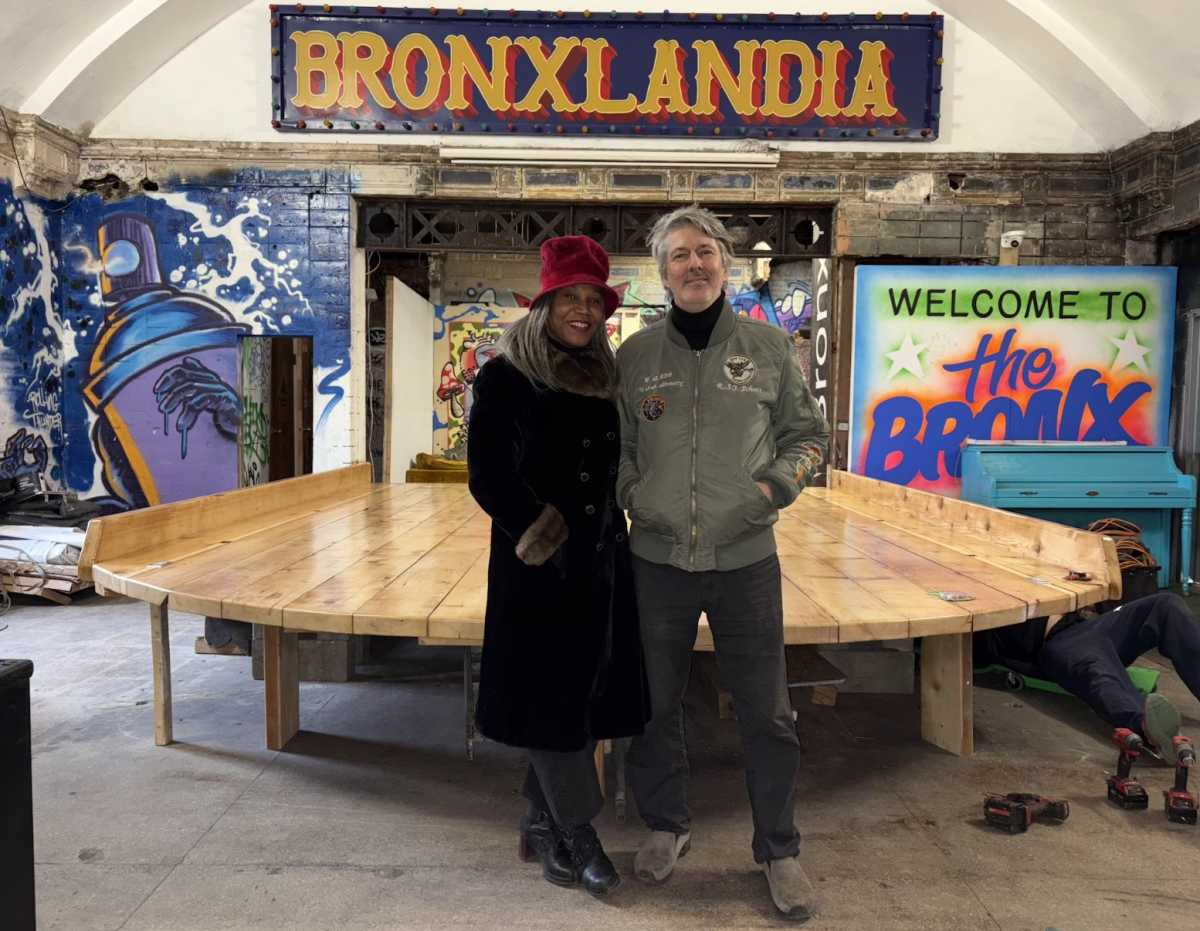
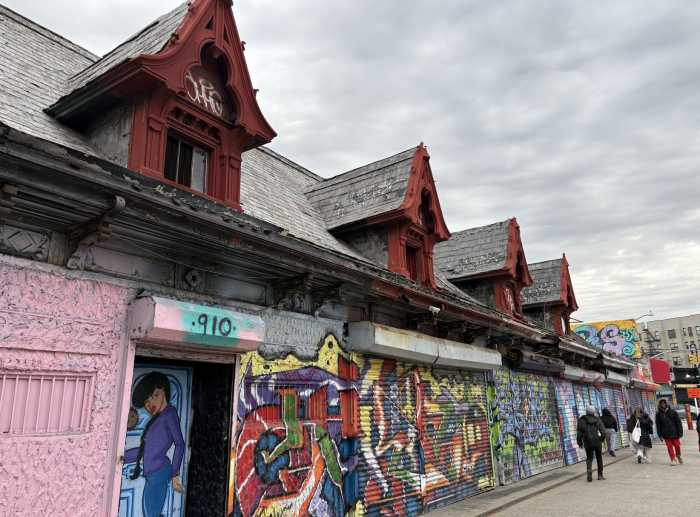
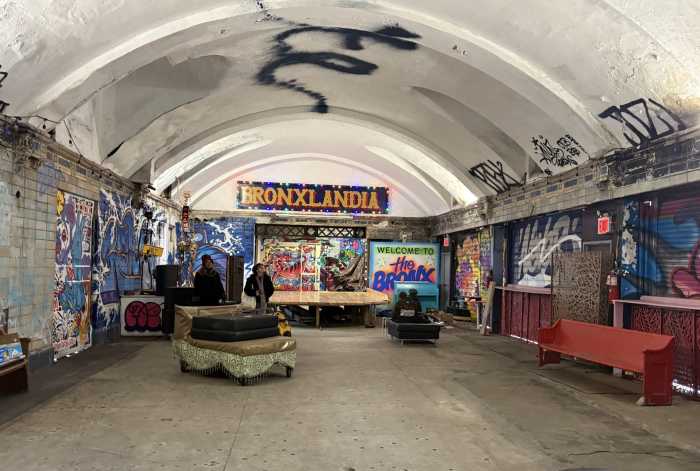
Majora Carter and James Chase founded Bronxlandia, a multi-use event space and former rail station, after recognizing a need for local Bronx residents to have spaces to showcase their talents and build community.
After purchasing the former landmark from Amtrak in 2016 for only $1, the couple began renovating the long empty space and started running events in late 2021.
Carter, a real estate developer and urban revitalization strategy consultant who was raised in Hunts Point, has spent years thinking about what it means to invest in community without displacing it.
“You go to these places [in Brooklyn] and there [are] bars and stores and fun and people on the street all the time having a blast,” Carter said in an interview with the Bronx Times. “And it was like, I want that, but I want our community to also be a part of it.”
Bronx residents suffer from a lack of “third spaces,” or locations outside of work and home where community can be fostered.
Bronxlandia aims to fill the gap, but before opening up the space to local clientele, the couple tested their ideas by launching Boogie Down Grind in 2019, a cafe designed to be more than just a place to grab coffee.
Affectionately known as “The Grind,” the cafe hosts multiple events each month such as comedy nights every Wednesday and open mic nights featuring different poets once a month on Fridays.
“We discovered that through the cafe, a good number of our customers and some of our employees are performers, and whenever we go to see them, it’s never in the Bronx,” Chase said.
“And then you hear young people in the cafe [saying] they just met this cool person on the train coming back from Brooklyn [even though] they don’t even live that far from each other, and they’re travelling an hour to get to not as cool a place,” he added.
Once the couple recognized that there is much talent emerging from the Bronx, they began thinking about the lack of resources preventing these individuals from reaching their full potential and prompting them to seek opportunities elsewhere.
“As community developers, we always wondered what was making people love or wanna leave their community,” Carter said. “We started thinking about our own community and how so many people feel like we should be measuring success by how far we get away from our community, and I grew up here.”
For Carter, the work has always been personal. When she was in high school, she had the mindset of escaping the Bronx, leaving the borough for better opportunities. It wasn’t until after graduate school that she learned to love her neighborhood.
“When you realize this is where magic, art, community and revolution happen, you need to be building these spaces here to give people reasons to stay,” she said.
Despite being the birthplace of hip-hop, the Bronx has a long history of being neglected and underfunded.
New York’s 15th congressional district, which represents the southern portion of the West Bronx and the South Bronx, is the poorest congressional district in the U.S. The area’s history explains why spaces like Bronxlandia and The Grind have been slow to develop.
In the 1970s, New York City faced a severe financial crisis caused by a combination of factors including a decade-long accumulation of debt, white-flight and high spending on social services.
According to the Bronx River Alliance, during that time, Bronx landlords were paying arsonists to burn their buildings for the insurance money and purposely letting properties decline because they were not being held accountable by the city.
According to New York State Environment and Health Data, redlining also played a major role in the devaluing of neighborhoods in the Bronx.
Areas like Mott Haven, Melrose, Morrisania and Bellmont, among other areas, were labelled hazardous or declining, leading to housing segregation and limited access to loans and home ownership in more desirable neighborhoods for people of color. This practice kept many residents from achieving long-term financial stability.
In addition to destroying homes, frequent fires also wiped out existing music venues.
90% of housing units were lost in the Bronx between 1970 and 1980 due to fires. With that, greedy brokers, landlords, fires and neglect became a regular occurrence in the borough.
Among burnt out buildings, however, creativity rose as both a coping mechanism and a form of expression.
Hip-hop icons like Melle Mel, Grandwizzard Theodore, DJ Kool Herc and Cindy Campbell emerged from this period of urban neglect, shaping a genre that would go on to influence the world.
Despite this legacy, the Bronx has not fully recovered from its fiery past, and continues to lack large performance spaces to house underserved communities and emerging talent.
“I feel like the lesson should have been learned now,” Chase said. “For 40 years now, this type of stuff has just been going on and on and nobody is even putting their toe in the stream to divert it at all.”
Carter, who also founded Sustainable South Bronx, a nonprofit that addresses environmental, economic and social concerns and published a 2022 novel called “Reclaiming Your Community,” has long worked on environmental justice and economic development, but she said the arts played a key role in shaping her approach.
Carter shared that she originally went to grad school for film then switched to creative writing hoping to write a novel and direct her own screenplay someday.
She eventually moved back home to live with her parents in Hunts Point after being unable to afford student housing and got involved with the Bronx WritersCorps, the Bronx chapter of a 1994 program and a project of the Bronx Council on the Arts, leading her to meet inspiring creatives in her own neighborhood.
When she found out that the city was planning to build a large waste facility by the waterfront, she became indignant.
“It’s because we are a poor community of color and nobody cares, especially our city and state,” Carter said. “They think that we are not going to notice this and I flipped out, but it was the arts that got me here.”
This prompted Carter to realize that, despite her newfound community, a career in the arts could not tackle these systemic issues and wouldn’t support her current work toward environmental justice.
“We took that experience of feeling like they’re treating us this way because they don’t see any value in us, [but] there is so much value in this community, we just have to show them,” Carter said.
Carter has since shown over the years how investing in community brings results.
And Bronxlandia, one of the many projects Carter has invested in which now hosts numerous monthly performances, pop-ups and art installations and has featured talent like French Montana and Sexyy Red, is just the first phase of a larger plan according to Carter.
“We really do strive for the same level of positive cultural entertainment activity that Queens and Brooklyn enjoy,” Chase said about Bronxlandia.
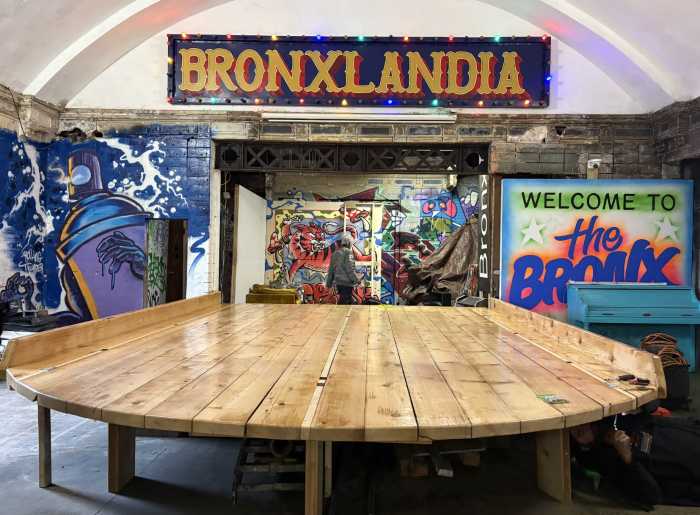
“We have a real professional performance space here, with a liquor license and a full sound package. When you come here there’s musicians, there’s plug and play. More importantly, people who want to be live event production professionals need a low risk place where they can do that, and we can provide that,” he said.
Both Carter and Chase have experienced the gap of cultural inequality firsthand. When reflecting on the Bronx’s history, as well as their own experiences, the couple explained how the name Bronxlandia came about.
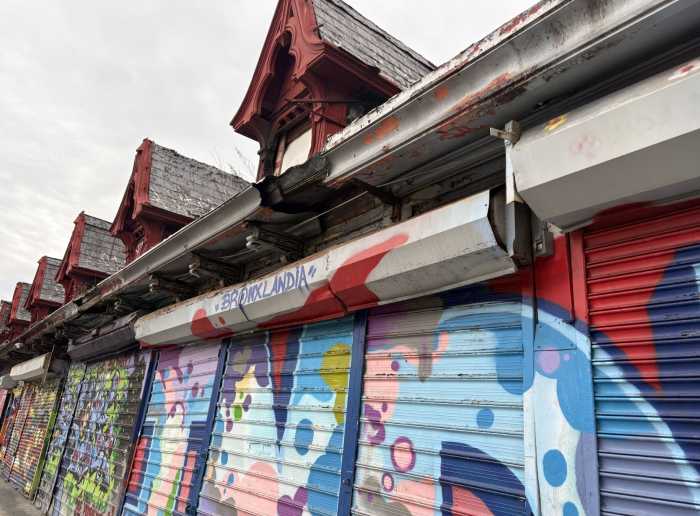
“We wanted a name that is uniquely ours,” Carter said. “Not too far from here, there was an amusement park called Bronx Land, and James spent a lot of time in South America, [where people] would call America ‘Gringolandia.’ I loved it, and it’s also a nod to our Latino and Latinx neighbors, and the show Portlandia.”
The couple’s decade-long project still remains a work in progress.
“We’re actually below the poverty line,” Chase said. “These places don’t return anything [financially] for years, but they’re just so much fun.”
“We keep getting discovered every day,” Carter said.
“The people that love us, love us. We don’t get a whole lot of traffic, but we started this as a labor of love in response to what we perceived was a community need.”