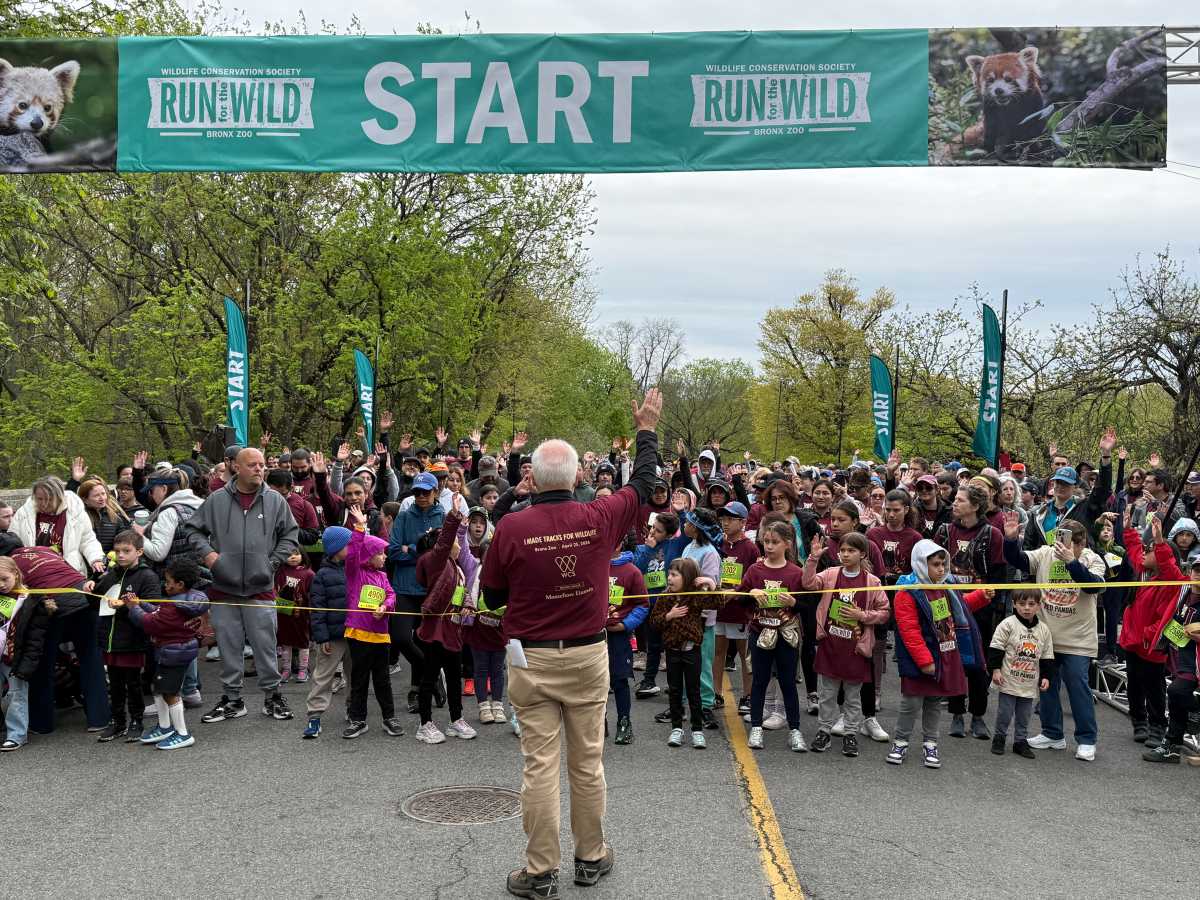
On a rather chilly and gloomy morning last Saturday, more than 5,700 runners and walkers flooded the Bronx Zoo for the 18th annual Wildlife Conservation Society (WCS) Run for the Wild — marking the largest turnout in the event’s history, and a testament to how deeply New Yorkers care about conservation.
This year’s Run for the Wild, which features an endangered species every year, was dedicated to the red pandas, a species native to the Eastern Himalayas and southwestern China with fewer than 10,000 remaining in the wild. Participants completed either a 5K race or a 3K family fun walk through the zoo’s 265-acre grounds.
After the run, the participants enjoyed all-day admission to see more than 11,000 animals — including the red pandas themselves, viewable at the Bronx Zoo’s Himalayan Highlands exhibit.
John Calvelli, Director of Public Affairs at the Bronx Zoo, was there when the idea of a run for animal conservation was first born. “This was an idea that 18 years ago, I was actually involved in the first one,” he said. “I was pushing for a Walk for the Wild. Thankfully, somebody said, ‘No, that’s horrible,’ and we got to call it Run for the Wild.”
What started as a hope to attract 1,000 participants has grown significantly. “This year, we have 5,700 people,” Calvelli said. “It is just an amazing statement of people’s love for wildlife, people’s love for nature.”

Why Red Pandas?
Craig Pipero, the WCS’s Director of Conservation, opened the family 3K walk with a rallying call: “Conservation isn’t a sprint. It’s a long term commitment,” he told the crowd. “Every one of those 4,000 steps you’re going to take today is a step to help pandas.”
Piper shed light on just how unique red pandas are. Despite their name, they share little with giant pandas. “Scientists have debated over the years how to classify them,” he told the Bronx Times. “When you start to look at really scientific differences in their body structure and when we start doing DNA analysis, the taxonomy completely changed. In the most recent times, red pandas are in their own scientific family all by themselves.”
Their physical adaptations are equally remarkable. “They spend most of their time in trees, and the way their wrist bones are developed for flexibility allows them to go up and down trees in either direction. They’ll come down a tree head first, which most animals won’t do,” Pipero said.
But the species faces serious threats. Habitat loss from deforestation, agricultural expansion, and poaching have pushed red pandas to endangered status. WCS has been working to protect them and their habitat in China and Myanmar since 1910, with over 115 years of on-the-ground conservation work.
“If you save this iconic species, you save a lot of other species too that aren’t as well known,” Pipero said.
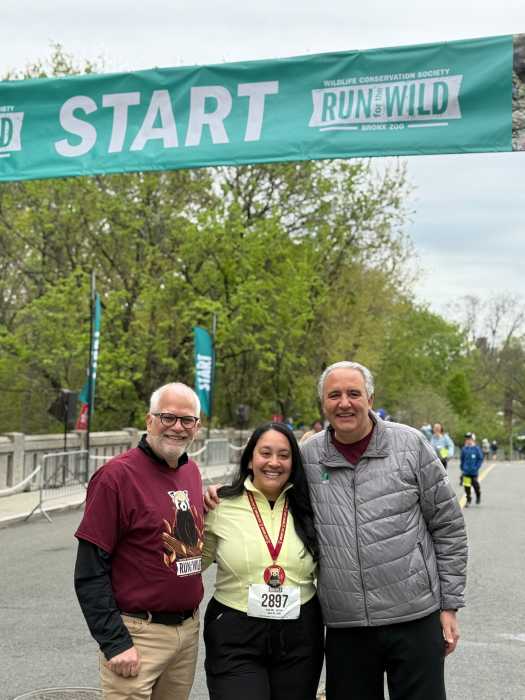
A diverse community of runners and walkers
Among the runners of the 5K is Jessica Stahmer, a 34 year-old Bronx resident and nine-year zoo member. She ran the 5K for the second year in a row.
“I’m really proud that we have a world class zoo 10 minutes from where I live,” she said. “It’s one of the reasons I love living in New York.”
City Council Member Amanda Farías, who also completed the 5K alongside her boyfriend, who is a runner, said she participated because, “Anything around conservation of certain species that are endangered. It’s like our duty”.
Farías also called on city and state leaders to put resources behind that mission. “Funding is where it’s at,” she said. “We need to be able to put our money and our wallets in the right places.”

For YouTuber Casey Neistat, who chaperoned his seven-year-old to the walk with his classmates, the Bronx Zoo holds personal memories: “The Bronx Zoo was one of the first places I visited when I was a little kid on a school trip,” he said. “I didn’t grow up in the city, so my earliest childhood memories of coming to New York were to come to the Bronx Zoo. So it’s fun to bring my little ones here.”
And for seven-year-old Theodore Stromstedt, who completed the walk with his father Christopher, the lesson of the day was already sinking in. Asked what he knew about red pandas, he didn’t hesitate: “They climb a lot. They move their ankles a lot when they climb down trees.” Asked if that made him want to protect them, his answer was simple: “Because they’re so cute.”
For those inspired to get involved with wildlife conservation, Pipero’s advice was straightforward: reduce waste, support clean water, use public transit, and raise your voice with political leaders to protect wild spaces. “All those little steps that each individual takes,” he said, “they add up to really big change over time.”
Carol Chen is a student at the Craig Newmark Graduate School of Journalism. For more coverage, subscribe to our newsletter and follow us on Twitter, Facebook and Instagram!