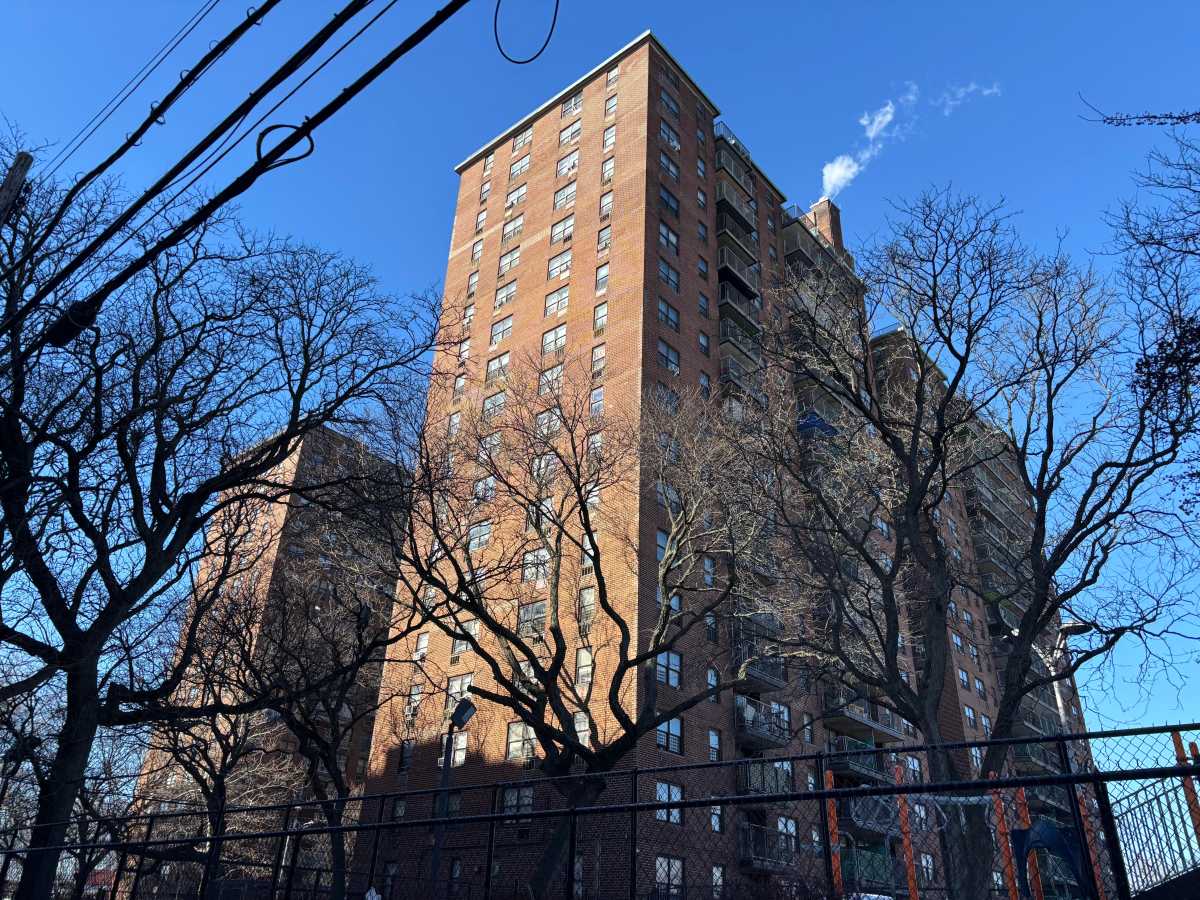
Mitchell-Lama housing across New York was created in the 1950s to provide affordable rental homes and ownership opportunities. But for many in the Bronx and the rest of New York City, the dream of keeping their New York City home for the long run is slipping away.
According to state Comptroller Tom DiNapoli, the Mitchell-Lama program and its more than 45,000 New York City households are suffering due to a lack of proactive oversight and support by the city and state.
DiNapoli has audited multiple Mitchell-Lama properties across the state and found that many residents are living in hazardous conditions that the oversight agencies —the state Division of Homes and Community Renewal (DHCR) and city Department of Housing Preservation and Development (HPD)— failed to prevent or remediate.
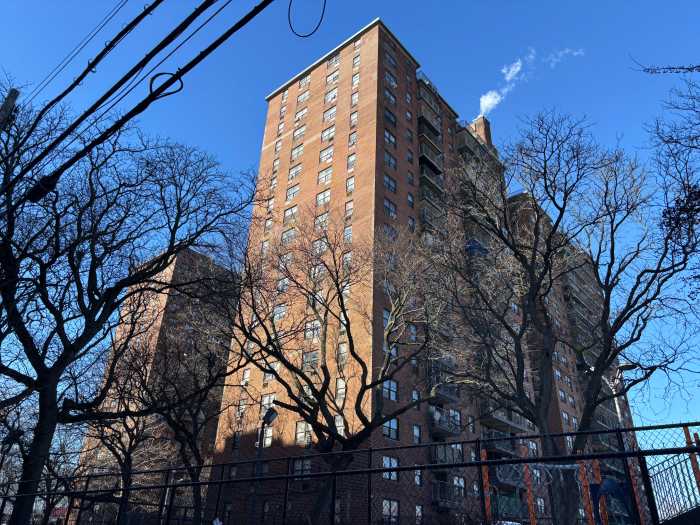
For instance, at Evergreen Gardens in Soundview, residents told the Bronx Times about extensive mold, cracked plaster, rats, non-working appliances, holes in the exterior walls and other problems at the property following a comptroller’s audit released in January.
And less than two miles away at Jamie Towers, mismanagement has run rampant, with shareholder board members saying the state has provided little help despite being the designated oversight agency. The comptroller is currently auditing the development.
In a statement sent to the Bronx Times, the Division of Homes and Community Renewal said it has “a limited role in overseeing the day-to-day management of Mitchell-Lama housing, which is privately-owned and managed. HCR, within its limited statutory authority, is working diligently with Mitchell-Lama housing companies to invest nearly $500 million in state funding for critical repairs, offering direct technical assistance, and implementing several changes recommended in a previous audit by [the comptroller].”
Caught in the ‘negative feedback loop’
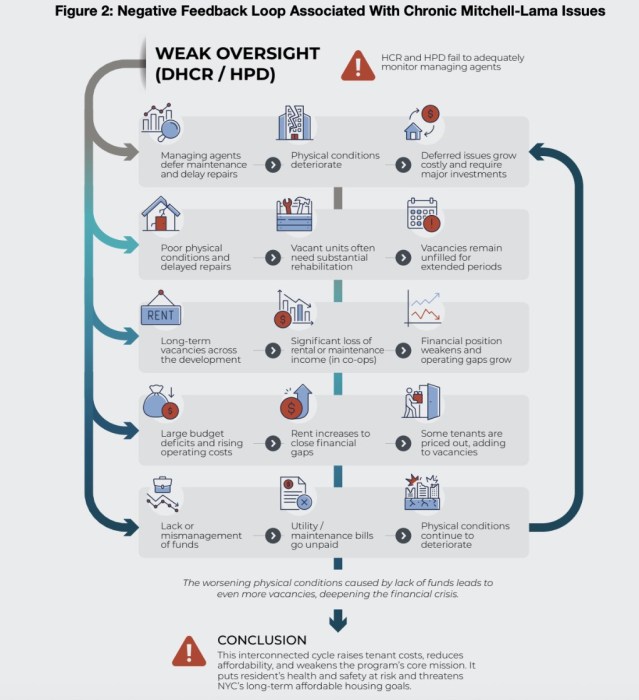
But the comptroller has repeatedly called out HPD and DHCR for “weak” oversight of Mitchell-Lama managers.
The agencies “have not developed the controls, including monitoring of managing agents, necessary to ensure funds used for the developments’ operations are spent efficiently and effectively,” the office wrote in a March 2026 report.
As a result, Mitchell-Lama’s problems — long-term vacancies, hazardous conditions and poor fiscal health — remain in a “negative feedback loop.”
The comptroller said the state has made significant recent investments in Mitchell-Lama, including tax abatements and $440 million in capital appropriations. “But in order for these investments to meaningfully contribute to the improvement of Mitchell-Lama housing, the state and city must improve transparency, enhance reporting, and better monitor and enforce maintenance, financial and other standards.”
Jamie Towers residents have felt this “negative feedback loop” acutely.
In mid-2025, their management company, Maxwell-Kates, opted not to renew its contract after the shareholder board discovered that staffers had spent at least $16,000 of the corporation’s funds on goods and services unrelated to property management, including designer eyeglasses and auto parts.
This wasn’t even the first time such misspending occurred at Jamie Towers. Before Maxwell-Kates, the board fired First Residential for the same reason.
To board president Maxine Breeden, these repeat problems were no coincidence. She told the Bronx Times in August 2025 that a small number of management companies just cycle through different Mitchell-Lama properties because they “knew there was no oversight.”
“What the f—k is limited oversight?” she said at the time.
State Sen. Leroy Comrie of southeast Queens has tried to fill that gap, calling for an independent watchdog for Mitchell-Lama complaints — similar to the Ombudsperson Call Center for NYCHA residents.
Comrie has repeatedly introduced a bill to add an independent watchdog to Mitchell-Lama that would be “empowered to receive, investigate, mediate, hear, make findings and recommend action, and make a decision on complaints against landlords, managing agents and co-op boards.”
The bill states that Mitchell-Lama residents, whether overseen by HPD or DHCR, have no unbiased source for complaints. In the case of DHCR, while it has a process for taking complaints, “there are no procedures established for findings, recommendations, decisions and appeals. As a result, the DHCR ‘complaint process’ is useless to the residents.”
But Comrie told the Bronx Times that although many lawmakers agree on the need for Mitchell-Lama reform, his bill is likely headed nowhere.
As in the four previous sessions, his oversight bill remains stalled amid “major pushback” from Gov. Kathy Hochul, who he believes doesn’t support it, he said.
In response to the Bronx Times’ inquiry, Hochul’s office said that she would review any bill that passes both houses of the legislature and would not comment on whether or not she supports the concept of adding Mitchell-Lama independent oversight.
Comrie said the city must build new housing while preserving the old. “Every third person who comes in my office is looking for housing,” he said. “I think Mitchell-Lama residents need to be protected as much as possible.”
A looming fiscal cliff
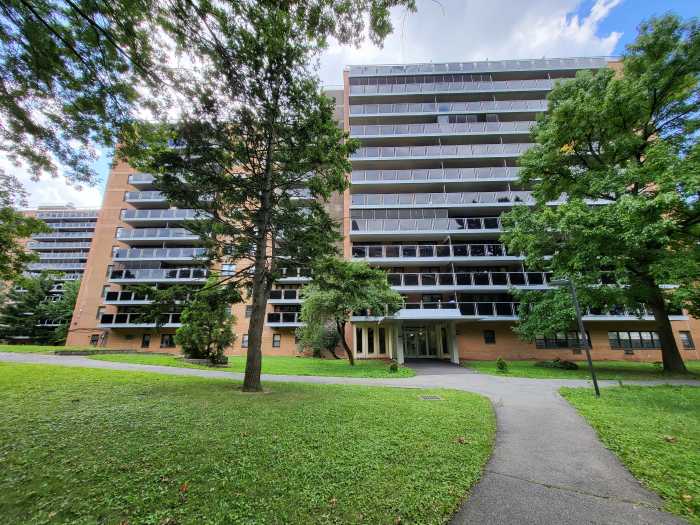
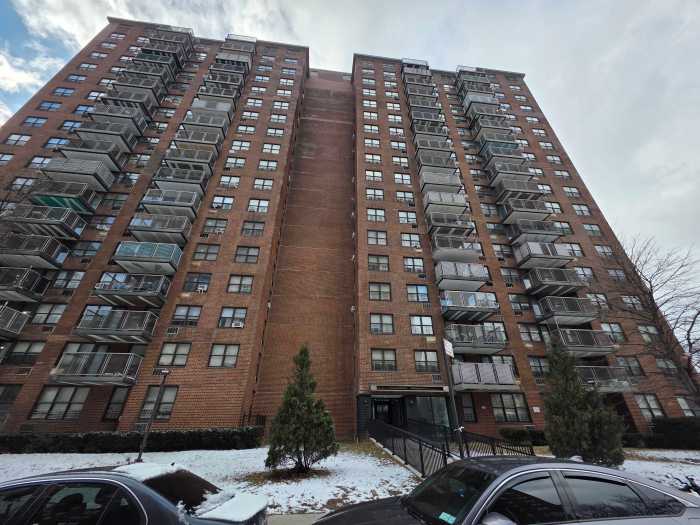
Jamie Towers’ four buildings and 620 units are currently operated by Metro Management, which took over in August 2025. The Bronx Times called the firm multiple times but did not receive a response in time for publication.
While residents were hopeful that Metro Management would turn things around, some say it only seems worse.
A site visit by the state comptroller’s office in February 2026 found that Jamie Towers has at least 60 vacancies, 40 of which require “a massive restoration,” according to documents obtained by the Bronx Times.
Management also owes as much as $100,000 to some vendors but also has no plan to address rent or parking fees that tenants owe, the report said. With 123 households owing more than two months’ rent, the corporation is losing money by the day, according to the report.
The auditor also identified on the property more than 20 nonfunctioning security cameras, dim lighting, sidewalk cracks posing trip-and-fall hazards, “pooling water” on the roofs of two buildings and only one security guard for four buildings. Now, even the one guard is gone, residents told the Bronx Times.
Jamie Towers also appears to face a major financial cliff in the coming years.
Despite charging a 40% monthly maintenance increase ($371.99 per room) since May 2024, the development still has a total net operating loss of $20 million as of March 31, 2025, according to records obtained by the Bronx Times.
Records also show that the current mortgage with Wells Fargo will come to maturity on Feb. 1, 2027, at which time the corporation will owe the remaining principal and accrued interest — totaling $23.3 million.
‘The spirit is dead’
Phyllis Gray, a Jamie Towers resident for close to 40 years and former board member, said she is tired of the corporation being “mismanaged and ripped off.”
Gray said the tree-lined property was once a beautiful and thriving property and even had a large swimming pool. But now, the pool has been closed for years, there’s no music in the halls and no nice smells of home cooking, she said. “The spirit is dead, and it’s really sad.”
Shareholders and the manager met on May 13 to discuss concerns about the state of Jamie Towers. But flyers only went up a day in advance, and many residents have checked out of the drama, Gray said.
Management also said too many residents were in arrears, which Gray characterized as pitting people against each other. Many residents are seniors on fixed incomes and are unable to pay, not withholding out of protest, she said, adding that management has posted embarrassing notices on some residents’ doors.
Amid all the stress, Gray said the oversight agency DHCR is providing “no guidance.”
She said the state should be going after Maxwell-Kates and First Residential to recover misspent funds, aggressively pushing current managers to fill vacancies, pushing potential newcomers to the front of the line, and helping to unlock government grants — including funds already allocated by elected officials that the corporation cannot currently access.
“We are in the sticks because the state has allowed us to be mismanaged,” Gray said.
Still, she vowed not to give up hope. Gray is talking to neighbors, contacting elected officials and setting up a committee to conduct a detailed census of vacancies, including the size and condition of empty units and how long they have been unoccupied.
“I’m not just about throwing in the towel. We need to fight for where we live,” Gray said.
Read more from our series, “Our Forgotten Borough.”
This story was updated May 28 at 10:45 a.m. to reflect that Maxwell-Kates opted not to renew the contract at Jamie Towers rather than being fired by the shareholder board.