It started as a phrase blunt enough to make his grandmother “roll over in her grave.” Now it’s becoming a policy. Two weeks into his term, Council Member Justin Sanchez is already delivering on the phrase that defined his campaign, “Clean the damn streets.”
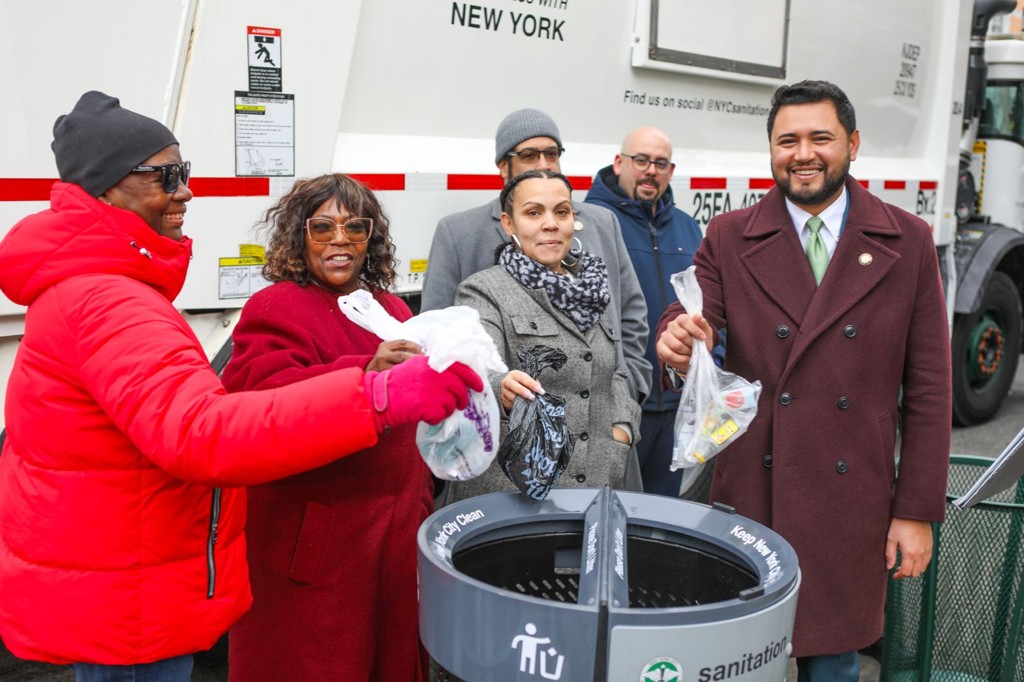
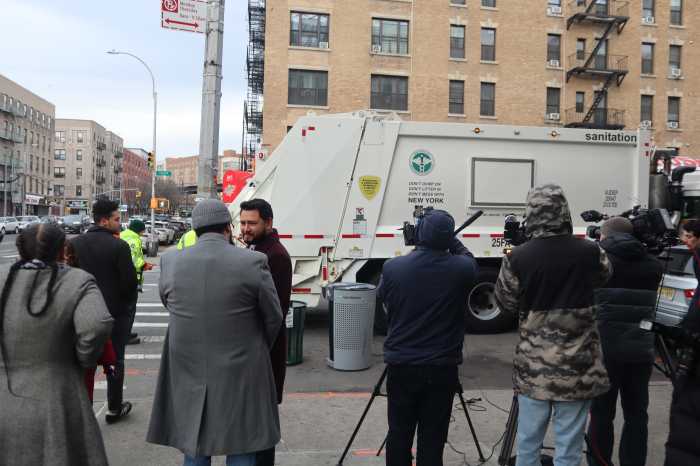
Standing at the corner of East 163rd Street and Intervale Avenue in Longwood, on Thursday, Jan. 15, Sanchez addressed residents, sanitation officials, and community leaders to announce the installation of more than 60 new street trash cans across District 17 – an early, visible action meant to fulfill the promise that powered his campaign.
“I represent the 17th Council District of the South Bronx, a place I’m proud to call home,” Sanchez said.
“The first thing you learn about growing up here in the South Bronx is that your environment shapes how you feel about yourself.”
For Sanchez, the absence of something as basic as a trash can is not a minor quality of life issue but a reflection of how communities are valued. What residents see on their way to school, to work, or to the corner store quietly communicates whether they are seen, cared for, or overlooked.
“In the South Bronx, litter is something that we see, that we touch, that we feel every single day,” he said.
“It’s on our sidewalks, it’s at our bus stops, it’s outside our homes and businesses. And when garbage piles up, it sends a message.”
Over time, Sanchez explained, that message erodes more than just physical space. Chronic litter affects mental health, physical health, and how residents perceive their own neighborhoods and how others perceive them too.
It was a central reason he ran for office on a platform grounded in neighborhood pride, representation, and dignity.
“Here in the South Bronx, dignity starts with four simple words: clean the damn streets,” Sanchez said. “That’s not a slogan, it’s a standard.”
Those four words, he said, were with him everywhere during the campaign: on doorsteps, at bus stops, outside bodegas, and on block corners all across the district. For voters, this wasn’t abstract policy; it was their daily reality. And now, Sanchez said, it was the government’s job to respond.
“This is one of the simplest ways to show that the government can actually work for you,” he said.
Even though he’s only been in office for two weeks, Sanchez told the Bronx Times that he intends to follow through on the promises that got him elected.
The new rollout includes more than 60 new trash cans placed throughout the district, many along corridors that previously went blocks without a single place to dispose of trash. Sanchez described the initiative as a starting point rather than a cure-all.

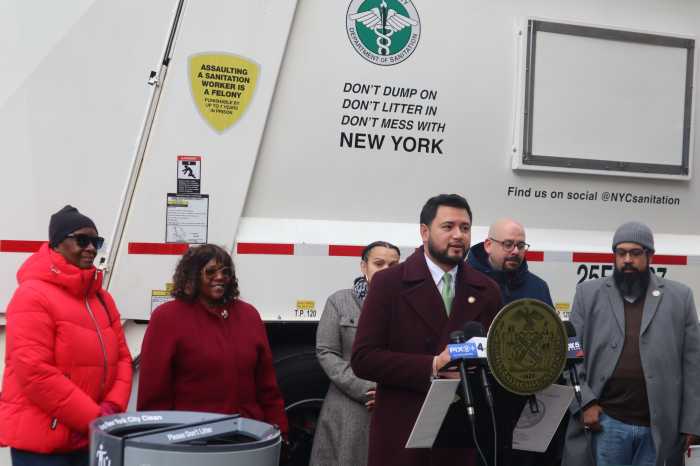
Sanchez was joined by representatives from the Department of Sanitation, business improvement districts and community boards. Many emphasized that sanitation is foundational to nearly every other quality-of-life concern — from public health to economic vitality.
Javier Lojan, acting commissioner of the Department of Sanitation, emphasized that the effort was part of a broader strategy to allocate resources more efficiently while working within existing service routes.
Most of the new trash cans, Sanchez later confirmed, are being placed along routes already maintained by sanitation crews, allowing the department to sustain service without major disruption while planning for future expansion in the next fiscal year.
“We’re working with what we have available,” Sanchez said, “and coming next year, we hope to expand on what we’re already doing.”
The city currently maintains 23,000 corner litter baskets across all five boroughs, according to Vincent Gragnani, press secretary for the Department of Sanitation. Over time, baskets go missing and a survey of the Bronx identified several areas that should have more.
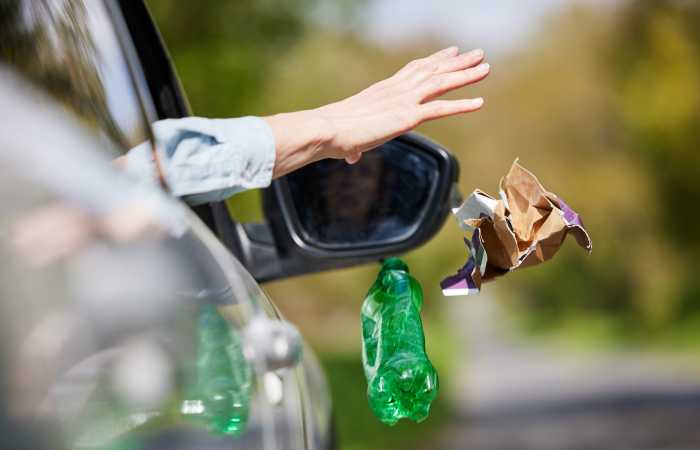
“These baskets help keep neighborhoods clean by giving pedestrians a place to dispose of ‘walking trash,’ like candy wrappers and coffee cups,” Gragnani said.
“To ensure that properly used litter baskets do not overflow, the Department of Sanitation is currently providing the highest level of service to litter baskets citywide.”
For local business leaders, cleaner streets aren’t just about appearances, they’re about business.
Javier Medina, executive director of the Southern Boulevard Business Improvement District, said visible trash discourages people from shopping, dining, or lingering in commercial corridors, which directly affects small businesses.
“When trash builds up on our streets, it affects how people feel,” Medina said. “If an area looks unclean, people are less likely to shop, dine, or spend money, which directly affects our local businesses and restaurants.”
The new containers, he said, would allow maintenance teams to work more efficiently, spending less time responding to overflowing street trash and more time improving overall conditions — a shift that benefits both residents and merchants.
Community board leaders emphasized that clean streets go hand in hand with neighborhood pride and morale. Etta Ritter, district manager for Community Board 3, noted how chronic litter and illegal dumping affect the community.
“When we have dirty streets, it undermines community morale,” Ritter said. “Over time, these conditions affect neighborhood pride, public safety, and overall health. When residents see chronic litter, it sends a message that their community is being overlooked.”
Ritter described the installation of new trash cans as an important first step — one that provides residents with the tools they need to take pride in their blocks while reinforcing that their concerns are being addressed in a tangible way.
“Clean streets uplift communities,” she said. “Today marks an important step in the right direction.”
For residents like Ariel Burgos, a Longwood local, the issue feels both obvious and overdue.
Burgos said he regularly sees people throw trash on the street, not necessarily out of disregard, but because there simply isn’t anywhere to put it.
“There isn’t a trash can on every block,” Burgos said.
“You can walk pretty far sometimes and not see one, which makes it hard for some people to throw their trash away. I think more trash cans will create more opportunities for cleaner streets.”
Sanchez acknowledged that more trash cans alone won’t fix everything. But argued that the initial absence of basic sanitation infrastructure made improvement nearly impossible.
“You can walk around like eight blocks in any direction in my district and not see a single trash can,” Sanchez said. “Then people wonder why the streets are littered. At its very essence, we have no place to put trash.”
For Councilmember Sanchez, the work doesn’t stop with installing trash cans – it’s about setting a new standard for how residents experience their neighborhoods and showing that the government can act on promises. Clean streets aren’t a luxury, they’re a sign that the South Bronx matters.
Kaylen Jackson is a contributing writer at the Bronx Times and a student at the NYU Graduate School of Journalism. For more coverage, subscribe to our newsletter and follow us on Twitter, Facebook and Instagram!