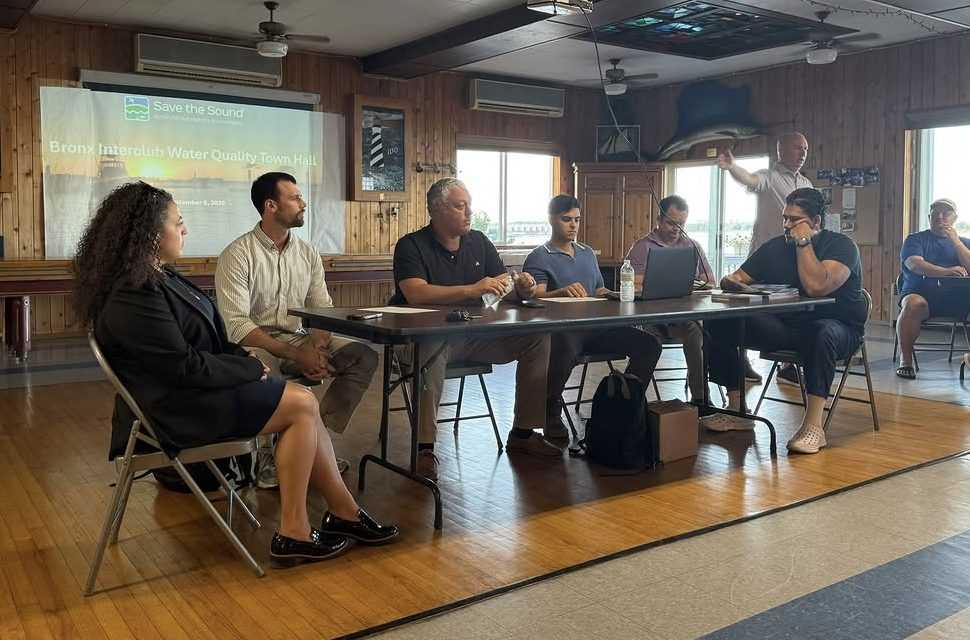
The White Cross Fishing Club brought members of the East Bronx Interclub community together on Sept. 8 for a town hall focused on an issue shared by the waterfront clubs along Eastchester Bay: water quality.
White Cross President Kenny Knapp organized the meeting after a New York Post article highlighted poor water quality grades at several Bronx beaches based on testing by Save the Sound.
The article brought increased attention to White Cross, American Turners New York, Trinity Danish Young People’s Society, Danish American Beach Club and Manhem Beach Club. At the town hall, however, the focus was less on the grades themselves and more on what is causing the poor results and what can be done about them.
David Abreu and Peter Lindroff of Save the Sound attended the meeting and presented nearly two decades of water quality data collected throughout Long Island Sound. The team walked members through the testing process, potential sources of contamination and maps showing stormwater outfalls and drainage areas that feed into Eastchester Bay.
Save the Sound tracks nearly 200 public and private beaches through its Sound Health Explorer, with testing conducted through its certified Healthy Waters Institute laboratory in Larchmont.
Across Long Island Sound, 77% of 192 beaches received an A or B in the latest report, a 5% improvement from 2024. In New York City, only 27% received an A or B, with Orchard Beach receiving the highest grade in the Bronx at a B+.
White Cross failed 60% of its wet weather samples and 31% of its dry weather samples. Its grade was based on 57 samples, including 42 taken during wet weather and 15 during dry conditions.
One of the major issues discussed was what happens after heavy rainfall. In areas served by combined sewers, household sewage and stormwater travel through the same system. When heavy rain overwhelms the system, combined sewer overflows can discharge sewage and stormwater into surrounding waterways.
Testing also looks for enterococci, bacteria used as an indicator of fecal contamination in marine waters, which can come from humans or other warm blooded animals, including geese.
The dry weather numbers show rainfall is not the only concern, with pollution persisting even without recent rain.
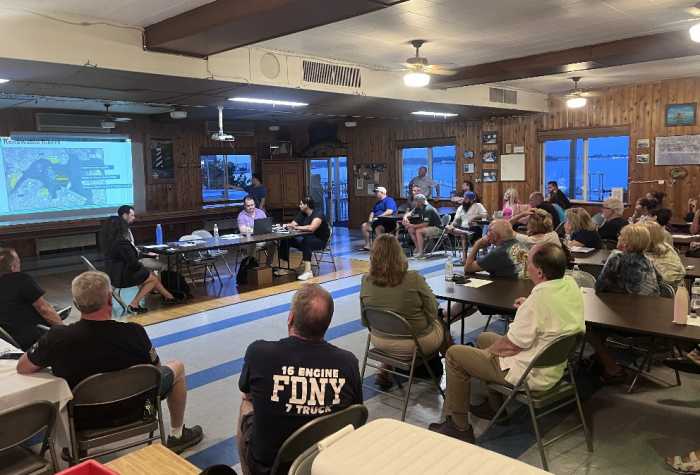
Save the Sound also showed members maps highlighting stormwater outfalls and the large areas that drain into Eastchester Bay. One outfall discussed, HP-648, collects runoff from a particularly large drainage area.
Knapp raised the same issue in a letter sent to Interclub members ahead of the meeting, noting that outfalls affecting the clubs drain a nearly 16 million square foot area that includes a portion of I-695.
“Our beaches will continue to be contaminated unless we speak up together,” Knapp said.
The meeting also focused on possible solutions. Oyster cages and shellfish restoration were among the ideas brought up. Oysters and mussels naturally filter water, and City Island Oyster Reef recently partnered with American Turners to install an oyster monitoring cage at the club.
Another idea was forming an Interclub water quality committee, giving the clubs a unified voice when working with the city Department of Environmental Protection, Save the Sound and elected officials.
“A consolidated, loud enough, hyper focused message, all aligned like ‘we want clean swimming beaches,’ voices can get this conversation going,” Lindroff said.
State Sen. Nathalia Fernandez, who attended the town hall, said the findings presented by Save the Sound should not be accepted as simply part of living along the waterfront.
“When beaches in our district are receiving failing grades for water quality, that is not something we can simply accept as the cost of living along the waterfront,” Fernandez said. “Clean water is a public health issue, an environmental issue, and a quality-of-life issue for every family that calls this community home.”
Fernandez said the next step is addressing the known sources of pollution and improving the systems already in place.
“Our shoreline is one of this district’s greatest natural resources, and we have a responsibility to protect it for the people who enjoy it today and for the generations who will inherit it tomorrow.”
The proposed Bally’s Bronx casino project at Ferry Point was also raised as one potential opportunity for funding. Community benefits associated with the project could provide an avenue for the surrounding East Bronx community to advocate for water quality, environmental mitigation and infrastructure projects.
For Knapp, bringing the clubs together was a first step toward making sure the recent attention on their beaches leads to action.
“Let’s work together to find solutions for this unacceptable infrastructural problem that has historically harmed our water quality and intruded on our ability to enjoy our beaches,” Knapp said.