
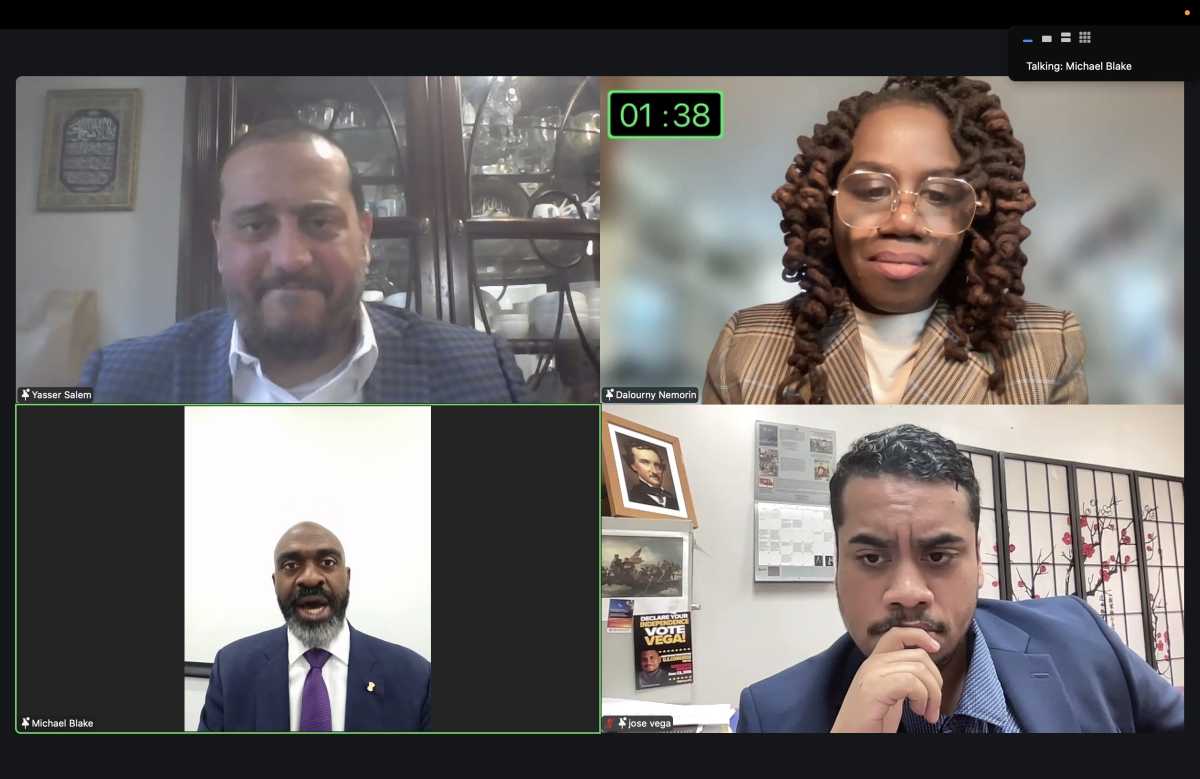
Michael Blake and Jose Vega faced off in a virtual debate on Tuesday for New York’s 15th Congressional District, which covers a majority of the Bronx.
The event was hosted by OneNYC Action, the advocacy arm of OneNYC, an independent expenditure group that spent nearly $220,000 last year supporting mayoral candidate Zohran Mamdani. The debate was moderated by public defender Dalourny Nemorin, who recently suspended her own campaign for the seat.
Yasser Salem, chairman of OneNYC Action, emphasized the urgency of holding the forum, pointing to overlapping crises including the nation’s multi-trillion-dollar debt, the city’s $5.4 billion budget deficit, and an ongoing war with Iran that he said “doesn’t seem to have a natural ending.”
Salem also stressed that the impact is especially severe in the 15th District, which is among the poorest in the country.
“It’s already bad enough for all of us. It seems like it’s the worst for those folks in the district that these men are running in,” Salem said. “That is why we felt it was important to take a part in this race and bring visibility while nobody else was doing so.”
The debate featured Blake, a former Assembly Member and former vice chair of the Democratic National Committee (DNC) and Vega, a political activist who identifies as a LaRouchite.
Notably absent from the debate was Rep. Ritchie Torres. Salem said the organization made multiple attempts to invite incumbent Rep. Ritchie Torres, but received no response.
“One question we should all be asking is why Congressman Ritchie Torres refused to show up and speak to New Yorkers,” Salem said. “He will have to answer that.”
The discussion remained largely civil until the final quarter, when Salem asked if the candidates would commit to avoiding a split vote closer to the election, as occurred in last year’s mayoral race. Vega sidestepped the question, instead criticizing Blake’s role in the DNC.
“I find it very difficult to ask the former vice chair of the DNC…to overturn the Epstein class, which he was part of from 2017 to 2021, or the fact that he attended various AIPAC conventions,” Vega said. “Although I know he’s reformed now and he has apologized for it when it became politically convenient.”
Blake pushed back and described Vega’s comment as “reprehensible.”
Salem acknowledged that Vega’s comment was out of line, while a viewer in the Zoom session shouted for the moderator to remain neutral and let the candidates speak.
“To the question about how we would help the community, Jose Vega literally just said, ‘I’m a part of the Epstein class,’” Blake said, noting Vega nodded in agreement.
“I’m not part of anything with Epstein. It is absurd on every level,” Blake responded.
Living and Affordability
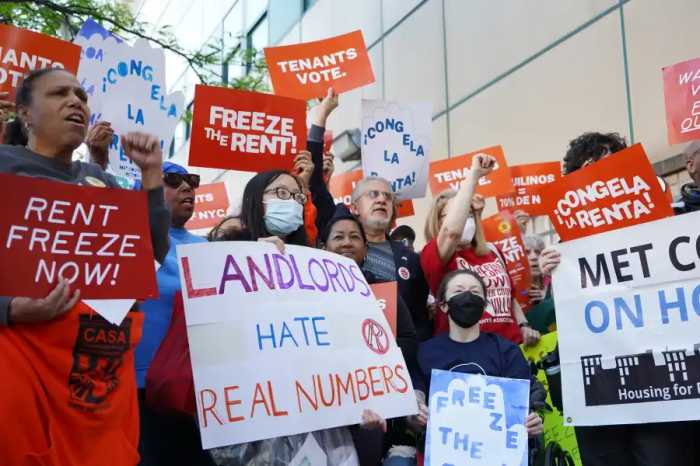
During the debate, moderator Dalourny Nemorin asked candidates whether they supported reforming Area Median Income (AMI), a metric used to determine eligibility for affordable housing that includes incomes from wealthier surrounding counties such as Westchester, Rockland and Putnam.
Blake argued that AMI fails to reflect the economic realities of Bronx residents and called for a shift to a local median income standard.
He also pushed for the elimination of credit scores from housing applications, saying they contribute to gentrification and displacement. He demanded stronger rent protections, expanded eviction-prevention measures and increased access to homeownership.
Vega, meanwhile, focused on the overall quality of housing, which he described as broadly substandard. He called for federal policy changes to ensure access to higher-quality housing for all residents, including those living in NYCHA developments.
Yasser Salem— a former McKinsey executive who now sits on the mayor’s Economic and Workforce Development Transition Committee— asked how the candidates would fund their proposals.
“Obviously, we have to tax the rich,” Blake said, echoing calls from the progressive wing. He also called for changes to the tax code to ensure Bronx communities are not disproportionately burdened, and emphasized the need for greater accountability in public housing, citing NYCHA as an example where increased funding has not led to meaningful improvements.
Vega proposed a more structural shift, arguing that the country should return to a national banking system to better access capital for housing development. He said commercial banks currently offer interest rates that are too high to make large-scale housing investment feasible.
Food Security
With roughly 40% of Bronx residents relying on SNAP benefits—and potential federal cuts to assistance for low-income families—moderator Dalourny Nemorin asked candidates what policies they would champion to address food insecurity in the district.
Vega argued that improving living standards and expanding access to stable, well-paying jobs would reduce reliance on food assistance programs.
“The Bronx used to be an industrial center, with residents able to support themselves through skilled labor,” Vega said, pointing to the need to restore “productive jobs” that provide long-term economic stability. Vega expressed support for expanding farm-to-table initiatives to improve access to fresh food, particularly in areas he described as food deserts.
Blake called for a more comprehensive approach, including expanding SNAP benefits, eliminating work requirements and increasing funding for culturally appropriate food options, such as halal meals. He also emphasized the importance of protecting the Hunts Point food distribution hub and supporting local restaurants and small food businesses as key parts of the borough’s food ecosystem.
Immigration and ICE
For Vega, the issue was personal. He said his stepfather had been detained by ICE in the week leading up to Thanksgiving, an experience that shaped his views on immigration enforcement. Vega argued that ICE stems from the expansion of the surveillance state following the Patriot Act and called for the abolition of both.
“The undocumented people in this country are just a test case for what the United States is about to do to American citizens and is doing to American citizens.”
Blake similarly pushed to dismantle ICE and repeal the Laken Riley Act, criticizing Torres for supporting the measure. He also advocated ending travel bans, creating a pathway to citizenship, and eliminating what he described as predatory remittance fees.
“We need to not only defund ICE— we need to abolish it and hold people accountable for inhumane treatment,” Blake said.
Job Creation
Nemorin focused the next section on what the candidates will do to ensure that tax dollars create jobs directly within our community.
Vega called for a return to the Bronx’s “industrial heart,” proposing the development of large-scale industrial parks that could employ thousands of residents. He said these projects would be paired with apprenticeship programs to train young people in skilled trades such as welding, machining, and construction.
Vega framed his answer as similar to his “Space Civilian Construction Corps,” a core part of his campaign modeled after the New Deal-era Civilian Conservation Corps.
He argued that not all job creation is equal, criticizing projects like the proposed Bally’s casino in Throggs Neck as producing low-quality employment.
“It’s not about generating money. It’s about generating real wealth, which exists in knowledge,” Vega said, adding that investment should prioritize industries like engineering and manufacturing.
Blake emphasized a broader approach that includes both trade and technology jobs. He pointed to his support for workforce development organizations like The Knowledge House and partnerships with groups such as the National GEM Consortium to create pipelines from high school to college and into careers.
Blake argued that federal and local hiring mandates are key to ensuring jobs benefit Bronx residents, particularly those who have lost employment in recent years.
“You’ve got to have federal, local hire mandates,” Blake said, adding that the focus should be on creating high-wage jobs with benefits rather than relying on seasonal or retail work.
Healthcare
Blake called for expanded healthcare access, including Medicare for All and stronger protections for Medicaid, alongside increased funding for hospitals and community- and school-based health centers to improve early care.
He also pointed to building conditions as a key driver of poor health outcomes, while advocating for stronger nurse protections, a more diverse medical workforce and greater investment in addressing the Black maternal health crisis through expanded access to doulas and midwives.
Vega said he agreed with several of Blake’s proposals, including Medicare for All, but argued that broader socioeconomic conditions must be addressed to improve public health outcomes.
“I don’t want anybody to walk into a doctor’s office or a hospital and worry about a bill,” Vega said.
He pointed to research showing that the Bronx is often hit hardest during public health crises and argued that improving living standards is key to preventing illness in the first place.
“Public health begins before you even walk into a hospital,” Vega said, adding that investments in areas like sanitation are critical to improving overall health conditions.
Environmental Justice and Asthma
Both Vega and Blake had personal experiences with family members and loved ones who had been hospitalized for chronic asthma.
Blake called for the closure of peaker plants, which operate during peak periods of electricity usage, like in the summertime, currently four operate in the Bronx. He also echoed calls to cap the Cross Bronx Expressway.
Vega said that while he agrees with capping the Cross Bronx Expressway, incentives need to be put in place to reduce its usage. Vega brought up another part of his campaign, which calls for a cross-Bronx train line that runs from Bay Plaza, across Fordham Road, to Spuyten Duyvil, into Manhattan, with a stop under the George Washington Bridge for New Jersey commuters.
War Spending and Israel
In one of the more anticipated segments, moderator Nemorin asked whether the candidates would commit to opposing further military funding —both offensive and defensive— to Israel.
Vega voiced full support for ending military aid but criticized the Democratic Party for failing to intervene in Gaza. He accused members of Congress, including Hakeem Jeffries and Gregory Meeks, of being influenced by the American Israel Political Action Committee (AIPAC).
Blake called for a permanent ceasefire in Gaza and an immediate halt to military aid.
“We shouldn’t be spending this money when people don’t have books, don’t have food, are struggling in hospitals,” Blake said. “Why are we putting more money into senseless wars instead of protecting our own communities?”
Vega also criticized Bronx elected officials who have endorsed Rep. Richie Torres while failing to act on conflicts in Gaza and Iran. “It’s the whole damn system,” he said. “The whole damn political class has got to go —Democrat or Republican— they are the same. That’s why people don’t come out to vote.”
Viewers in the chat asked Blake to address his past embrace of Israel, including multiple trips to the country and attendance at AIPAC conferences.
He acknowledged the question: “I have visited Israel twice because I’m an ordained reverend. I went on one AIPAC trip, one JCRC trip, where I led the Sermon on the Mount and prayers for Black and Jewish relations.”
Blake said he ended his relationship with AIPAC because the organization “was shutting down conversations on apartheid, on not wanting to exercise conversation on genocide.” He added that he does not support Benjamin Netanyahu or the Israeli government.
Reach Marina Samuel at msamuel@schnepsmedia.com. For more coverage, subscribe to our newsletter and follow us on Twitter, Facebook and Instagram!