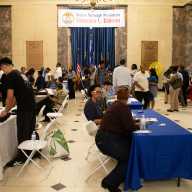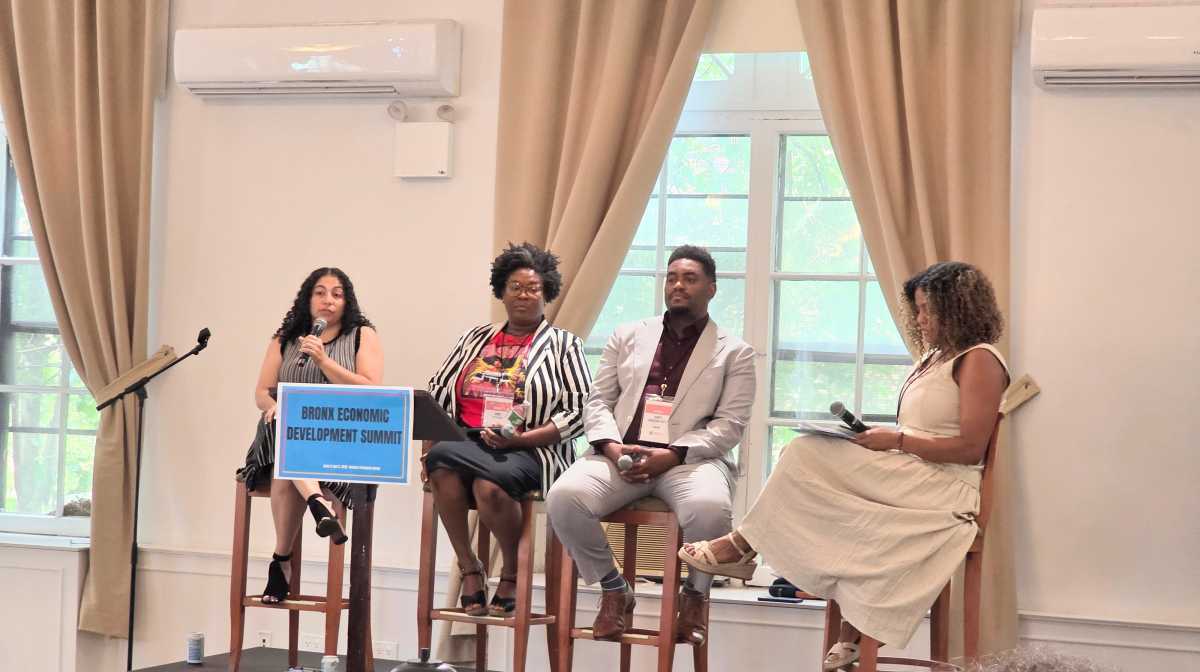
The two-day Bronx Economic Development Summit convened at the Andrew Freedman Home starting June 5, focused on building collective power that benefits all people in the borough.
The summit focused on creating and implementing policies that improve the lives of Bronxites of all ages, neighborhoods and income levels and create wealth within the community.
The effort to convene the summit took off in 2024 with support from a federal planning grant to the Bronx Economic Development Corporation and the nonprofit Our Bronx (formerly called the Northwest Bronx Community and Clergy Coalition).
Both organizations have been working on the first-ever Comprehensive Economic Development Strategy for the Bronx, a federally supported plan for decisionmaking that generates wealth in the borough — and keeps it there.
A draft of the plan is now available, and BXEDC is seeking feedback through June 15.
“The central question is not whether change is coming, but how broadly opportunities, risks, benefits, and decision-making will be distributed,” the draft report said. “Without a coordinated and intentional strategy, new development will continue to favor higher-income newcomers, outside investors, and uses that do little to improve long-term conditions for current residents.”
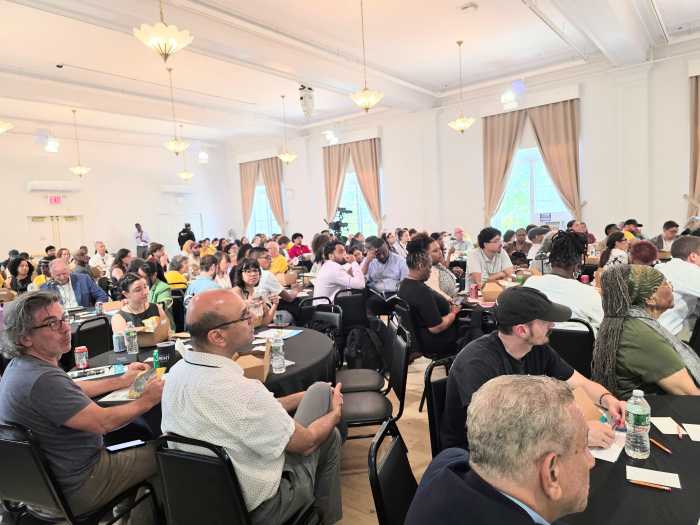
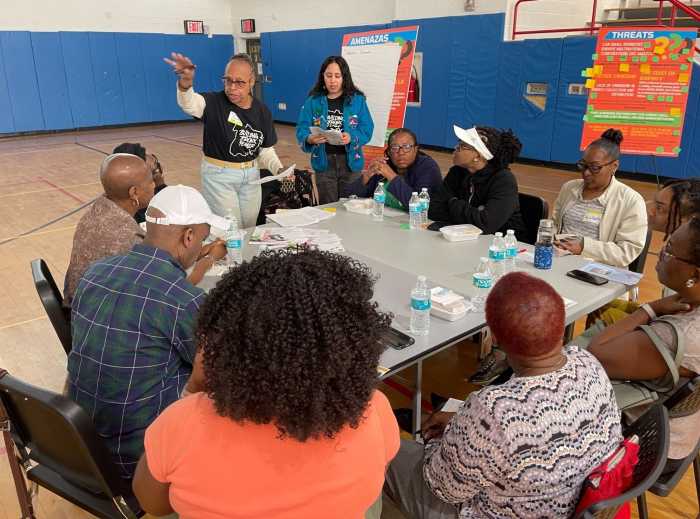
The Andrew Freedman Home event brought together a diverse group of experts and local leaders around the issues in the draft plan, with time to build relationships and attend sessions by speakers from across the city and the country.
The Friday sessions primarily focused on how traditional concepts of economic development — employment, small business, real estate — are now being “reimagined.” Sessions included perspectives from those in the New York City area, as well as Chicago, St. Louis, Philadelphia, Oakland, Boston and more.
The Saturday program looks to the history and future of the Bronx in terms of environmental resilience, finance, manufacturing, small business and other industries.
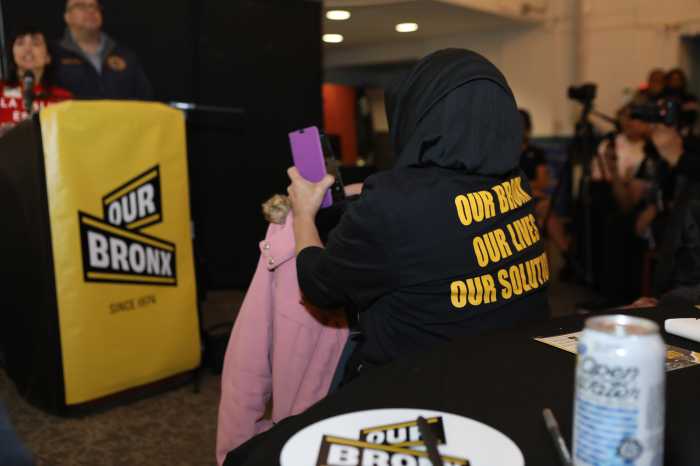
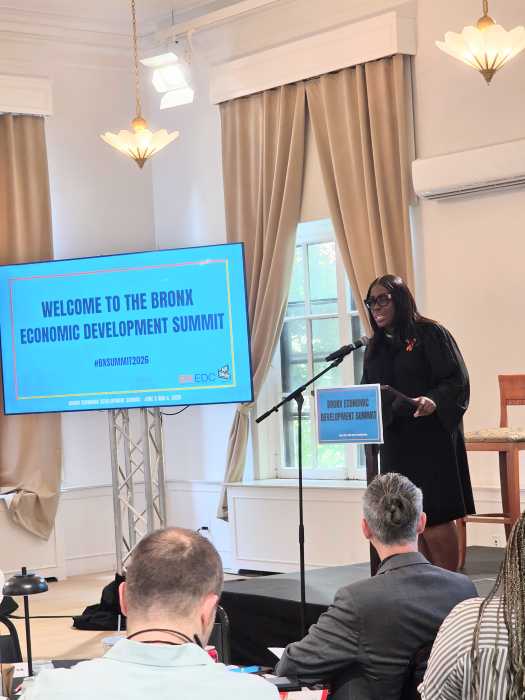
The summit kicked off with remarks by Borough President Vanessa Gibson, BXEDC President Winston Peters and Our Bronx Executive Director Sandra Lobo
Gibson said the summit was part of an effort to “reclaim the Bronx” and lift up its communities. “We will aim high and raise the standard for years to come.”
Last year saw a record-breaking $9 billion in investments in the borough, with 17,000 new housing units and 19 million square feet of other development, she said.
Gibson said 2026 “is looking like another great year” towards new ventures that will impress locals and tourists alike.
This year will see the opening of the Hip-Hop Museum, which she called “a global empire” and an expansion of the Bronx Museum of the Arts.
In addition, the new pavilion at Orchard Beach is reopening after nearly two decades of closure, and work to redevelop the long-vacant Kingsbridge Armory is starting soon, according to Gibson.
The borough president also cited the ongoing Metro-North expansion in the East Bronx, which not only adds new stations in Parkchester-Van Nest, Co-op City, Morris Park and Hunts Point but also 7,000 new homes and three million square feet of development.
“Our borough has always been defined by our courage, determination, resilience and strength, collectively charting a path forward together for where we want to go,” Gibson said.
Changing times
Amid a time of transition, Lobo said the Bronx is indeed seeing new investment — which in turn sparks concerns about who benefits.
“For many residents, the economy is rent, bills, job quality, safety, health — all the things that determine whether life is stable and affordable. For many professionals, the economy is growth, investment, development indicators. Our work over the next two days is to connect those realities into one cohesive set of strategies,” Lobo said.
With a population of nearly 1.5 million, “The Bronx is too interconnected and the challenges are too big for siloed solutions.”
Peters similarly said the summit will “break down silos” that typically separate community partners, even ones working towards similar goals.
The draft strategy creates “a common platform for coordination” in the Bronx, “where one plus one doesn’t equal two, it equals, like, ten.”
At the same time, partners must be able to actually implement ideas on a borough-wide level, Peters said. “A strategy is only as valuable as it leads to action.”
Friday attendees also heard from keynote speakers engaged in new models of economic development in communities across the country.
First was Nneka Onwuzurike of The Community WEB, focused on shared wealth building in Chicago.
Onwuzurike said she began working for the city in June 2020, during the height of the COVID-19 pandemic and just days after the police killing of George Floyd in Minneapolis. She had to set high-level policy aside to just make sure people had food, masks and other essentials.
That period for her was a “portal” after which nothing was the same and forced her to rethink the traditional metrics of wealth.
The questions driving her current work are, “How do we redefine wealth as shared prosperity?” and “What are the portals that exist in this moment?”
In times of major change, as the Bronx is undergoing, “a people infrastructure” that draws new voices in and relies on existing expertise is essential, Onwuzurike said.
Charli Cooksey of WEPOWER St. Louis echoed that in her “radical community design” workshops, residents offer a vision for wealth that goes far beyond money.
Many people don’t necessarily want to be millionaires but want well-educated, thriving communities with easy access to good food and resources, she said.
Cooksey also drew parallels between the Bronx and her home city. In St. Louis, about 27% of households have zero or negative net wealth, concerns over population loss are growing, and about 70% of local businesses are owned by people nearing retirement age, according to Cooksey.
St. Louis also has a legacy of redlining, disinvestment and other racist policies meant to limit the wealth and power of communities of color.
Cooksey also pointed to the current challenge of state and federal attacks on progressive policies. Though New York is a blue state, the Bronx has seen such challenges in, for example, federal cuts to SNAP benefits that target already-poor populations.
With much money and organizing power going towards far-right policies, “The only way forward is together,” Cooksey said.
For more information on the two-day summit, see https://www.bxedc.org/bxedc-summit-2026.
Reach Emily Swanson at eswanson@schnepsmedia.com or (646) 717-0015. For more coverage, subscribe to our newsletter and follow us on Twitter, Facebook and Instagram!