
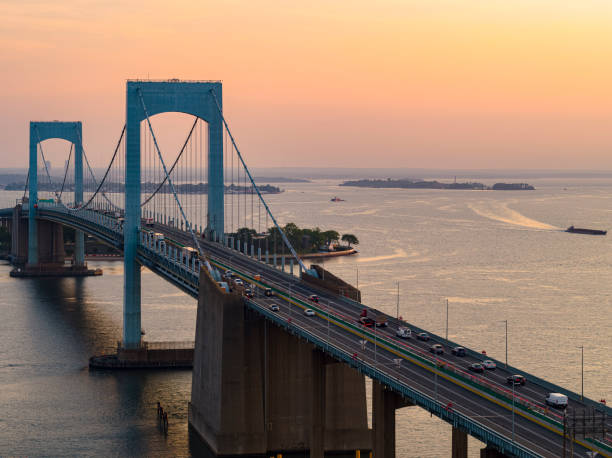
Cheers to the Throgs Neck Bridge! The critical connector between the Bronx and Queens is turning 65 years old, having opened to traffic this month in 1961.
MTA Bridges and Tunnels is marking the occasion with a special exhibit at Grand Central Station featuring original construction drawings and records, which will remain open until June.
Nellie Hankins, special archive and engineering manager for MTA Bridge and Tunnels, said the exhibit provides an opportunity to appreciate the bridge.
“Usually, people crossing our bridges are driving, so it’s great to have a little bit more of a personal touch where people can stop, read and look around,” she said.
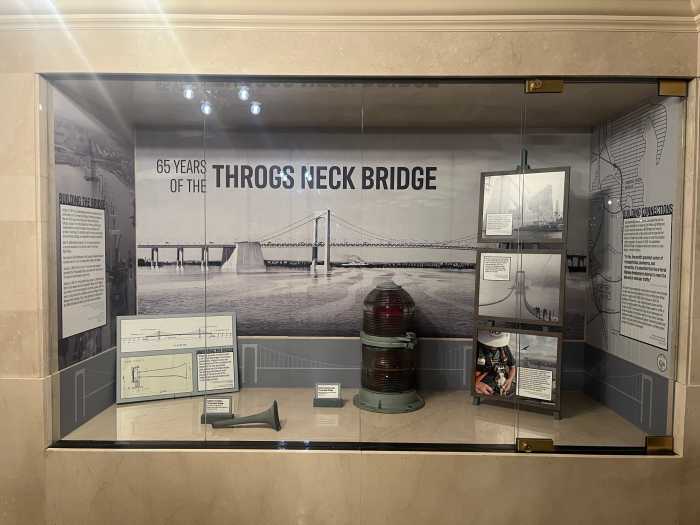
The construction process for the Throgs Neck Bridge was well-documented, and Hankins’ work deals with records, research and events dating from the 1930s to today. “You never know what you’re gonna be doing day to day,” she said.
The Throgs Neck Bridge was built as a “second-generation” structure to ease congestion on the Bronx-Whitestone Bridge, which opened in 1939, Hankins said.
As WWII ended and car culture began to take off, the Whitestone could no longer handle traffic volumes on its own. Traffic doubled on the Bronx-Whitestone between 1946 and 1950 and again between 1950 and 1960, according to Hankins.
In 1962, the first full year of traffic on the Throgs Neck Bridge, it saw 17,000 million total crossings, Hankins said.
Today, between 100,000 and 110,000 drivers cross it every single day — likely without noticing many of its finer points.
The Throgs Neck Bridge is a suspension bridge that carries six lanes of traffic over the East River using two towers, two cables and anchorages. Its main span is 1,800 feet with 142 feet of clearance for marine traffic underneath.
Maintaining the cables is a top priority for the MTA, as the “boxy, stable, sturdy bridge” is only suspended in the air thanks to them, said Hankins, adding that each cable consists of 37 strands twisted and layered with 296 wires per strand.
MTA Bridges and Tunnels sees more than 336 million vehicles per year across seven bridges and two tunnels, and workers must pay constant attention to the condition of each structure’s paint, steel and all other components.
For the Throgs Neck Bridge, “Sixty-five years old, sitting out in the elements all day, there is a lot of wear and tear,” Hankins said. “It’s just basically looking at every element of the bridge and what it needs to stay in a state of good repair.”
As the bridge turns 65, it seems a long way from retirement — and yet, a longstanding controversy remains. Is Throgs Neck spelled with one G or two?
Residents may have noticed that roadway signs use one G, while neighborhood signs for NYCHA Throggs Neck Houses, use two.
Hankins said infamous urban planner Robert Moses was rumored to have pushed for one G, for simplicity’s sake — but technically, both spellings are wrong, she said.
According to Hankins, Throgs Neck was actually named after John Throckmorton, who settled in the area in 1643, so it really should have been spelled “Throcks Neck.”
However you spell it, the bridge remains sturdy as ever.
Reach Emily Swanson at eswanson@schnepsmedia.com or (646) 717-0015. For more coverage, subscribe to our newsletter and follow us on Twitter, Facebook and Instagram!