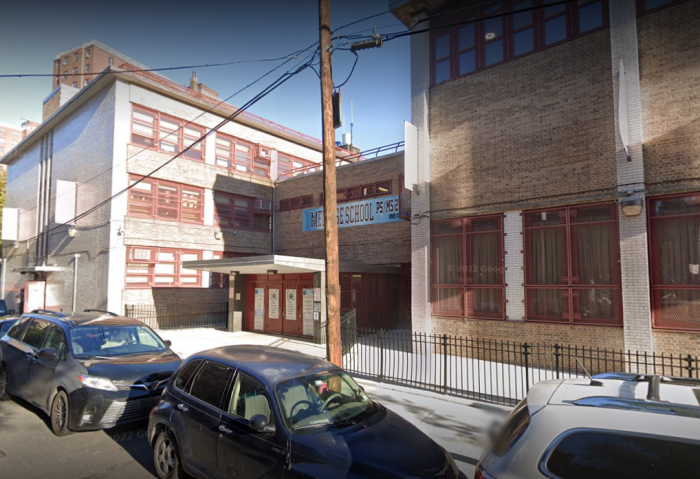

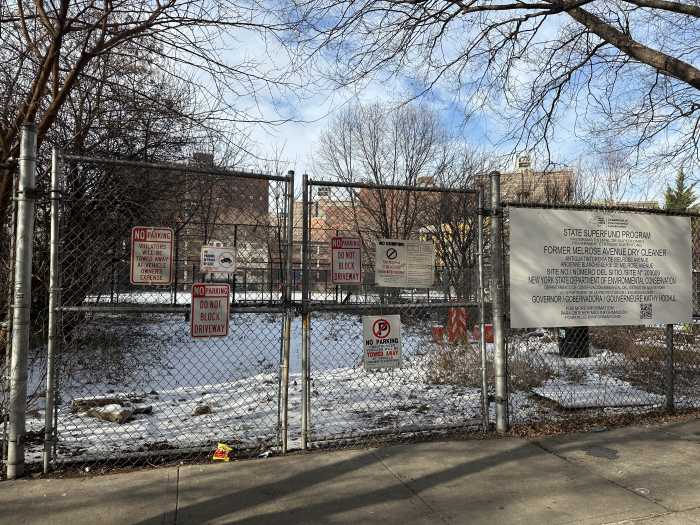
For years, residents and environmental advocates in Melrose have pushed state officials for clearer information about the toxic contamination beneath a long-vacant lot at 753 Melrose Avenue.
In early November, the New York State Department of Environmental Conservation (DEC) said it plans to clean up the residual chemicals in up to ten years.
The Melrose Environmental Awareness Committee, led by Bronx resident Angel Garcia, has repeatedly pushed the DEC to study and clean-up the dry cleaning chemicals left behind after a business closed in the 1960s.
The site has been classified as a “significant threat to public health or the environment” under the state’s Superfund program.
In the winter of 2024, the committee brought Environmental Protection Agency officials on a tour of the eight-block area surrounding the lot— a swath that includes an elementary school, a community garden, religious institutions, small businesses and thousands of homes.
At the time, the DEC said it had been conducting community outreach since 2013 and shared fact sheets and mailing lists to support that claim.
But residents and activists insisted that many neighbors had never received any updates and that basic questions about testing, health risks, and the agency’s plans remained unanswered.
At a presentation to Community Board 1 in November, Alan Wong, the project manager for DEC’s remediation project, walked residents through the history of the site and the proposed remediation plan.
Wong said the contamination was discovered in 2013 when an investigation of a petroleum spill at the nearby fire station led DEC officials to discover tetrachloroethene (PCE) –a chemical that can cause impaired cognitive functions, kidney and liver issues and reproductive problems– in groundwater 16 to 20 feet below the surface.
The contamination has gradually migrated downward for decades and continues to move along the natural slope of the land.
Wong emphasized to Bronx residents that the contaminants are not in residential drinking water.
“Water comes out of your tap supplied by pipes,” he said. “New York City water comes from upstate.”
According to Wong, DEC will use a method called in-situ chemical oxidation (ISCO) to remove the PCE from the land. The process works by injecting a chemical oxidant—in this case, potassium permanganate—directly into the contaminated groundwater 16 to 20 feet below the surface.
When the permanganate encounters PCE molecules, it transforms the toxic compound into non-toxic substances like carbon dioxide and water. This allows the contamination to be treated where it sits, rather than having to dig up and haul away thousands of tons of contaminated soil.
Michelle Crimi, a professor in the department of civil and environmental engineering at Clarkson University, said ISCO works instantaneously.
“If I were to mix the PCE and promagagnate in the lab, you would see the non-toxic particles form within minutes,” Crimi said.
The process is currently being tested in a pilot phase “to make sure it is effective,” Wong added.
Crimi said the use of permanganate for chemical oxidation is very common and has been used safely for a couple of decades, specifically for cleaning up previous dry cleaner sites.
If the preliminary studies prove this method to be effective, the DEC plans to start its first large-scale injections in the summer 2026 – with three rounds of injections per year. The agency also plans to continue long-term groundwater monitoring, potentially for decades.
“The wells will stay until they’re no longer needed,” Wong said.
Crimi explained the remediation will take several years because of how PCE behaves once spilled. When PCE enters the ground, it forms deep underground pools. The permanganate treatment only works at the outer edges, not deep inside the contaminated zone.
PCE also absorbs into the surrounding soil, making it harder to reach. That’s why multiple treatment rounds are necessary—the DEC must wait between injections to give the PCE time to dissolve back into the groundwater, where it can then be neutralized by the next round of treatment.
At the meeting, several residents said that while the engineering plan appears sound but that the agency needs to communicate more clearly with the local community.
Garcia welcomed the explanation but noted that the DEC has yet to fulfill earlier promises of broad outreach. In March 2024, activists submitted a list of 240 addresses they believed should receive DEC’s updates.
The DEC, however, said it only mailed letters to 22 buildings— the ones directly above where soil vapor intrusion was most likely.
“That’s a big difference,” Garcia said. “People have watched drilling rigs in front of their buildings for years. They deserve a basic explanation.”
Cesar Yoc, a community board member, said residents need more than general reassurance that the cleanup method “has worked elsewhere.” He wants the DEC to show evidence from the ISCO method working in previous sites.
“People worry about their health and they worry about time,” Yoc said. “If the study area is the whole yellow line on the map, then everyone in that area should get information.”
Residents also raised concerns about the absence of health testing for residents. In the past, the DEC has said that indoor air testing hasn’t indicated the need for individual health monitoring, but activists point out that contamination has been present since the 1960s.
“57 years is a long time,” Garcia said. “You can’t assume no one was ever exposed just because you don’t see it now.”