
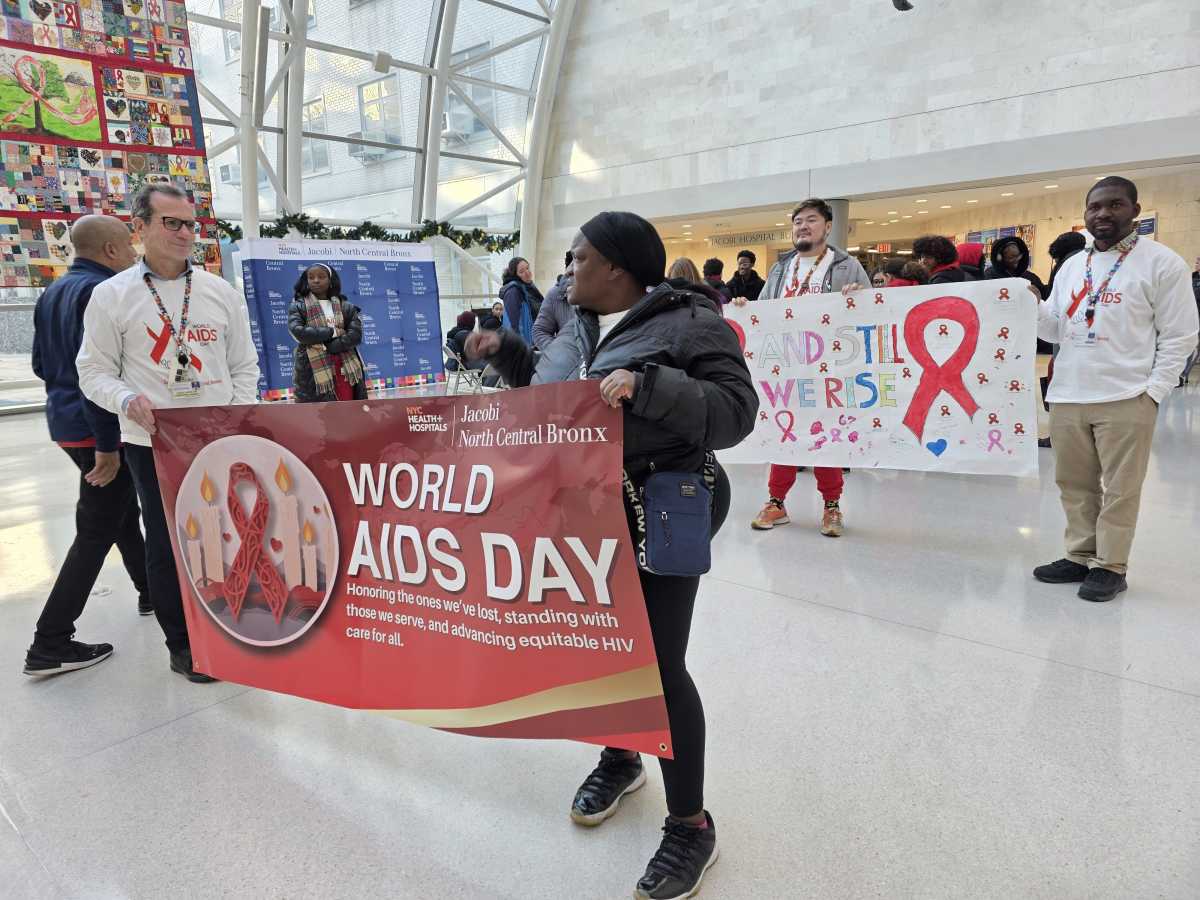
On Dec. 4, Jacobi Medical Center hosted a daylong series of events in recognition of World AIDS Day, culminating in a walk on campus to honor those who have died and those currently living with HIV and AIDS.
While the Honor Walk was kept brief due to the cold weather, participants carried a handmade banner that read “And Still We Rise,” featuring some patients’ names.
The rest of the event, organized by Community Liaison Worker Jose Clemente, featured HIV education, patient testimonies, a patient lunch and more. In the light-filled atrium of Building 8 hung a large quilt honoring those with HIV and AIDS, alongside a red ribbon display studded with pairs of angel wings bearing initials of people who have passed.
The Jacobi event came amid the U.S. government’s decision to not officially recognize World AIDS Day on Dec. 1 for the first time since it was established by the World Health Organization in 1998. A Trump executive order at the start of his second term withdrew the United States from the WHO entirely.
For World AIDS Day, federal employees were directed to “refrain from publicly promoting World AIDS Day through any communication channels, including social media, media engagements, speeches or other public-facing messaging,” as reported by the New York Times.
The State Department said the U.S. government continues to combat the disease while allowing other governments more local control and accountability.
Throughout New York City, commemorations continued despite the administration’s lack of support — and its plan to slash funding for HIV/AIDS treatment and prevention programs by at least $1.5 billion.


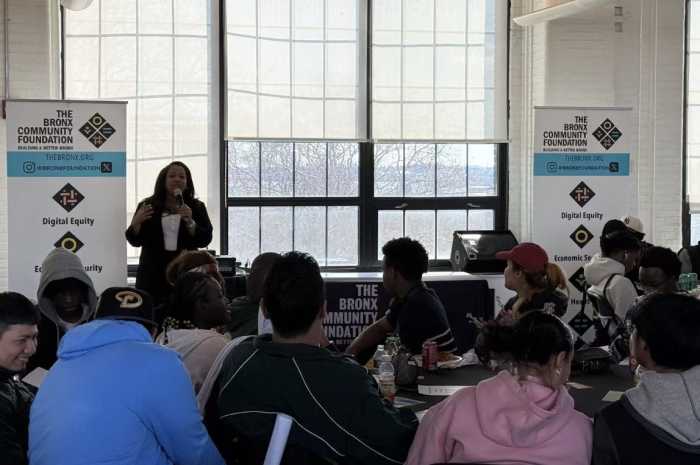
The Jacobi event included a group of 28 students from Bronxdale High School, some of whom were members of the school’s gay-straight alliance. Students took part in a panel where they asked doctors questions and learned about the Adult Clinic at Jacobi that treats patients with HIV and AIDS.
Dr. Ramiz Rafailov, a supervising psychologist with Jacobi, spent time with the group and said the event revolved around remembering lives lost while also “celebrating the healthy livelihoods” of people using medication to treat HIV and AIDS. Educating young people is key to eliminating stigma around the virus, Rafailov said.
For instance, students learned about the phrase “U=U,” or “undetectable equals untransmittable,” referring to people with HIV who are undergoing treatment and whose viral load is so low that there is no possibility of transmitting to future partners. The U.S. Centers for Disease Control promotes U=U in a global public health strategy that is now disputed by the Trump administration as “gender ideology.”
“This page does not reflect biological reality and therefore the Administration and this Department rejects it,” reads a banner at the top of the CDC’s page on U=U.
Although medications have come a long way towards preventing and treating HIV, Rafailov said Bronx infection rates remain a major cause of concern. According to city data, the Bronx has the highest rate of new HIV diagnoses within the five boroughs, mostly among cisgender men, as opposed to women and transgender men and women, and concentrated in neighborhoods with very high poverty.
The New York City Department of Health and Mental Hygiene reported that an estimated 24,700 people with an HIV diagnosis are living in the Bronx as of 2023.
In response, Jacobi has ramped up testing and emphasized treating the physical and mental needs of HIV/AIDS patients, Rafailov said. The hospital has begun testing more people who come to the emergency room, and patients have to opt out, which is helping detect more cases and get people started on “360 holistic care” if needed.
“We are really advocating for change,” Rafailov said.
This story was updated Dec. 5 at 11:35 a.m. to include information from the State Department.
Reach Emily Swanson at eswanson@schnepsmedia.com or (646) 717-0015. For more coverage, subscribe to our newsletter and follow us on Twitter, Facebook and Instagram!