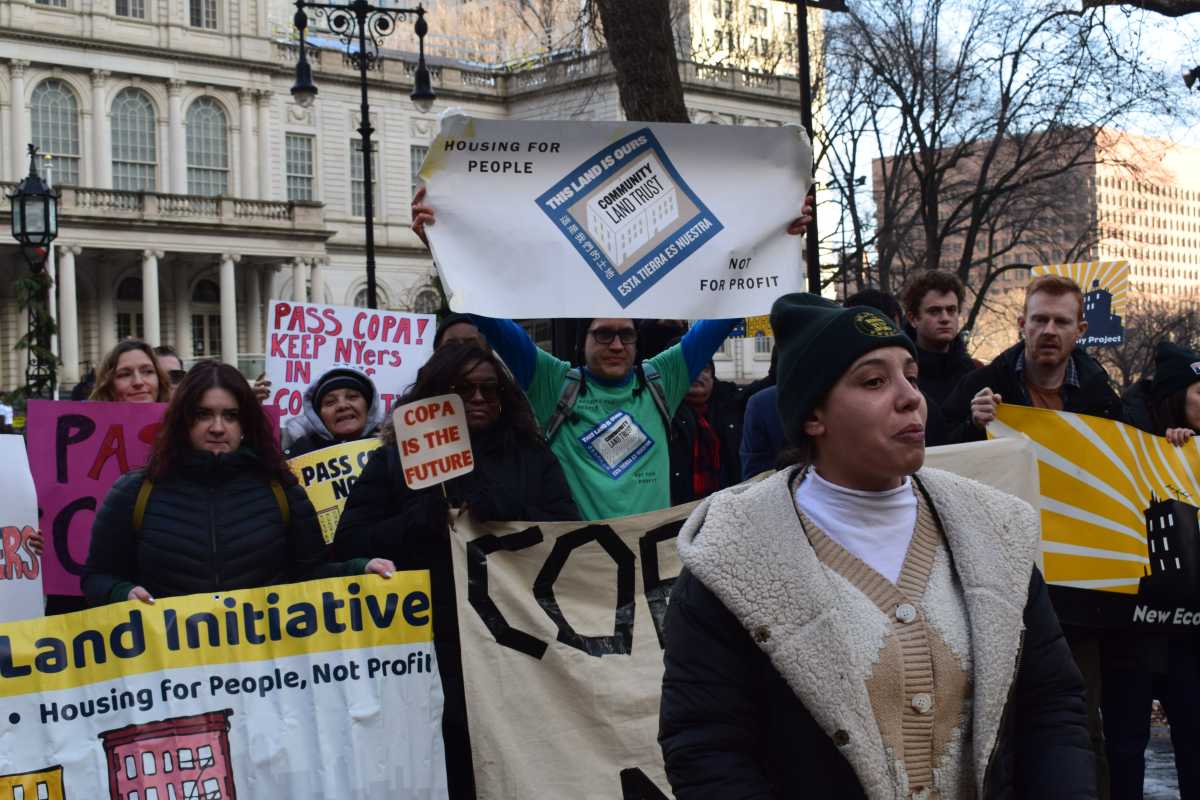
Bronx-based affordable housing groups won a City Council vote yesterday on the Community Opportunity to Purchase Act (COPA), a bill that gives nonprofits new leverage to buy distressed apartment buildings and keep them affordable.
Introduced by Council Member Sandy Nurse –who represents majority-Hispanic neighborhoods along Brooklyn’s northern border– the bill gives city certified housing preservation groups first dibs on some apartment buildings when they go up for sale.
Landlord and real estate groups objected to the bill, saying it would expand government involvement in private property sales, while supporters say it will increase the supply of permanently affordable housing managed by tenants or nonprofits.
If signed into law by Mayor Adams by the end of the year, it will come into effect in 2027.
“Today’s passage of the Community Opportunity to Purchase Act is a transformative victory for housing justice — won through years of organizing by community land trusts, tenants, and groups across the five boroughs,” said Deyanira Del Rio, executive director of New Economy Project in a statement.
While official tallies are not available yet, the bill did not pass with veto-proof majority, meaning that Adams could veto the bill, but supporters expect that council members will override the veto if so, said Will Spisak, Senior Policy Strategist at New Economy Project.
Several organizations that aim to use COPA are based in the Bronx, which suffers the most out of all boroughs from the city’s affordable housing crisis. Eight of the Bronx’s 12 community districts are in the highest risk category and facing the greatest threats to affordable housing, according to the latest Housing Risk Chart from the Association for Neighborhood and Housing Development.
Affordable housing organizations have managed apartment complexes for decades, but they often struggle to compete with real-estate investors who can offer cash for properties.
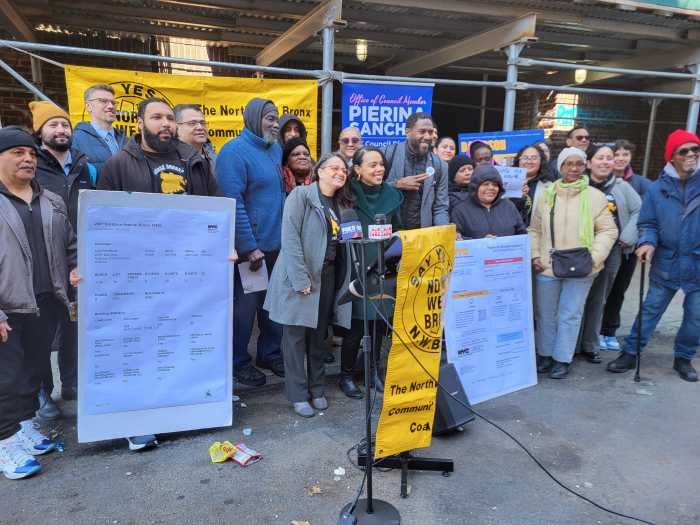
“We’ve had too many missed opportunities,” said Edward Garcia, who directs organizing work at the Northwest Bronx Community and Clergy Coalition (NWBCCC), a longstanding community organizing nonprofit which won partial ownership of the Kingsbridge Armory in an unprecedented deal earlier this year.
He said that the bill would allow them to finally take care of buildings that landlords walk away from after having “neglected them for years.”

Garcia said he’s seen tenants come back to NWBCCC, decades after they helped the tenants organize because a new owner –or even the same one– will engage in the same behavior that they successfully fought against.
“We’ve seen over time that buildings in our community continue to be used as a business without the intent of providing safe and affordable housing,” he said.
Modeled on laws passed in Chicago, San Francisco, and other cities, COPA gives organizations certified by New York City’s Housing Preservation and Development Office (HPD) several weeks to submit a first offer before it hits the open market —it also gives them the right to match offers made by other bidders within 15 days afterwards.
The legislation originally proposed longer windows and would have required all buildings with three or more apartments for sale to be offered first to nonprofit groups only.
After pushback from landlords and the HPD, the legislation was amended so that it only applies to buildings with at least four units that have significant physical or financial problems. It also allows for-profit buyers to team up with nonprofit groups to make bids.
Community Land Trusts as Organizing Infrastructure
Community Land Trusts, or CLTs, are nonprofit, community-based developments of individually-owned buildings on land whose usage is determined by the community.
Pioneered by Black farmers in the South who had lost their homes and jobs after registering to vote, CLTs have been used for urban agriculture and gardens, low-income housing, limited-equity homeownership, and community centers.
They have become part of the strategy for NYC nonprofits looking to tackle the city’s affordability crisis, and there are now 19 in the city, 3 of which are in the Bronx.
Today’s legislative victory follows a five-year campaign led by the NYC Community Land Initiative (NYCCLI), a citywide coalition of CLTs coordinated by New Economy Project, said the New Economy Project in a statement after the vote.
NWBCCC incorporated the Bronx CLT in 2020, and has three projects in the pipeline to provide affordable housing to Bronxites in perpetuity: Two co-op conversions and a construction project.
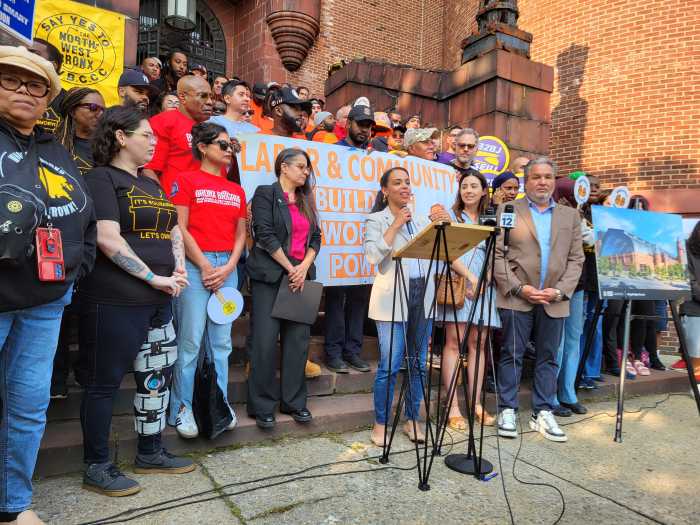
“Marginalized communities like mine have been denied access to owning anything, or even having control,” said Julie Colon, the lead housing organizer at NWBCCC, at a rally in front of City Hall. “Tenants are ready to be stewards of their homes.”
Colon, who grew up in Morrisania, in the 1990s and early 2000s, said she saw the impact of urban neglect, burnt building, and redlining firsthand.
“As a tenant and an organizer, I’ve seen the horrible conditions in the Bronx and not just in the Bronx but around NYC,” she said.
Recent Wins in Community Ownership
The new legislation comes after a long list of community-oriented land purchases by the Bronx in recent years.
On Tuesday, NYC Council approved a 99-Year lease of a former recovery center to South Bronx Unite’s CLT, the Mott Haven-Port Morris Community Land Stewards, which was founded in 2015 to acquire land for public use and to hold it in perpetuity.
South Bronx Unite, a nonprofit that brings together Mott Haven and Port Morris residents and organizations to advocate for issues affecting their community, aims to start converting the building into a center for health, education and the arts in 2026.
South Bronx Unite said in a statement that the purchase was the culmination of nearly a decade of dedicated organizing, advocacy and community-led envisioning. They say it marks a significant step forward for community ownership in NYC as the city’s first non-residential building developed under a CLT framework.
In 2022, Port Morris residents won a 3 year long fight to convert their 21-unit building into a co-op with the help of Urban Homesteading Assistance Board (UHAB), a nonprofit that specializes in supporting resident-controlled housing.
After years of legal fights with tenants in an attempt to end the rent-stabilized status of their building, the landlord said in a statement to amNY that the tenants’ organizing “wore him down” and drove him to put the building on the market in 2020, after which UHAB was able to secure a loan from private family foundation to cover the acquisition of the building.
Nos Quedamos, a South Bronx-based housing and social service organization that was formed to help prevent Melrose residents from being pushed out of their community by redevelopment efforts, was able to purchase four buildings for the first time in 2024, including the 124-unit “Palacio del Sol” apartment complex which sits on top of their office on Melrose Avenue.
More Than Housing: Ownership, Stability, and Support
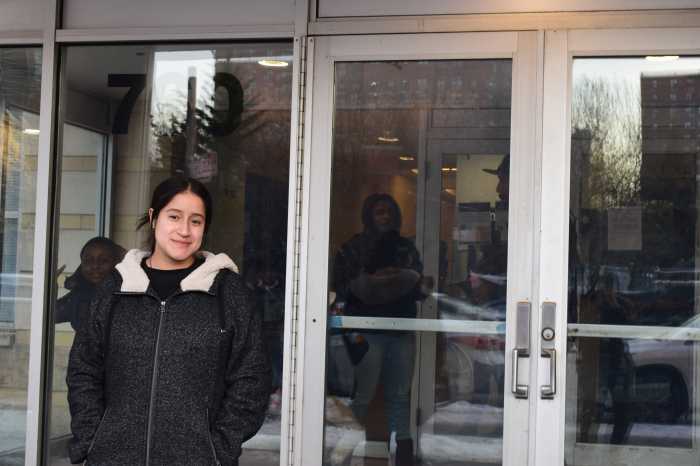
Melanie Reyes –a housing organizer at Nos Quedamos– said that she hoped the purchase would be the start of a process to own their entire collection of more than 20 low-income rental and affordable home-ownership housing units and that bills like COPA would “put community organizations first” by allowing organizations run by Bronxites to implement their visions for the community right where people live.
Through their CLT and housing organizing work, they’ve been able to provide tenants at their buildings with free wifi, environmental resiliency hubs, language classes, legal assistance and greater agency when it comes to addressing housing issues.
What’s most exciting to Reyes –who grew up near Longwood– is that organizations like Nos Quedamos are managed by people from the community where the properties are located.
“New York has to be affordable to New Yorkers,” said Kaila Paulino, a community organizer at South Bronx Unite.
People from all over the world look to New York for culture, arts, and education, Paulino said. “And yet, the people that are so instrumental to what this city contributes to the world are being pushed out.”
The benefits of CLTs in areas like Melrose can expand throughout NYC, especially in areas with people of color and working class communities, Reyes said.
Yet, Reyes added, “it only happens when people have the voice.”