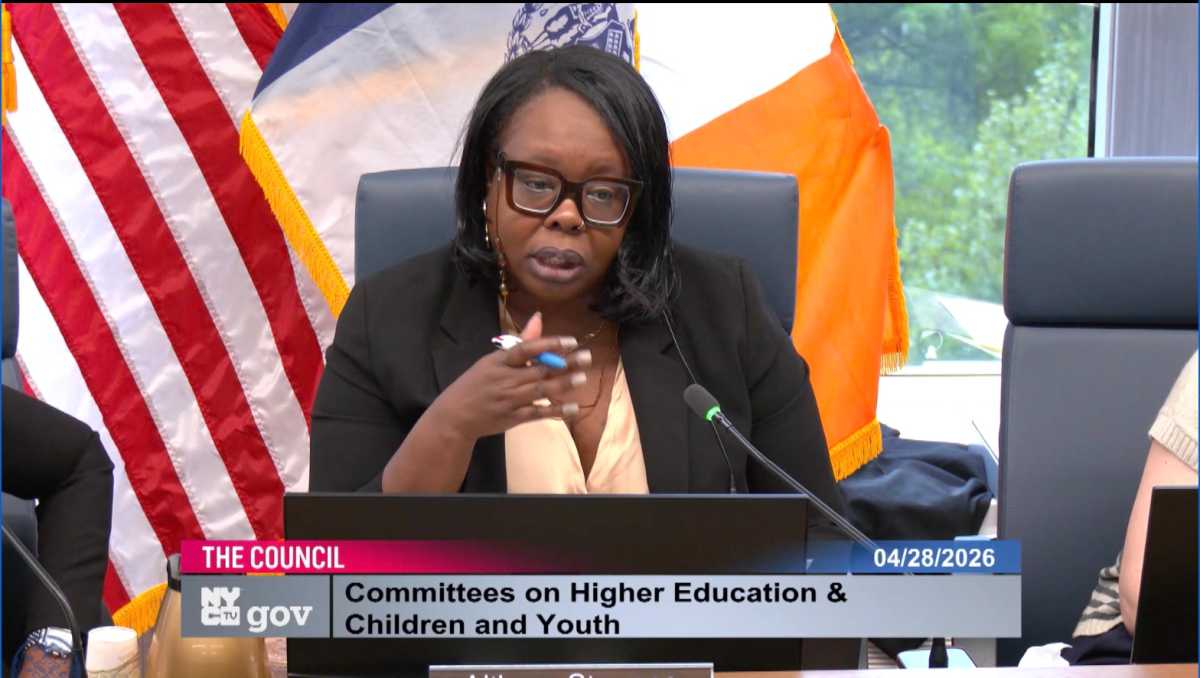
The New York City Council convened a joint oversight hearing on Tuesday to identify the barriers youth with foster care experience face in accessing and graduating from college, highlighting gaps in awareness, coordination and long-term support.
The hearing, held by the Committees on Children and Youth and Higher Education, focused on strengthening pathways for current and former foster youth within the City University of New York (CUNY) system.
Chaired by Council Members Althea Stevens and Rita Joseph, the hearing brought together representatives from CUNY, the Administration for Children’s Services (ACS), students and advocates to assess existing programs and identify areas for improvement.
“For too long, young people who have experienced foster care have had to navigate higher education without the stability and support systems they deserve. If we are serious about equity, then access alone is not enough.” Councilmember Althea Stevens said.
“We must ensure our students have the resources to persist, graduate, and thrive. This hearing is about holding our systems accountable and building a more holistic approach that meets foster youth where they are, supports their full journey, and invests in their future.”
Despite local programs such as the Foster Youth College Success Initiative (FYCSI), College Choice and Fair Futures, national graduation rates for foster youth remain low —they are estimated to be between 8% and 12%.
Testimony from students and advocates underscored that access to these resources is inconsistent, with many young people unaware of available support.
“After enrolling in FISE last year, everything changed for me,” said Alyssa, a former foster youth who now attends Borough of Manhattan Community College. “Without that support, I can guarantee right now I would not be enrolled in college.”
“However, there is still work to be done. I do not believe we will reach the majority of foster youth by having posts on ACS social media and events. We must ensure foster youth are informed earlier by making signage of programs like FYCSI visible in places where they spend the most time, such as group homes and foster homes.”
According to a 2026 FYCSI impact study, 55% of respondents said they learned about the program through their foster care agency, while only about 43% said their schools were familiar with FYCSI and its services.
Council members raised concerns about inconsistent communication between agencies.
“How do we get to a place where consistency is across the board and young people can access information without always having the barrier of the agency, who often does not do the legwork?” Stevens said, directing the question to Ina Mendez, deputy commissioner for the Division of Family Permanency Services at ACS.
Advocates and testifiers also called for structural changes to better support foster youth in higher education, including expanding FYCSI eligibility, improving coordination and data sharing between CUNY and ACS, and ensuring year-round housing stability.
One testifier who did not provide their name, outlined several recommendations. Which included eliminating age-based eligibility restrictions for FYSCI, creating dedicated foster youth liaisons on every CUNY campus and adopting broader success metrics beyond graduation rates.
“Despite these efforts, significant challenges still remain. Coordination between CUNY and ACS is often uneven, like the Chair mentioned earlier. Data sharing is limited and students frequently experience confusion about which supports they qualify for and when those supports end,” the unidentified testifier said.
“Foster youth are not asking for special treatment,” he said. “They are asking for a fair chance. When given stable support systems, clear pathways, and institutional commitment, foster youth can succeed.”
Stevens said the hearing is part of an ongoing effort to strengthen support systems for foster youth and will not be the last discussion on the issue.
Reach Marina Samuel at msamuel@schnepsmedia.com. For more coverage, subscribe to our newsletter and follow us on Twitter, Facebook and Instagram!