
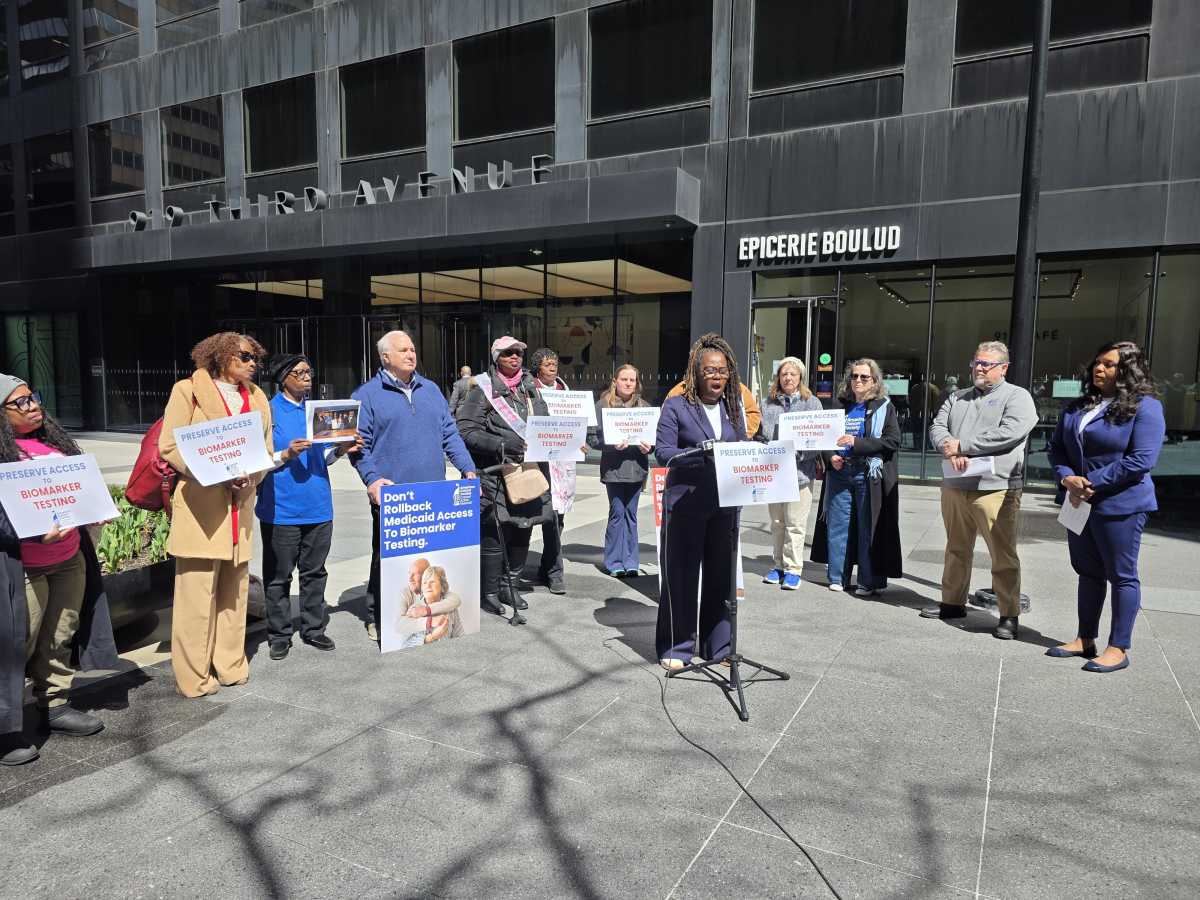
A group of cancer survivors from the Bronx and statewide gathered outside Gov. Kathy Hochul’s NYC office on Third Avenue on April 7 to implore her to preserve Medicaid funding for precision treatment known as biomarker testing.
Because all cancer cells are unique, biomarker testing can provide a detailed look at an individual’s cancer to determine which treatments may be effective or whether a current treatment is working, according to the American Cancer Society. It can also detect some early cancers before a patient develops symptoms and can be applied to other serious diseases beyond cancer.
A state law took effect in 2024, requiring Medicaid and all state health plans to cover biomarker testing. But Gov. Hochul is now proposing to restrict the Medicaid coverage criteria, effectively shutting out those patients, while privately insured patients would be unaffected.
Advocates say such a system, if adopted in the final state budget, would worsen existing health disparities faced by low-income people of color.
For the rally, about a dozen people came from the Bronx, Manhattan, Long Island, Westchester and the Albany region to rally and distribute information to passersby.
Michael Davoli, Senior Government Relations Director with the American Cancer Society Cancer Action Network (ACS CAN), said that a million cancer survivors are currently living in the state and approximately 132,000 New Yorkers will be newly diagnosed this year. Biomarker testing “gives them hope,” he said.
ACS CAN and dozens of other medical organizations are working to keep the biomarker testing rollbacks out of the final state budget.
Davoli told the Bronx Times that Hochul is “trying to balance the budget on the backs of cancer patients” and that biomarker testing actually saves money while preventing patients from enduring treatments that will never work.
“Instead of the trial-and-error approach, it’s precision medicine,” Davoli said.
Jackie Nesbit of the Bronx, an 11-year lung cancer survivor, spoke at the rally while holding a photo of herself with Hochul last December, as the governor signed legislation that expanded access to early lung cancer screening.
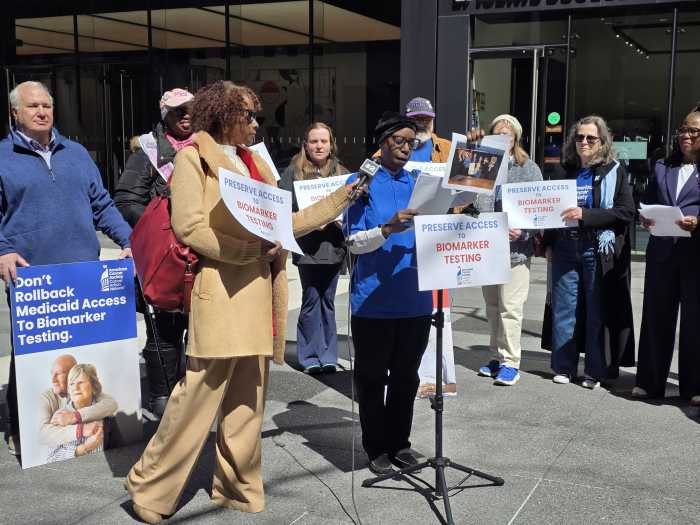
Nesbit said she was “shocked” that Hochul dismantled other barriers to cancer care, only to propose a new one.
“I’ve watched for too long as people of color, low-income individuals and neighbors of mine disproportionately shoulder the burden of disease like cancer,” she said. “It’s largely because we’ve been shut out of advances like biomarker testing.”
Colette Smith of the Wakefield neighborhood said she credits biomarker testing with saving her life after being diagnosed with lung cancer 11 years ago.
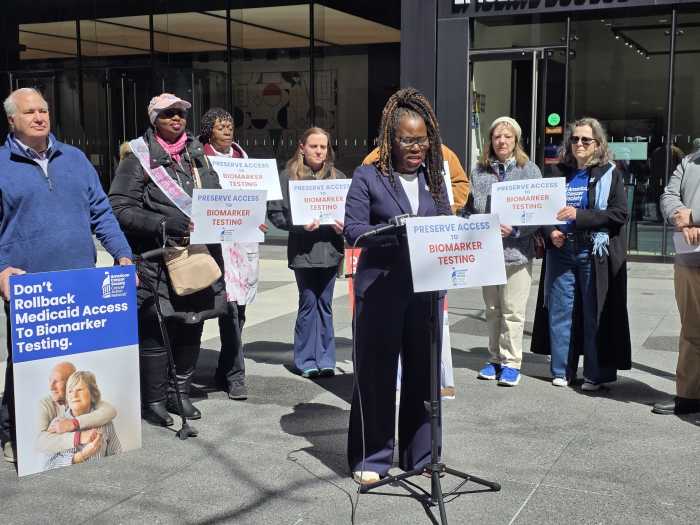
Smith told the Bronx Times that she shows no evidence of disease today, but the unexpected diagnosis — especially since she was not a smoker — upended her and her young son’s life. “I was terrified, and that fear stayed with me for months.”
Biomarker testing helped doctors develop a plan targeted towards Smith’s particular cancer.
They determined that a lobectomy, a removal of the upper left lung, was her “best bet” for survival and that traditional chemotherapy would’ve been “a waste,” according to Smith.
That testing “gave my doctors a road map, it gave me options, and it gave me, my son and our family real hope,” Smith said.
She said the governor’s proposal to roll back coverage would create “an inequity for underserved communities,” as it would only impact those who lack the income for private health plans.
“I understand budgets,” Smith said. “But when lives are at stake and we’re making a differentiation between private coverage and Medicaid, it screams injustice.”
Reach Emily Swanson at eswanson@schnepsmedia.com or (646) 717-0015. For more coverage, subscribe to our newsletter and follow us on Twitter, Facebook and Instagram!