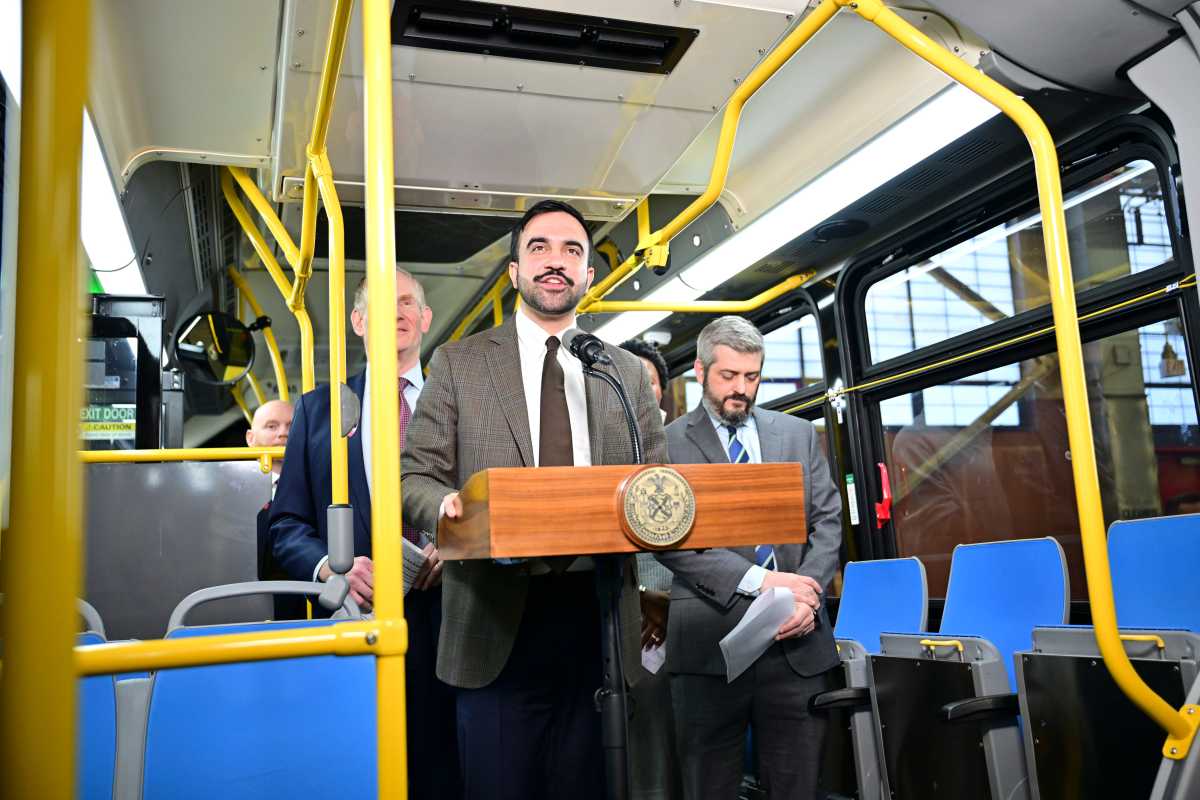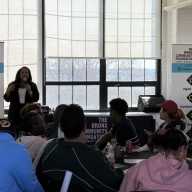
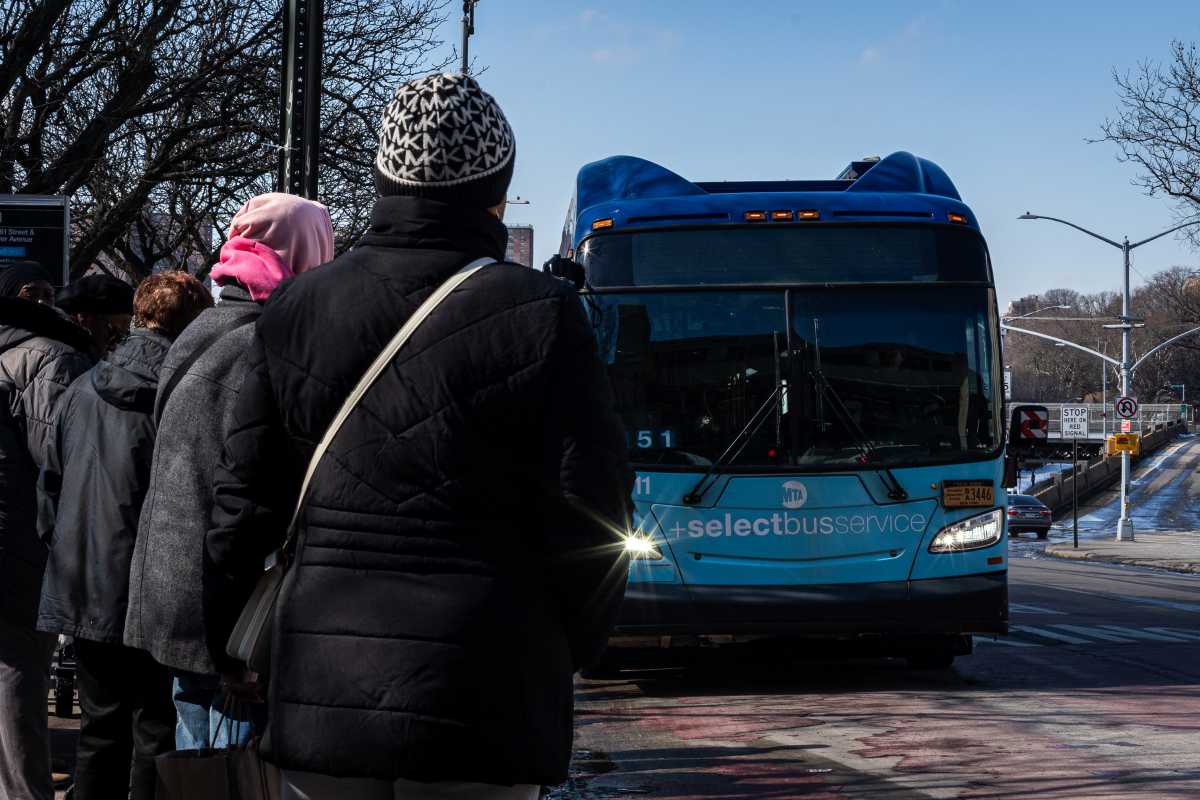
On a mid-February morning, transit advocates gathered with local officials on a bus parked inside a Bronx depot to celebrate a triumphant moment: the resurrection of the paused Fordham Road bus lane project.
They stood with Mayor Zohran Mamdani, who won his post largely on a pledge to make city buses faster and free. He committed to revive the effort, which was put on ice by his predecessor, Eric Adams.
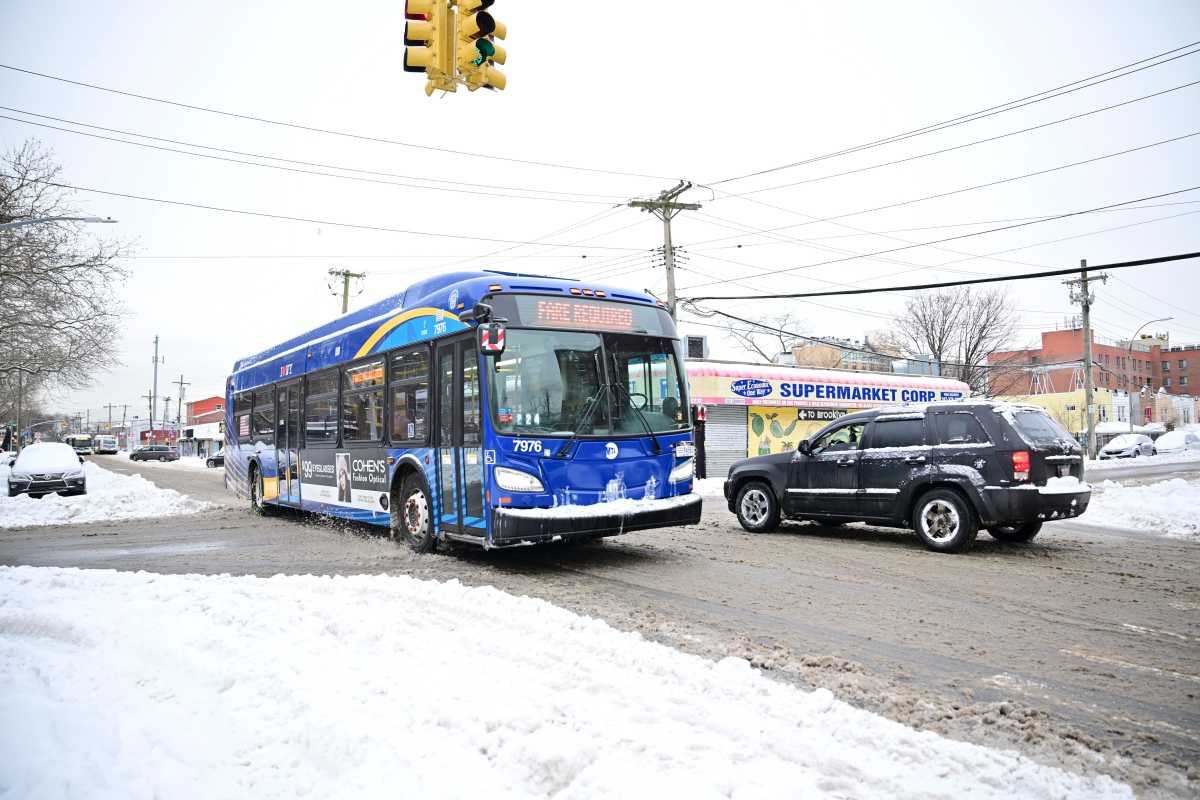
The project aims to speed up the sluggish vehicles, which currently travel down the borough’s busiest bus corridor at roughly 4 miles per hour during peak times. An average 130,000 riders take the buses on Fordham Road — primarily the Bx12 and Bx12 Select Bus Service (SBS)— each day.
Transit advocates broadly viewed the announcement to speed up buses on the Bronx’s most heavily used east-west corridor as a big step forward for a borough starved of speedy cross-town transit.
Lisa Daglian, executive director of the Permanent Citizens Advisory Committee to the MTA (PCAC), said the project is “going to be a golden opportunity for the thousands and thousands of people who ride the Bx12 for work, who take it to the zoo, who go shopping, who just need to get where they’re going.”
Advocates have long viewed speeding up corridors like Fordham Road as the best to ease travel from one part of the Bronx to another.
Danny Pearlstein, a spokesperson for the group Riders Alliance, said that advocates see the Fordham Road project as a test case that can lead to similar changes on the Bronx’s other east-west corridors.
“Our hope is if we really prove a very robust concept on Fordham that leads to much faster buses and saves people a lot of time, that that’s something that other communities will want to see replicated to the north and south,” Pearlstein said.
“Fordham is the place to start because that’s the one that most people have some experience with because it’s the heaviest ridership.”
The Bronx’s glacially slow east-west transit
A majority of the Bronx’s 1.3 million residents (61%) do not have access to a private vehicle, according to 2024 U.S. Census data. As a result, the bulk of the borough’s population depends on public transit.
But while the Boogie Down has seven subway lines that fan out from the South Bronx to areas including Woodlawn and Pelham Bay Park, not one of them connects the borough’s east and west sides.
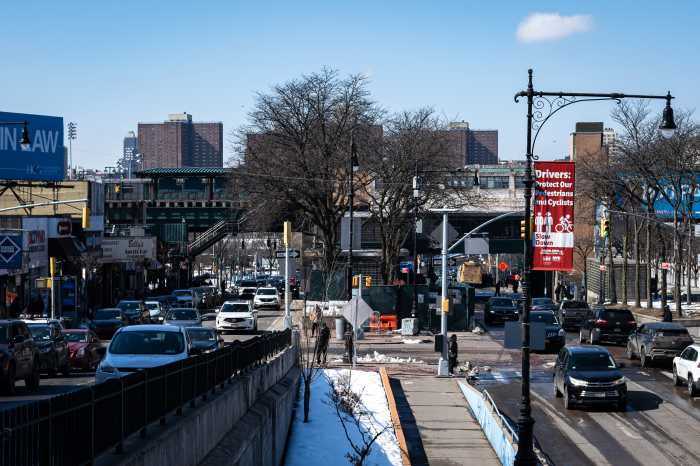
That reality means east-west bus routes such as the Bx12, on Fordham Road, and the Bx36 on Tremont Avenue, are the main options for crosstown commuting. But the slow speeds at which buses move along those streets, due to congestion, render them inadequate.
The Bx12 travels at an average speed of 8 mph, according to MTA data, while the Bx12 SBS moves only slightly faster at 8.8 mph. But on the slowest stretches of Fordham Road, bus speeds can dip below 4 mph, according to 2019 MTA data presented by the city Department of Transportation (DOT) in 2023.
Bronxites who live along the Bx12 heavily depend on the bus, as 62% of them do not have access to a car and 71% commute to work via public transit, walking, or biking — according to DOT.
The stretch currently has bus lanes adjacent to the curb, which experts say are less effective at speeding up buses than offset bus lanes running down the center of the street or busways. The project, paused by Adams and now restarted by Mamdani, would install center-running bus lanes on Fordham Road between Sedgwick Avenue and Boston Road.
On Tremont Avenue, a corridor that serves over 39,000 daily riders, buses travel at less than 5 mph during peak times, according to the DOT.
Seventy-two percent of households living along the corridor do not have access to a car, while 78% commute to work by public transit, biking or walking.
Similar to Fordham Road, DOT was set to install a busway — where private vehicle traffic is restricted — along the route of the Bx36 on Tremont Avenue until the Adams administration suddenly shelved the project last summer. The plan called for building half-mile-long busways eastbound from Third Avenue to Southern Boulevard, and westbound from Southern Boulevard to Belmont Avenue.
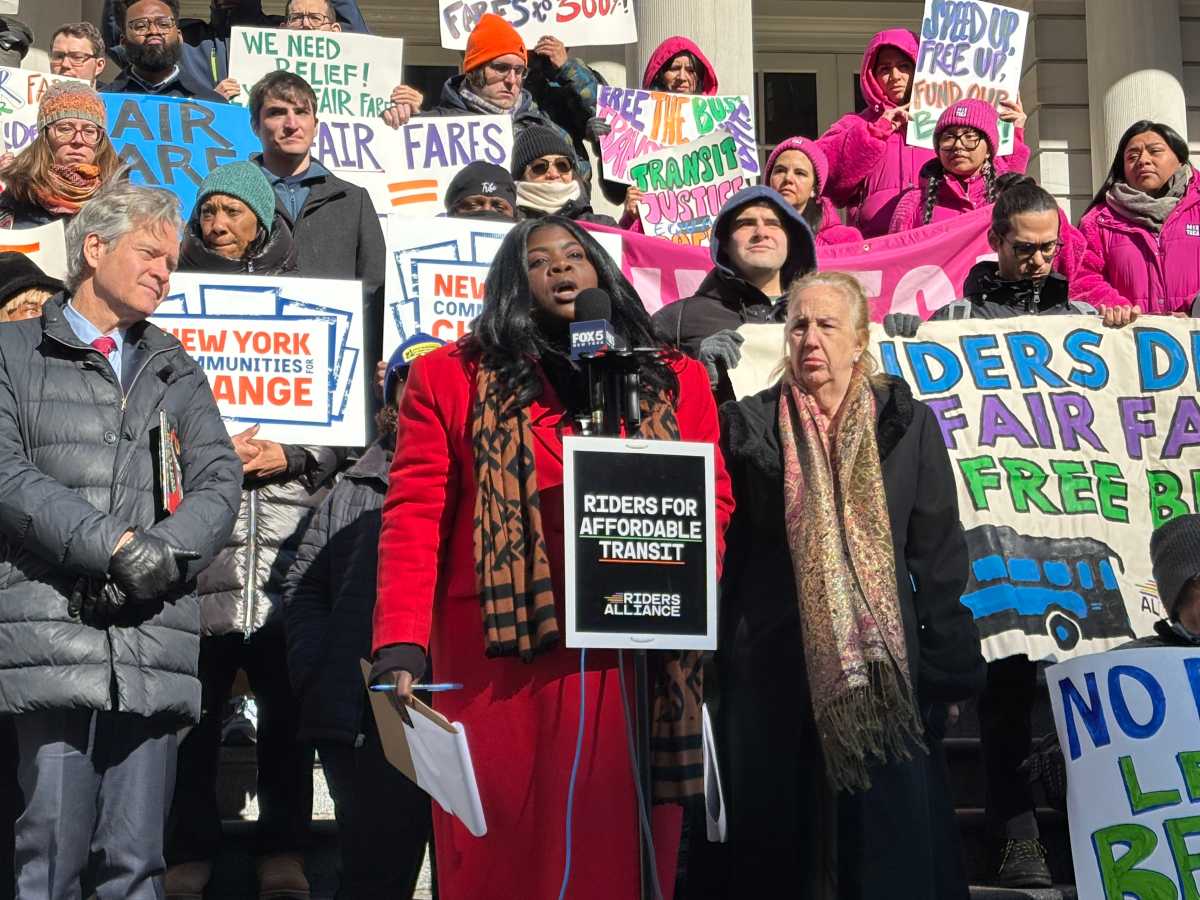
Local advocates demanded Mamdani relaunch the project at a Feb. 25 rally
“The Tremont Avenue busway still remains frozen after being shelved by the Adams administration last summer,” Siddhartha Sánchez, executive director of the Bronx River Alliance, said at the rally.
“We are the most bus-reliant borough in the whole city, and for Black and brown communities still physically divided by the Cross Bronx, buses are an especially critical lifeline,” he added, referring to the Cross Bronx Expressway that cuts across the middle of the borough. “We need the mayor to fast-track the Tremont Avenue busway.”
Seeking a faster way
Anna Berlanga, the Bronx organizer for the advocacy group Transportation Alternatives, and a Bronx resident, said members of the group’s Bronx/Uptown Activist Committee recently identified the lack of speedy east-west transit as the most common challenge facing Bronxites.
“We were having a lot of trouble with the east-west bus routes in particular, largely because if you’re going north-south, you can take the train…but getting from east to west is very difficult,” Berlanga said.
Democratic City Council Member Amanda Farias, whose district covers east Bronx neighborhoods including Soundview and Parkchester, echoed Berlanga’s sentiment.
“We do not have any real timely and reliable east-to-west transit in our borough, particularly because we are completely reliant on the bus system that has to crisscross around several parkways and highways, major areas that have a lot of congestion,” Farias said.
Berlanga said that while the subway system was oriented to move people into and out of Manhattan, commuting patterns have changed in recent years, with Bronxites traveling more within the borough than to and from Manhattan.
“Four times as many Bronx residents work in the Bronx as they do in Manhattan,” she said. “So people really need to get around the Bronx.”
Berlanga said the group will soon launch a campaign focused on speeding up four east-west bus routes: Fordham Road, Tremont Avenue,161st Street, and 149th Street.
She said the group would accept a range of “effective solutions” to quicken bus speeds on the corridors, including busways and certain kinds of bus lanes.
“Different things will work on these corridors, but we just want them to go faster,” Berlanga said. “The average speed on these corridors is…barely faster than walking.”
While advocates were broadly supportive of Mamdani’s Fordham Road announcement, some voiced concerns that his plan to install bus lanes rather than busways would be less effective. However, they were pleased he said DOT will tinker with the project until it boosts bus speeds by 20%.
DOT Spokesperson Vincent Barone said of the Tremont Avenue project: “We’re just getting started; the Mamdani administration has tasked us with developing bold ideas to bring bus service to the next level, and we look forward to sharing these plans soon.”
It was unclear whether or when the Mamdani administration would restart the redesign.
Barone did point to improvements DOT already has in the works on other east-west corridors.
For instance, on 161st Street, where the Bx6 local and SBS move at average speeds of 6 to 7 mph, Barone said DOT will break ground on an improvement project this year. He said the redesign aims to speed up SBS service on the stretch by enhancing its painted curbside and center-running bus lanes with concrete infrastructure.
Specifically, Barone said DOT will install bus boarding islands along parts of the road between River and Melrose Avenues, which are intended to keep cars out of the center-running bus lanes.
Ed García Conde, who lives near 161st Street, said anything would be better than the street’s current design, which he compared to a “parking lot.”
“Anything that would physically bar vehicles from going in, other than the buses and emergency vehicles, would be an improvement,” Conde said.
Penn Access
Speeding up east-west bus service is not the only area in which local officials and advocates are looking to improve transit in the Boogie Down.
Another is a project known as “Penn Access.” The undertaking promises to eliminate “transit deserts,” where there are limited public transportation options. It promises to give 30,000 daily riders in the East Bronx rail access to Manhattan by bringing four new MetroNorth stations to that side of the borough.
The $2.9 billion effort will see the new stations — to be located at Co-op City, Morris Park, Parkchester/Van Nest, and Hunts Point — built along existing rail tracks used by Amtrak and Metro-North Railroad.
The Metro-North trains, running via its New Haven line, would be routed into Penn Station on Manhattan’s west side — connecting it to the hub for the first time.
“There’s not too much subway access in the far East Bronx, and this is an opportunity using existing infrastructure to get people much faster access to Manhattan,” Pearlstein of Riders Alliance said.
“There shouldn’t be miles and miles of rail infrastructure with no stops through the Bronx,” he added.
Daglian, of PCAC, said Penn Access will “provide a huge opportunity for access to education, to employment, to fast transit that didn’t exist before.”
But the undertaking, originally slated for completion by 2027, has been derailed by a dispute between the MTA and Amtrak. It is now not expected to be finished until 2030 at the earliest, MTA officials said last year.
“This project has been troubled from the start and that’s predominantly due to the fact that we are working on Amtrak territory, subject to Amtrak’s cooperation and oversight,” said Jamie Torres-Springer, the head of MTA Construction and Development, during the agency’s October 2025 board meeting.
Farias, whose district includes the Parkchester/Van Nest station, said the delay is “very disappointing.”
“The four districts that it’s impacting in the Bronx already have waited an extremely long time to see this project move, and a lot of commitments and promises were made from the last administration to these communities,” she said, referring to the Adams administration’s plans to build housing around two of the new stations.
Despite the delays, the MTA drafted a plan to stand up temporary stations at Co-op City, Morris Park, and Parkchester/Van Nest by next year. Those stations would allow east Bronx commuters to begin benefiting from Penn Access, while the MTA continues construction.
When asked for an update on Penn Access’ current status during the February MTA Board meeting, agency Chair and CEO Janno Lieber said they are “making progress” with Amtrak on the work schedule.
“But [we’re] still working with them on coming up with a viable plan to have [an] early start of…Penn Access service,” Lieber said. “So that is still a work in progress and negotiations and work is underway.”
Bronx subway capital investment
Although Penn Access is by far the MTA’s largest Bronx infrastructure project at the moment, the agency says it has also invested in making the borough’s subway lines more accessible, performing necessary repairs, and replacing decades-old trains over the current and last capital plans.
“The numbers will show that the Bronx is getting a big benefit from the current MTA capital program,” Lieber said at the February board meeting.
The MTA invested $7 billion in the Bronx in its last capital program for 2020 through 2024, and boosted that amount to $10 billion in its current 2025-2029 plan, according to agency data.
The plans have and will bring several more Bronx subway stations in compliance with the Americans with Disabilities Act by installing elevators. For many years, the MTA has been woefully behind in fulfilling its obligations to make every one of its 472 stations accessible, but has steadily been making a dent in that gap in recent years.
Lieber said that it is no easy feat, given the way that many of the Bronx’s subway lines are designed.
“The Bronx has a lot of elevated structures, a lot of elevated stations, and so it’s particularly challenging for ADA, but we are getting that done,” Lieber said.
By the end of the current capital program, 42 Bronx subway stations will be equipped with elevators, meaning 59% of the stations in the borough will be ADA-compliant, data shows. That is compared to just 18% that were accessible in 2020.
Lieber said that means the Bronx will have a slightly higher percentage of accessible stations than the citywide average of 55%.
The plan also funds updating aging subway infrastructure in the borough, Lieber said.
In the current capital plan, those updates include repairing and painting elevated structures on the Pelham 6 line, Jerome Avenue 4 line, White Plains Road 2 and 5 lines, and Dyre Avenue 5 line; repairing the underground structure on the Jerome Avenue 4 line and the White Plains Road 2 and 5 lines; and rehabilitating 9 electrical power substations and building a new one to serve the 1 line.
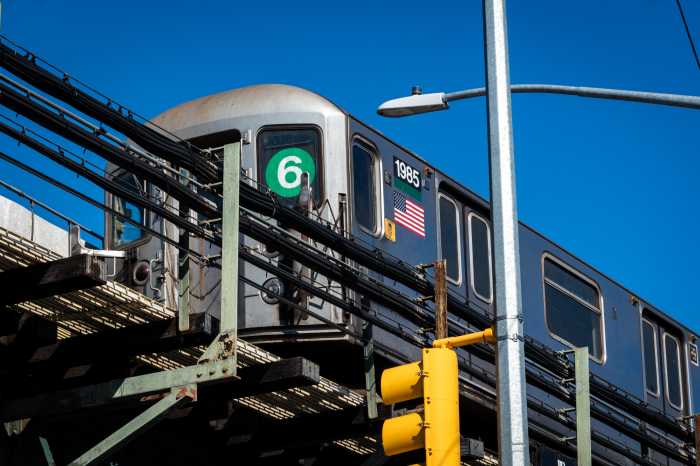
The MTA also funded the replacement of subway cars on the 1 and 6 lines, which both run through swaths of the Bronx. The plan will switch out mid-1980s-era subway cars, which are more prone to breaking down and are technologically outdated, with new modern trains known as R262s.
One area where the Bronx is lagging behind other boroughs in the latest capital plan is with the modernization of signal systems — the technology that tells train operators whether they can move forward or should stop. Older signals throughout the system often cause delays because they require more spacing between trains.
An MTA spokesperson said that part of the agency’s spending in the Bronx in its current capital plan is going toward preparing it for adding modern signal systems in the next one — covering 2030 to 2034. For instance, the spokesperson said, they need to begin running the new trains on the 1 and 6 lines before moving forward with signal modernization, due to the immense cost of retrofitting older trains to be compatible with new signals.
But the spokesperson said the agency can afford to take more time with modernizing signals in the Bronx because they are in good shape compared to the rest of the system. The oldest signals in the Bronx were installed in the 1990s, they said — making the technology far newer than some of the signals in Brooklyn and Queens that date back to the 1930s.