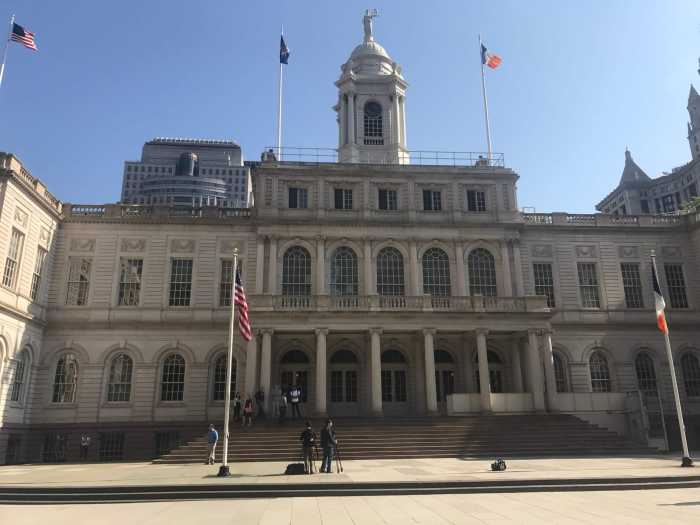

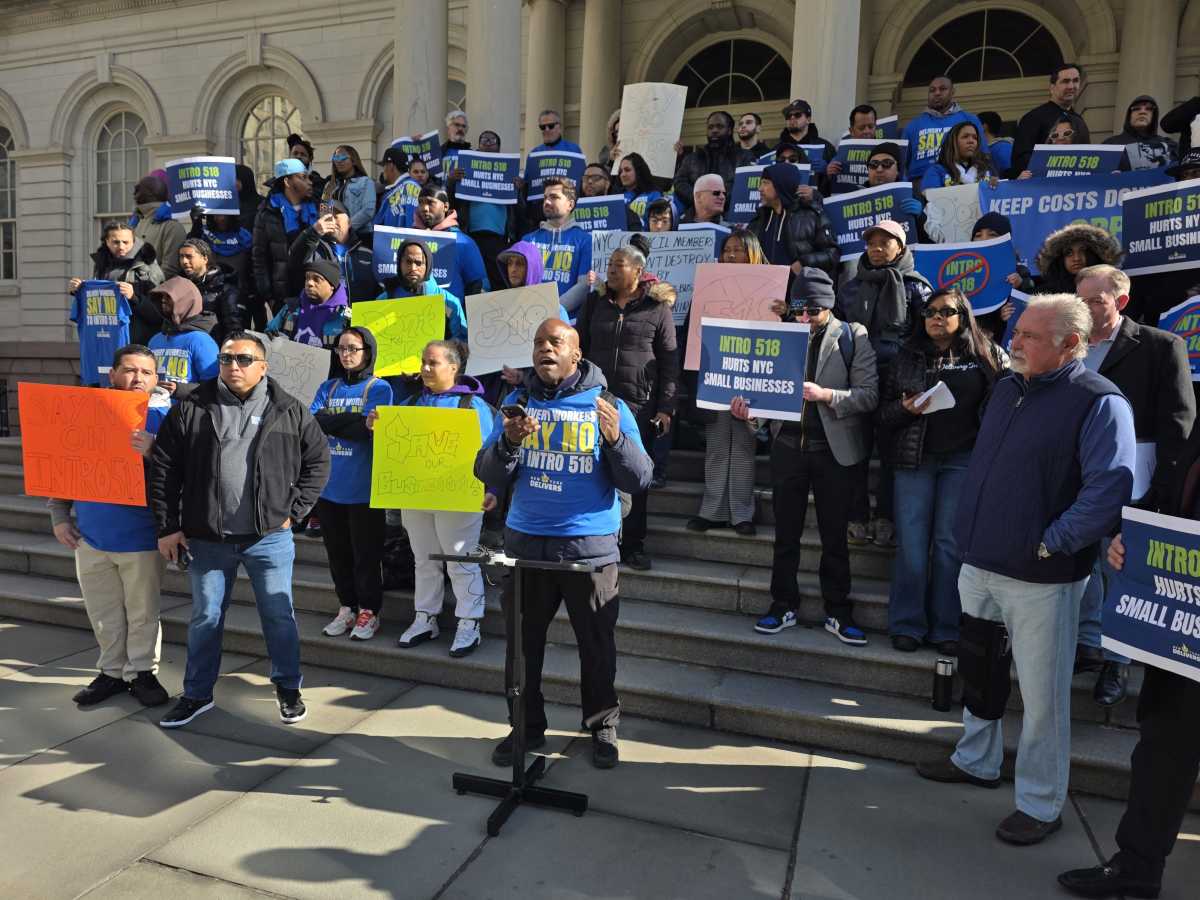
A crowd of hundreds descended on City Hall April 9 to rally for and against a council bill, Intro 518, that would create a licensing requirement for last-mile delivery facilities, along with job safety requirements.
Amid the explosive growth of online ordering in recent years, more than 1 billion packages are expected to be delivered in NYC this year alone. Yet distributing these goods quickly comes at a cost to people and the environment.
At the rally and subsequent council hearing, supporters said the bill is necessary because delivery workers are forced to prioritize speed above all, resulting in an overwhelming workload where they work while ill, have no time to eat or use the bathroom, do unsafe heavy lifting, use vehicles in disrepair and potentially drive in a hazardous manner — all of which puts workers and the public at risk.
Supporters believe that licensing is the only way to hold companies accountable when things go wrong. But opponents said the bill represents government overreach and would result in significant job losses at a precarious time for the city’s economy. An analysis by consulting firm AKRF estimates that more than 10,000 NYC jobs could be lost if the bill takes effect.
The legislation already has a broad base of support from the Mandani administration, Queens rep Tiffany Cabán as lead sponsor and 30 more co-sponsors, including Bronx members Justin Sanchez, Amanda Farías, Pierina Sanchez, Althea Stevens, Elsie Encarnacion and Shirley Aldebol, who serves on the Committee on Consumer and Worker Protection.
However, Intro 518 also faces strong opposition from local chamber of commerce leaders, as well as New York Delivers, a coalition of small business owners and workers who brought hundreds out to protest the bill’s impact on subcontractors — and the other businesses that rely on them.
Ahead of the 10 a.m. hearing, about 100 opponents of the bill rallied on the City Hall steps with signs that read, “Don’t kill jobs!” and “Intro 518 hurts NYC small businesses.” Several hundred more waited outside the gates and were not let in until the hearing.

The rally was led by Rudy Cazares, owner of Pelham Bay-based Cazar Logistics LLC, one of Amazon’s top subcontractors.
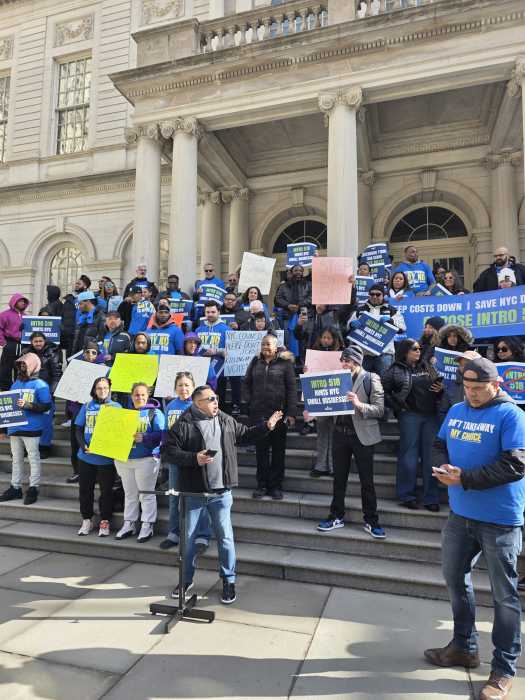
Cazares, a Marine Corps vet raised in Queens by Mexican immigrant parents, said his company has delivered 20 million packages throughout the Bronx and Queens. In addition, it has also delivered 140,000 meals to veterans and service members at no cost to the city, he said.
Cazares said Intro 518 is an overreach that would kill his company.
“This is New York City deciding who gets to do business in this city. And if small businesses like ours are pushed out, those opportunities don’t grow,” he said. “Protect our workers, absolutely. But do not do it by destroying small businesses that already employ them.”
After the rally, Cazares told the Bronx Times he shares the council’s concerns about worker safety, air pollution and other issues the bill aims to address.
The city has previously identified serious concerns with the last-mile delivery industry. The Nov. 2025 Comptroller report, “Fast Shipping, Slow Justice: Traffic, Worker, and Climate Hazards in Last Mile Delivery,” noted steep increases in traffic crashes and injuries near last-mile distribution facilities, though not always involving delivery vehicles.
It also pointed to increased air pollution in areas with high concentrations of last-mile facilities, such as Hunts Point in the Bronx and Red Hook, Brooklyn, as well as high rates of worker injuries.
The licensing requirement would bring subcontractors into the fold as direct employees. Without that measure, supporters say companies can evade responsibility for their injured workers and increasingly polluted neighborhoods.
While Cazares and others agreed these problems should be addressed, they disagreed that Intro 518 is the best solution.
He said his company is already working to reduce pollution. He said he participated in an Amazon e-bike pilot program and has some electric vehicles, though not the entire fleet.
“We’re all 100% about the environment and our community, which is why we doubled down on safety, why we doubled down on wanting to go electric,” Cazares said.
He said the entire premise of the bill should be revisited to include more input from industry leaders like him.
“I think we start from scratch,” he said. “This bill did not go through any real process to really, truly understand – how do we make it about the workers and not special interests?”
A balancing act
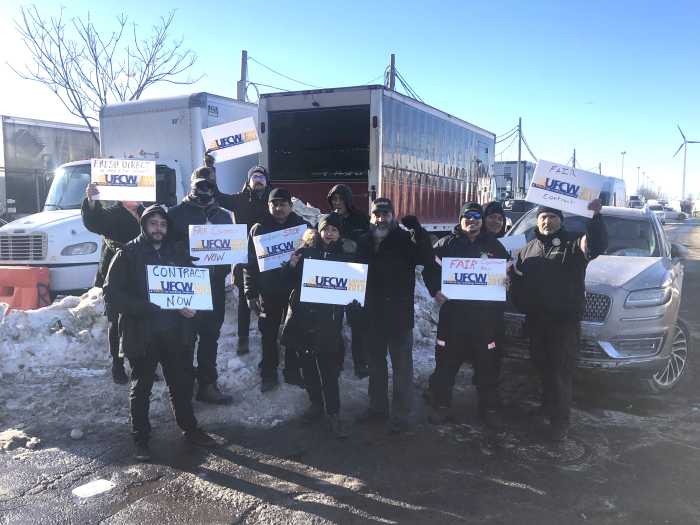
The bill’s lead sponsor, Tiffany Cabán of Queens, was among several electeds who joined the smaller group of Amazon Teamsters rallying to pass the bill.
“We’ve seen workers forced to drive vans literally held together with f—ing tape, and they’re forced to urinate in bottles so that they can meet impossible quotas and ever shorter delivery windows,” Cabán said. “This is a public safety issue, period.”
Epstein, who chairs the committee overseeing the hearing, also joined supporters.
“I’m going to stand with workers and stand with this union and these union brothers and sisters, and say this is enough. People deserve to work in safe conditions.”
Brooklyn Borough President Antonio Reynoso said the last-mile industry can undergo successful reform without folding, using the trash carting industry as an example. He said no one is asking Amazon to leave New York City but rather to meet higher standards.
“The least you can do is have a standard that matches your profit margins,” he said. “Make it so that you’re the greatest company in the city of New York, that your employees get paid more than anyone else, have the best health insurance, have the best safety standards. That is the standard that we want you to set here in New York City.”
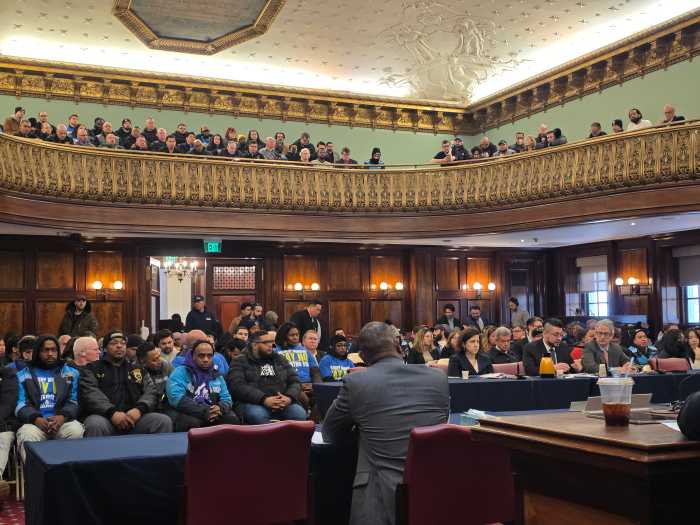
Following the rallies, the 10 a.m. hearing by the Committee on Consumer and Worker Protection, chaired by Harvey Epstein of Manhattan, was the bill’s first public discussion and drew a packed chamber.
Lisa Sorin, president of the Bronx Chamber of Commerce, said the bill would result in job losses in the borough.
She said she spoke with eight Bronx business owners and concluded that 1,200 jobs would be lost if the legislation passes.
Sorin also said workers are not necessarily better off as direct employees of a large corporation.
She said many last-mile businesses like Cazares’ are owned by immigrant, veteran and/or first-generation entrepreneurs who support their workers through mentorship, tuition reimbursement and more.
The city should deal with bad actors individually rather than a one-size-fits-all approach, since most last-mile owners do not mistreat their workers, Sorin said.
“These are not faceless operators. … They have achieved the American dream and are now working with their employees to do the same.”
Her Brooklyn counterpart, Randy Peers of the Brooklyn Chamber of Commerce, said the bill would “put a whole subsector of the economy out of business” at a time when the city can little afford to do so.
Under the bill, large companies could not be forced to rehire subcontractors as their employees — so preserving those jobs is not a given, Peers said.
He said that last year, in New York City, more businesses closed than opened for the first time since the pandemic. “Do you really want to now shut down a whole sector of our economy?”
‘This act will save lives’
At the hearing, Carlos Ortiz, chief of staff for the city Department of Consumer and Worker Protection, said the agency and the Mamdani administration support the bill.
Licensing can be an important means of holding bad actors accountable, and the subcontractor model has thus far “shielded” companies from any liability, he said.
If the bill is implemented, the agency must carefully balance business needs with the new regulations, he said.
A large number of people testified in person and via video, with some supporters of the bill saying that companies cannot be trusted to protect workers.
One participant, Ira, said he worked with Amazon from 2019 to 2025 and witnessed a “daily disregard for the safety of workers and the public.”
The company had what he called an “obsession with speed,” resulting in a dangerous, chaotic environment with “vans speeding all over the area” as people rushed to load the vehicles. Ira said the company also behaved irresponsibly during a COVID outbreak, a severe storm and other instances.
Ira said he witnessed accidents and many close calls, yet Amazon denied liability. He also said he could not find any clear safety guidelines for employees.
“Safety at Amazon does not exist unless they’re using it to discipline workers, and then they make up rules out of thin air,” he said. “This act will save lives.”
Reach Emily Swanson at eswanson@schnepsmedia.com or (646) 717-0015. For more coverage, subscribe to our newsletter and follow us on Twitter, Facebook and Instagram!