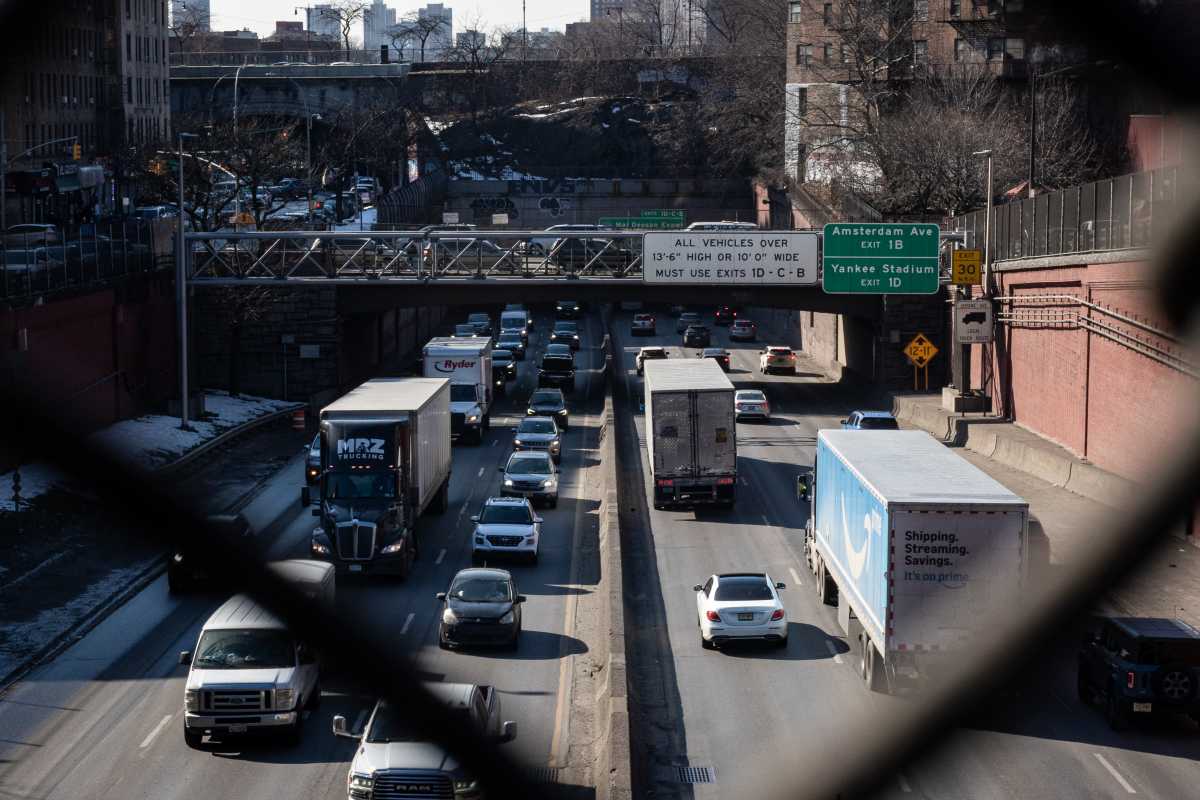
The Cross Bronx Expressway has defined the geography of the South Bronx for over seven decades, and not for the better.
Cutting across the borough from east to west, the highway serves as a crucial stretch of Interstate 95, which runs from Miami to Canada and carries over 200,000 vehicles each day. Robert Moses, the driving force behind urban renewal in the middle part of the 20th century and champion of the automobile, designed the expressway in 1948.
It would turn out to be perhaps the most destructive example of urban planning in the United States.
Stretching about 6 ½ miles long and spanning six lanes between the Alexander Hamilton Bridge in Highbridge to the mouth of the New England Thruway in Throggs Neck, the Cross Bronx displaced more people and cost more money per mile than any other similar project in the country.
It notoriously destroyed neighborhoods and sliced integrated communities in half. The years after the expressway’s construction saw these communities spiral into high rates of poverty, crime, and racial divide.
Today, it pollutes the air day and night, subjecting thousands of people living nearby to choking diesel fumes and the sounds of honking horns and rumbling engines around the clock.
And many drivers who use the highway never set foot in the Bronx.
The Cross Bronx has the highest proportion of freight traffic among highways in New York City, with freight trucks accounting for 18% of all vehicles that use the Cross Bronx, according to a joint 2025 study by the city and state.
The report found that, though the highway is “frequently used for through trips that neither start nor end in the Bronx, the majority of trips (66%) have an origin or destination in the Bronx, including approximately 13% of trips that are Bronx-to-Bronx.”
“It’s not a highway that serves New York, it’s a highway that goes through New York,” said Adam Susaneck, an architect and urban planner who has long studied New York City highways and efforts to mitigate their impact.
With so much of the highway’s traffic going through the borough, but not to or from it, advocates for the highway’s reform say the Bronx is taking the hit for a road that serves relatively few in the community.
“It’s an artery that serves the region, and it comes at a cost to the local community,” said Siddhartha Sánchez, executive director of the Bronx River Alliance.
Advocates have long fought for mitigation of the Cross Bronx’s worst features. The South Bronx, nicknamed “asthma alley” by some, is host to some of the worst health outcomes across the entire state, with a staggering asthma rate 12 times greater than the national average. The Cross Bronx is just one piece of an area packed with highways, waste facilities, power plants, and warehouses.
Mending a built boundary
The Cross Bronx Expressway cut through neighborhoods that were, at the time, some of the most ethnically integrated areas in the country, with significant Jewish, Irish, and Italian populations and growing Black and Puerto Rican populations.
The highway’s construction dragged down property values as white residents left for the suburbs with government-backed mortgages, and Black and brown residents remained, largely due to redlining policies and a lack of government support.
“The Cross Bronx cut the Bronx in half and provided basically no local benefit and only environmental and mobility crises,” Susaneck said. “The makeup of the neighborhood changed because of it.”
Susaneck founded and runs the project Segregation by Design, a long-running study documenting the “destruction of communities of color due to red-lining, ‘urban renewal,’ and freeway construction” using aerial footage, diagrams, and demographic data.
The South Bronx is just one example of the disparate health and community outcomes for communities of color resulting from highway construction in the United States. People of color account for 42% of the U.S. population, and represent 57% of individuals living in counties with designated unhealthy levels of air pollution; 53% of those individuals live in counties with the worst air quality.
“The Cross Bronx and the pollution that it emits has been really devastating for Black and brown communities in the Bronx for generations, impacting the environment, sickening families, children and elderly in particular,” Sánchez said.
Nilka Martell is the founder and director of Loving the Bronx, a community organization focusing on environmental and social justice issues, and has long advocated for capping parts of the highway.
She has seen firsthand how the highway impacts health outcomes in the Bronx. Her son developed asthma when he was just a few months old, which is what led her to environmental advocacy work.
Doctors asked her about whether anybody in the house smoked, her home’s carpeting, and whether her family had mold, pets, rodents, or roaches. But none asked, “Do you live near a highway?”
“People are completely disconnected from the fact that living near these highways, that this built environment really impacts public health,” Martell said.
A plan to expand despite the problems
Even though the problems of the Cross Bronx Expressway have been well documented, New York State is looking to move forward with a 50-foot expansion to the highway as parts of it fall into disrepair — a proposal that has enraged locals, advocates, and elected officials.
While the state backed off its original plans to add a new mile-long expansion of the Cross Bronx — a development the State described as a “traffic diversion” structure — advocates worry that any additions to the highway will only hurt the community more.
The State extended its deadline to finalize the environmental determination and construction planning for the development, named the Five Bridges Project, from January 9 to March 10, allowing more time for changes to the project. However, Sánchez said that the River Alliance and other groups in the Stop the Cross Bronx Expansion Coalition have hit a wall with the State ever since they successfully negotiated against the State’s most disruptive plans for the highway.
“It has been nearly four months of silence from the State,” Sánchez said. “We thought we were making progress, we thought we were at the table.”
The City and the State have acknowledged the harms caused by the Cross Bronx throughout history, describing the highway in their report as having “divided the borough in a way that displaced residents and separated vibrant and cohesive communities, resulting in economic disadvantage and disinvestment.”
Still, the State has a responsibility to maintain the highway as a crucial regional artery. Advocates have tried to work with the State to balance local and regional interests, but the State-owned highway has continued to harm those closest to it.
New York State Department of Transportation (NYSDOT) spokesperson Rolando Infante wrote in a statement to amNewYork that the department is “fully committed to making historic investments in the Bronx and to right the wrongs of past generations.”
“As we advance a project to provide urgently needed rehabilitation of five aging bridges on the Cross Bronx Expressway, we have engaged with the community at every step of the way, making significant changes to the proposed alternatives in direct response to public feedback,” Infante wrote, rejecting the characterization of the roadway addition as an “expansion.”
“This is not an expansion project of the expressway, rather a project that will enhance safety and ensure that the infrastructure of the Bronx is resilient for generations to come,” Infante added.
NYSDOT plans to release the final environmental impact report sometime in March, according to a representative of the department. According to the department, the proposed addition to the highway would not increase the highway’s capacity, but would boost road safety by widening shoulders and replacing aging infrastructure.
Capping the Cross Bronx Expressway
For years, advocates, researchers, architects, and engineers have weighed potential solutions to the Cross Bronx’s community divide.
In the 2010s, an idea began to pick up speed: What if the State could “cap” parts of the highway, effectively moving traffic under new developments of public space and reconnecting neighborhoods that have been divided for decades?
Other cities across New York and the United States have taken on similar projects. Most notably, Boston’s “Big Dig” created five new parks and hid a 1.5-mile swath of highway in the city’s urban center. The project took 16 years to complete, with the city breaking ground in 1991 and completing the construction in 2007.
It was also notorious for cost overruns and constant breakdowns. Since its completion, it’s seen leaking tunnels, ceiling collapses, and an investment that could end up exceeding $20 billion once it’s finally paid off in 2038.
Capping parts of the Cross Bronx would be a much smaller undertaking, but it would serve a different purpose.
“A cap hasn’t been built for the express purpose of equity before,” Susaneck said, noting that most caps are built in business districts and city centers.
A 2018 study by Columbia University researchers found that capping parts of the Cross Bronx Expressway with “deck parks” could “bring health benefits alongside economic savings over the long term.”
New York City and State identified 13 potential capping locations along the Cross Bronx Expressway in their 2025 report, clarifying that further study would be needed for each location and that funding would “need to be identified and secured.”
A spokesperson for the New York City Department of Transportation said in a statement that the proposals in the 2025 report “reflect two years of public outreach.”
“NYC DOT is currently refining project designs and will share more with the community soon,” the spokesperson said.
But advocates are telling a different story.
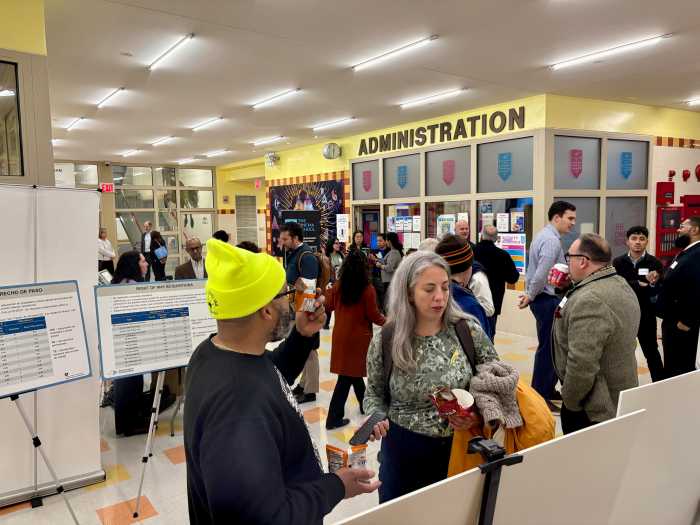
The State published a 6,000-page environmental assessment on the Five Bridges Project on Nov. 18, 2025, giving the public until Jan. 9 to comment — a timeline that advocates said left the community in the dark, as low awareness over the holiday season led to low engagement.
Sánchez said that, even despite the relatively short comment period running over the holiday season, residents and advocates have “identified and expressed concerns” around the health and environmental risks within the proposals.
Martell sees capping as the primary way to reduce air pollution, noise pollution, connect communities that have been “severed” by the highway, and create new green space.
“We’re looking at this as an opportunity to right these wrongs of Robert Moses and not look at these spaces that can be capped as spaces for housing but really look at it as, maybe, a continuous, linear park,” said Martell, who is also the board chair of the Bronx River Alliance.
Capping parts of the highway would open up more space for local residents and, most crucially, take steps toward reconnecting the communities that were cut in half by the highway’s construction.
Thaddeus Pawlowski, an urban designer and a professor at the Columbia Graduate School of Architecture, Planning and Preservation, said that capping parts of the highway would be an ideal solution for many of the problems it poses to the surrounding community.
“I know it’s expensive, but it’s more expensive to leave all these communities suffering from this air pollution and this noise and this disconnection,” Pawlowski said of the capping proposal.
Capping is a complex undertaking for the architects and engineers tasked with its implementation. In addition to creating green space where it didn’t previously exist, capping requires ventilation to avoid harmful chemicals getting trapped with drivers.
Congestion pricing in the Bronx?
In addition to capping, Sánchez hopes the City and State will look at implementing congestion pricing, which has proven to be successful in Midtown Manhattan, on the Cross Bronx to limit the amount of vehicles on the road.
“It’s just so exhausting,” Martell said. “It’s the same agency that undertook this feasibility study, and it’s currently taking on the planning and environmental linkage study to see how the capping can be done, so it just doesn’t make any sense to me how the same agency could look at all these projects and think that it’s important to widen this highway.”
Solving the borough’s transit problem
When he built the Cross Bronx Expressway and other highways across New York state, Moses often cited their need to help reduce traffic citywide. But building more roadways only saw the city’s traffic problem grow worse — a phenomenon known in urban planning circles as induced demand.
Today, the Cross Bronx carries on average up to 165,000 vehicles per day. Not one MTA New York City Transit bus runs along the main expressway, though several routes run on service roads.
As most drivers on the expressway merely pass through, local residents are often stuck relying upon increasingly slow public transportation in the area — an issue advocates have repeatedly raised.
“The biggest issue, if you ask folks in the area around the Cross Bronx, is how to get around,” Sánchez said. “Transit is very slow and oftentimes 15 minutes away from where people live, at best.”
Danny Pearlstein, the policy and communications director at the Riders Alliance — an organization that advocates for affordable, safe, and comprehensive public transportation — said that the State and City should focus on solutions that divert traffic from the highway and emphasize public transportation.
“It’s really nearsighted to say that the Cross Bronx is the route that has to bear the burden of the traffic,” Pearlstein said. “The traffic can and will go elsewhere, and we’ve seen time and time again that traffic moves where there’s capacity for it to go … we really need to think outside the box here.”
Bronx Borough President Vanessa Gibson wrote in a statement that the highway “has long symbolized environmental injustice in our borough, splitting communities and burdening residents with pollution and asthma.”
“Any plan to lessen its impact should be community-centered, focusing on expanding green spaces, providing effective and alternative transportation options like Hunts Point’s Blue Highways program, and prioritizing the health and safety of our families,” Gibson wrote. “I look forward to continuing conversations with the City, the State, and environmental advocates to develop a plan that is resident-led and promotes clean air and reduces toxic air pollution that has affected our borough for generations.”
Thinking long-term, Susaneck posited that the State should seek ways to take traffic off the highway so that, eventually, the region can do without it. The highway’s theoretical demolition would need to be preceded by a slew of smaller steps, like capping, diversion of traffic to boats and trains, and public transportation improvements, Susaneck said.
“The solution for the highway is reducing its demand so we can someday hopefully just get rid of it,” Susaneck said.
Correction: A previous version of this article incorrectly stated that the public comment period had been extended to March 10. In fact, the public comment period ended Jan. 9. A previous version of this article incorrectly stated that the State’s 6,000 page environmental impact report was on capping. In fact, the report was on the Five Bridges Project proposal. The Bronx Times regrets these errors.