
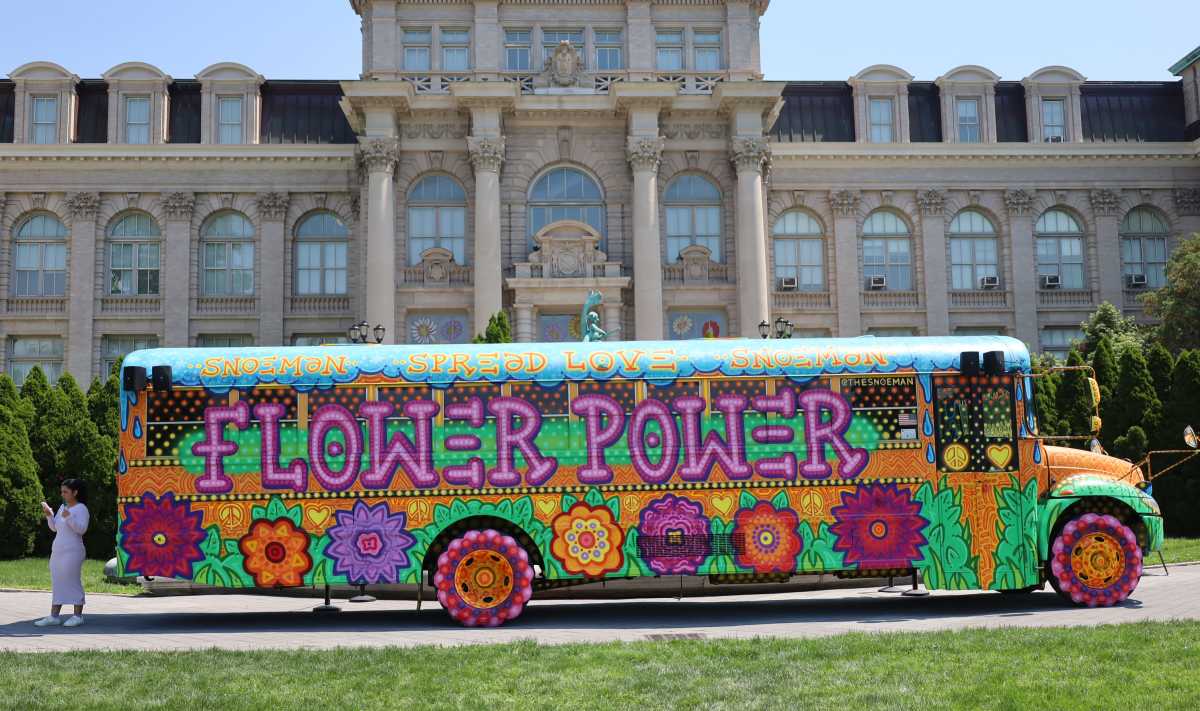
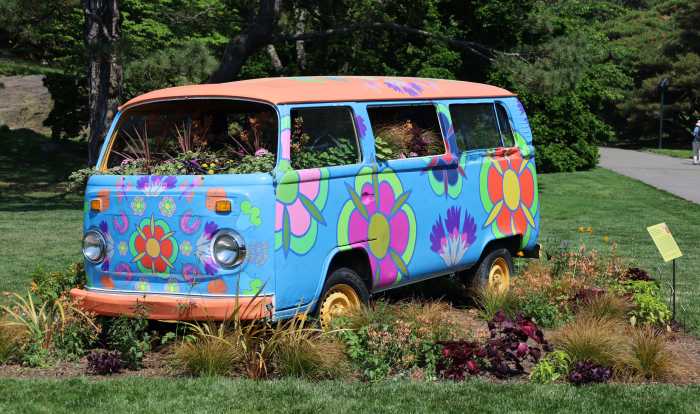
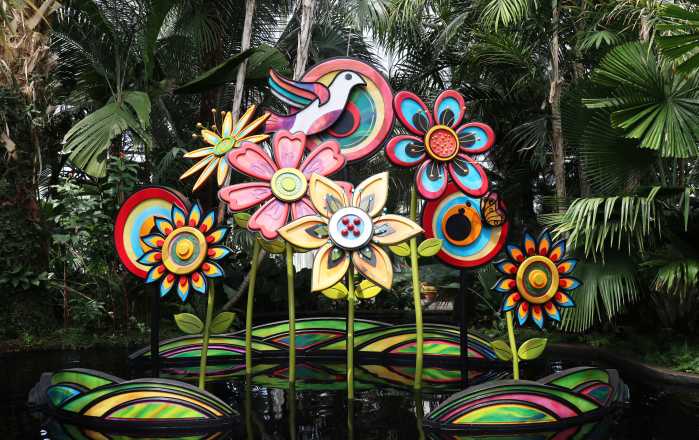
A windowless Volkswagen bus filled with plants and wrapped in groovily-painted vinyl, plays Jefferson Airplane’s 1967 hit, “White Rabbit.” At the Tulip Tree Allée, Gil Scott-Heron’s 1971 anthem, “The Revolution Will Not be Televised,” blares out of a spray-painted school bus. Near the visitor’s center, a 15-foot peace sign adorned with flora sits in a reflecting pool.
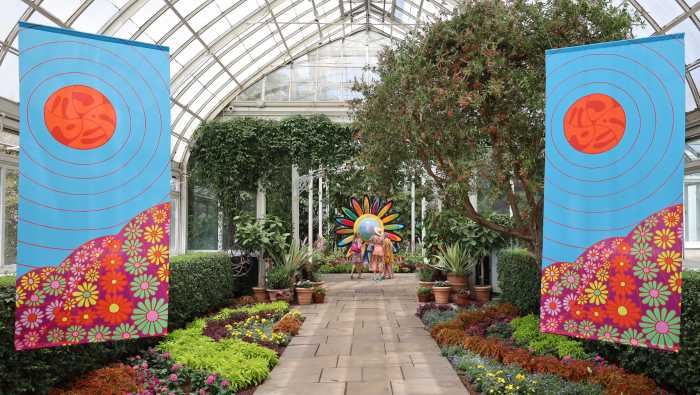
Harkening images of the hippie counterculture, the New York Botanical Garden’s newest exhibit “Flower Power” fuses the aesthetic of the 1960s anti-war and liberation movements with contemporary art and posits the flower as a symbol of passivity and unity.
“Everyone has their own associations out of that time period,” said Michaela Wright, NYBG director of exhibition content and interpretation. “We were sort of interested in just diving into some of the beauty and the joy and the optimism.”
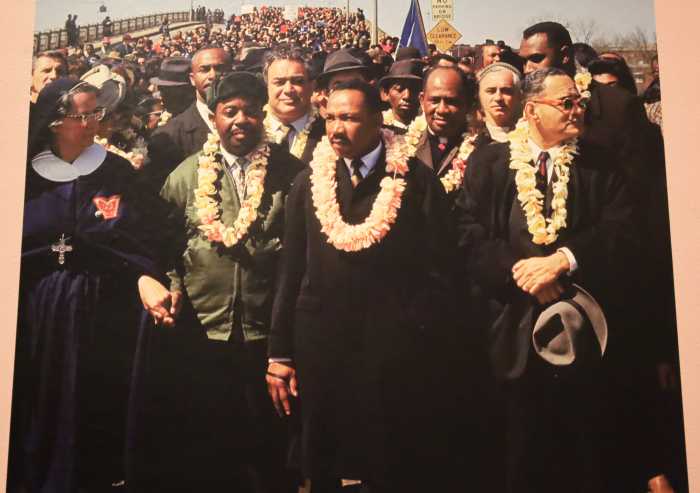
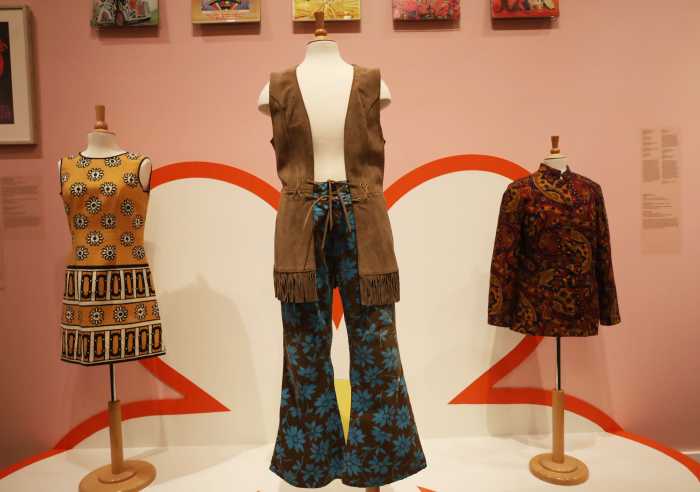
In the garden’s Mertz Library, fashion, art and ephemera of the era are on display. Pieces include Andy Warhol’s “Flowers” (1964), a copy of Betty Friedan’s 1963 book, “The Feminine Mystique,” and a photo of Martin Luther King Jr. wearing a lei on his historic walk from Selma to Montgomery, Alabama in 1965.
The same year, poet and activist Allen Ginsberg wrote, “Demonstration or Spectacle as Example, As Communication or How to Make a March/Spectacle.” One of the tenets suggests protestors face police with “masses of flowers.” While many credit this manifesto for coining the term “flower power,” the phrase doesn’t appear in the text.
The moniker wouldn’t come into fruition until 1967 when the National Mobilization Committee to End the War in Vietnam organized the “Flower Power” march at the Pentagon in Washington, D.C. It was then further cemented when photos of march-goers, holding flowers in opposition to rifles and bayonets, made headline news. These images would come to define the generation and are also on view at the garden’s library.
While flowers have long been viewed to symbolize peace and beauty throughout time and across cultures, it was its pervasive use during these significant moments that solidified it as an icon.
“A flower’s unassailable beauty is able to soften the edges of cruelty,” Jill Brooke told the Bronx Times, flower historian and author of the book, “The Genius of Flowers.”
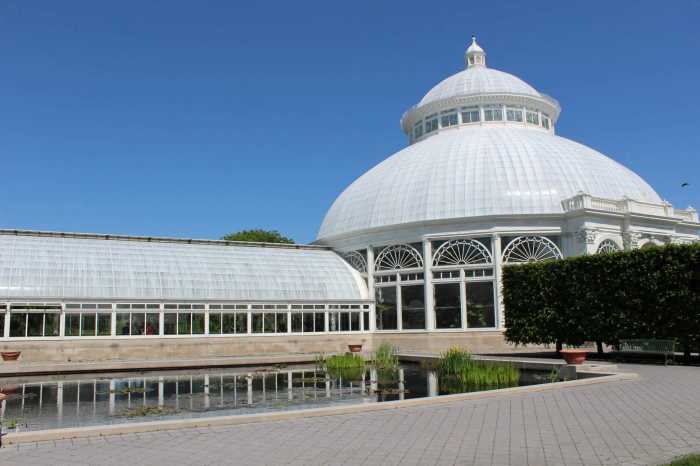
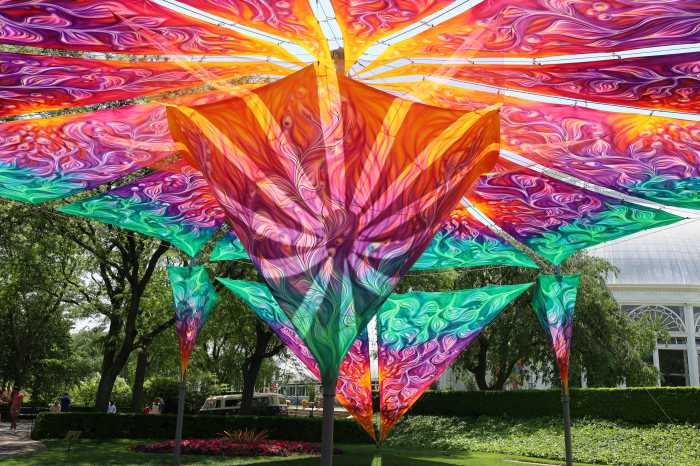
Outside the Enid A. Haupt conservatory, William Hochweber’s “Velora” glows vibrantly under the beaming sun. The installation acts as a large makeshift canopy with psychedelic, airbrushed swirls that exemplify Hochweber’s gestural style. The fabrics will change with the seasons, shifting to rainbow colors in the summer and earth tones in the fall.
Nearby, several metal fences act as a canvas with peace signs made of yarn woven directly into them. Upon closer view, one notices the circles are composed of several crocheted flowers. In a literal interpretation of community, visitors are encouraged to add to Carmen Paulino’s work and weave through the fences themselves with yarn provided by the garden.
“I think the person-to-person interaction is very important. I think it’s good for intergenerational as well. Young people meet older people and they come together and we unite,” Paulino said.
While the exhibit uses nostalgia and the narrative of a nearly bygone era, little ones can also join in on the fun with “Summer of Moomin” at the Everett Children’s Adventure Garden. Based on the picture books of the late Finnish author, Tove Jansson, the hippo-like trolls live in a carefree and idyllic world that parallels the desired utopia of the 1960s.
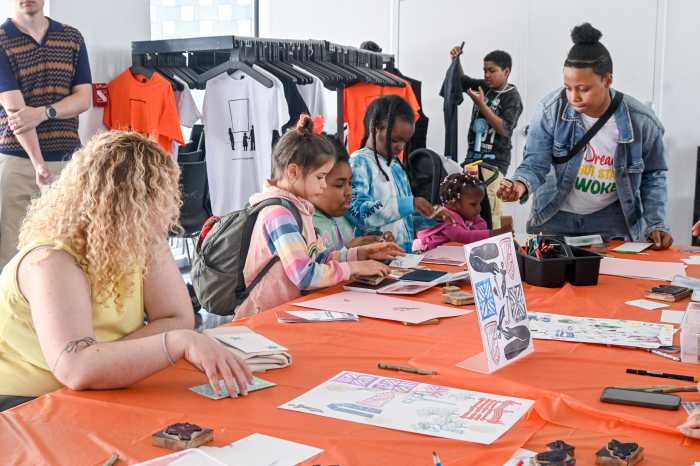
Running through Oct. 18, “Flower Power” aims to engage guests with nature and other visitors through communal programming, featuring drum circles, sound baths, bracelet making, light shows, concerts and movie screenings – like the 1979 musical “Hair.”
“No one can live somewhere else besides Earth,” added Wright. “We all live here together and I think the flower is a symbol that cuts across every line. We can’t escape the ecosystem that we’re a part of.”
Reach ET Rodriguez at etrodriguez317@gmail.com. For more coverage, subscribe to our newsletter and follow us on Twitter, Facebook and Instagram!